

As with other rubbers, fluoroelastomers are capable of beingcompounded
with various additives to enhance specific properties for particular applications. FKM coatings have an allowable temperature range of K 408 F(K 408 C)
to 4008 F( 2048 C).
Fluoroelastomers provide excellent resistance to oils, fuels, lubricants,
mostm ineral acids, manya liphatic and aromatic hydrocarbons (carbon
tetrachloride, benzene, toluene, andx ylene)t hata ct as solvents for
chlorinated solvents, and pesticides.S pecial formulationsc an be produced
to obtain resistance to hot minerala cids, steam, and hot water.
These elastomers are nots uitable for use with low-molecular-weight
estersa nd ketones,c ertain amines,a nd hot anhydrous hydrofluoric or
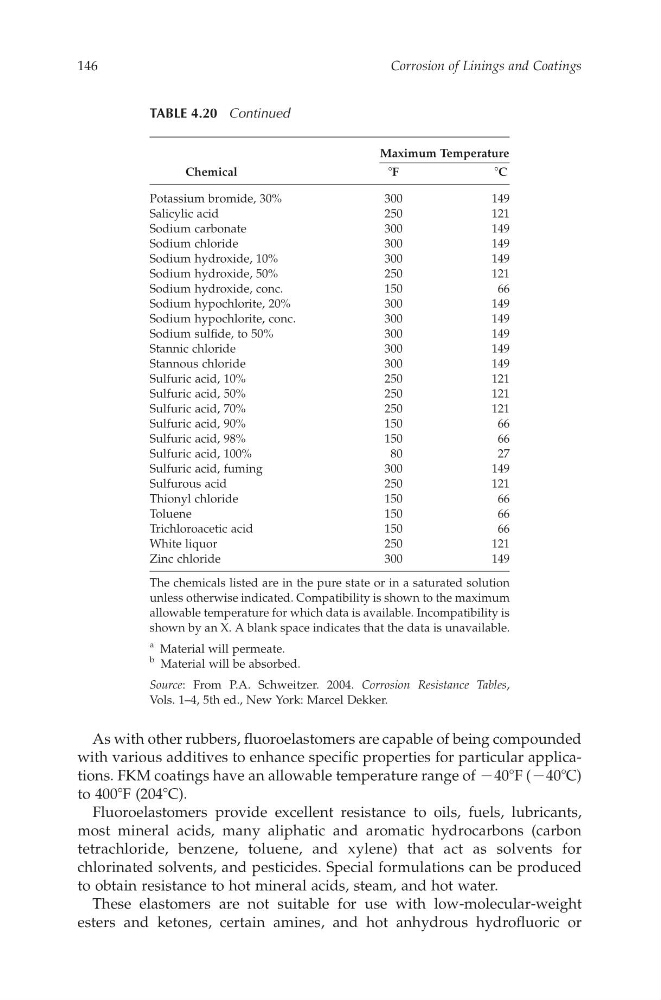
TABLE 4.20 Continued
Maximum Te mperature
Chemical
8 F
8 C
Potassium bromide, 30%
300
149
Salicylic acid
250
121
Sodium carbonate
300
149
Sodium chloride
300
149
Sodium hydroxide, 10%
300
149
Sodium hydroxide, 50%
250
121
Sodium hydroxide, conc.
150
66
Sodium hypochlorite, 20%
300
149
Sodium hypochlorite, conc.
300
149
Sodium sulfide, to 50%
300
149
Stannic chloride
300
149
Stannouschloride
300
149
Sulfuric acid, 10%
250
121
Sulfuric acid, 50%
250
121
Sulfuric acid, 70%
250
121
Sulfuric acid, 90%
150
66
Sulfuric acid, 98%
150
66
Sulfuric acid, 100%
80
27
Sulfuric acid, fuming
300
149
Sulfurous acid
250
121
Thionyl chloride
150
66
Toluene
150
66
Trichloroacetic acid
150
66
White liquor
250
121
Zinc chloride
300
149
The chemicals listed are in the pures tate or in as aturated solution
unless otherwise indicated. Compatibility is shown to the maximum
allowable temperaturefor which data is available. Incompatibility is
shown by an X. Ablank space indicates that the data is unavailable.
a Material will permeate.
b Material will be absorbed.
Source:F rom P. A. Schweitzer.2 004. CorrosionR esistanceT ables,
Vo ls. 1–4, 5th ed., New York: Marcel Dekker.
Corrosion of Linings and Coatings
146
CAT8247—CHAPTER 4—17/10/2006—14:35—SRIDHAR—XML MODEL B–pp. 69–174
with various additives to enhance specific properties for particular applications. FKM coatings have an allowable temperature range of K 408 F(K 408 C)
to 4008 F( 2048 C).
Fluoroelastomers provide excellent resistance to oils, fuels, lubricants,
mostm ineral acids, manya liphatic and aromatic hydrocarbons (carbon
tetrachloride, benzene, toluene, andx ylene)t hata ct as solvents for
chlorinated solvents, and pesticides.S pecial formulationsc an be produced
to obtain resistance to hot minerala cids, steam, and hot water.
These elastomers are nots uitable for use with low-molecular-weight
estersa nd ketones,c ertain amines,a nd hot anhydrous hydrofluoric or
TABLE 4.20 Continued
Maximum Te mperature
Chemical
8 F
8 C
Potassium bromide, 30%
300
149
Salicylic acid
250
121
Sodium carbonate
300
149
Sodium chloride
300
149
Sodium hydroxide, 10%
300
149
Sodium hydroxide, 50%
250
121
Sodium hydroxide, conc.
150
66
Sodium hypochlorite, 20%
300
149
Sodium hypochlorite, conc.
300
149
Sodium sulfide, to 50%
300
149
Stannic chloride
300
149
Stannouschloride
300
149
Sulfuric acid, 10%
250
121
Sulfuric acid, 50%
250
121
Sulfuric acid, 70%
250
121
Sulfuric acid, 90%
150
66
Sulfuric acid, 98%
150
66
Sulfuric acid, 100%
80
27
Sulfuric acid, fuming
300
149
Sulfurous acid
250
121
Thionyl chloride
150
66
Toluene
150
66
Trichloroacetic acid
150
66
White liquor
250
121
Zinc chloride
300
149
The chemicals listed are in the pures tate or in as aturated solution
unless otherwise indicated. Compatibility is shown to the maximum
allowable temperaturefor which data is available. Incompatibility is
shown by an X. Ablank space indicates that the data is unavailable.
a Material will permeate.
b Material will be absorbed.
Source:F rom P. A. Schweitzer.2 004. CorrosionR esistanceT ables,
Vo ls. 1–4, 5th ed., New York: Marcel Dekker.
Corrosion of Linings and Coatings
146
CAT8247—CHAPTER 4—17/10/2006—14:35—SRIDHAR—XML MODEL B–pp. 69–174