

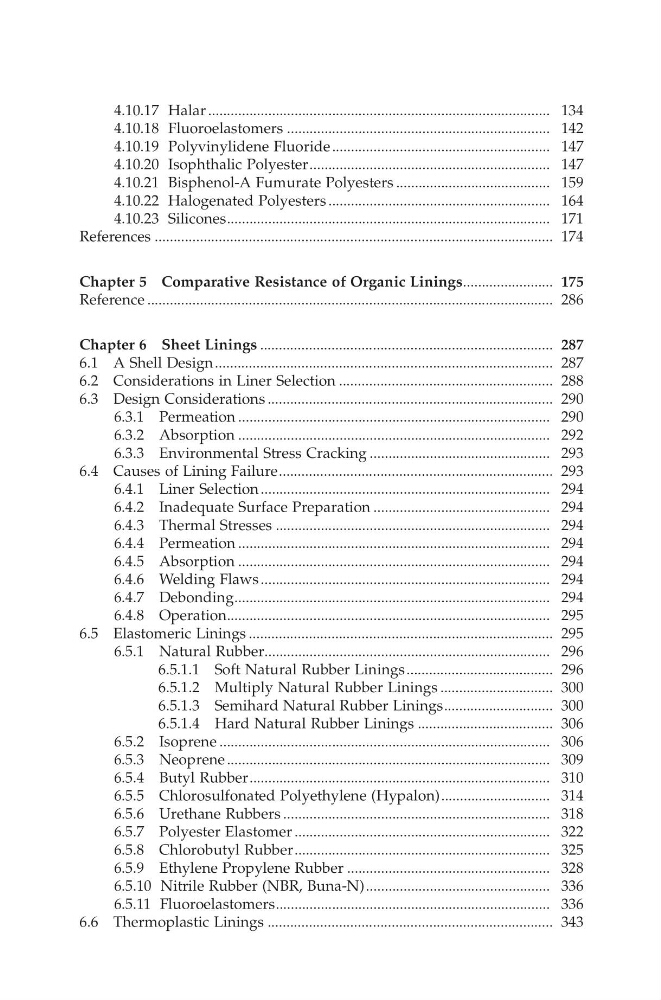
4.10.17 Halar ........................................................................................... 134
4.10.18 Fluoroelastomers ...................................................................... 142
4.10.19 Polyvinylidene Fluoride .......................................................... 147
4.10.20 Isophthalic Polyester................................................................ 147
4.10.21 Bisphenol-A Fumurate Polyesters ......................................... 159
4.10.22 Halogenated Polyesters ........................................................... 164
4.10.23 Silicones...................................................................................... 171
References .......................................................................................................... 174
Chapter 5C omparative Resistance of Organic Linings........................ 175
Reference ............................................................................................................ 286
Chapter 6S heetLinings .............................................................................. 287
6.1 AS hell Design .......................................................................................... 287
6.2 Considerations in Liner Selection ......................................................... 288
6.3 DesignConsiderations ............................................................................ 290
6.3.1 Permeation ................................................................................... 290
6.3.2 Absorption ................................................................................... 292
6.3.3 Environmental Stress Cracking ................................................ 293
6.4 Causes of Lining Failure......................................................................... 293
6.4.1 LinerSelection ............................................................................. 294
6.4.2 Inadequate Surface Preparation ............................................... 294
6.4.3 Thermal Stresses ......................................................................... 294
6.4.4 Permeation ................................................................................... 294
6.4.5 Absorption ................................................................................... 294
6.4.6 Welding Flaws............................................................................. 294
6.4.7 Debonding.................................................................................... 294
6.4.8 Operation...................................................................................... 295
6.5 Elastomeric Linings ................................................................................. 295
6.5.1 Natural Rubber............................................................................ 296
6.5.1.1 Soft NaturalR ubber Linings ....................................... 296
6.5.1.2 Multiply Natural Rubber Linings .............................. 300
6.5.1.3 Semihard Natural RubberLinings............................. 300
6.5.1.4 Hard Natural Rubber Linings .................................... 306
6.5.2 Isoprene ........................................................................................ 306
6.5.3 Neoprene ...................................................................................... 309
6.5.4 ButylR ubber................................................................................ 310
6.5.5 Chlorosulfonated Polyethylene (Hypalon)............................. 314
6.5.6 Urethane Rubbers ....................................................................... 318
6.5.7 Polyester Elastomer.................................................................... 322
6.5.8 Chlorobutyl Rubber.................................................................... 325
6.5.9 Ethylene Propylene Rubber...................................................... 328
6.5.10 Nitrile Rubber(NBR, Buna-N)................................................. 336
6.5.11F luoroelastomers......................................................................... 336
6.6 Thermoplastic Linings ............................................................................ 343
CAT8247—PRELIMS—10/11/2006—21:01—SRIDHAR—XML MODEL B–pp. 1–15
4.10.18 Fluoroelastomers ...................................................................... 142
4.10.19 Polyvinylidene Fluoride .......................................................... 147
4.10.20 Isophthalic Polyester................................................................ 147
4.10.21 Bisphenol-A Fumurate Polyesters ......................................... 159
4.10.22 Halogenated Polyesters ........................................................... 164
4.10.23 Silicones...................................................................................... 171
References .......................................................................................................... 174
Chapter 5C omparative Resistance of Organic Linings........................ 175
Reference ............................................................................................................ 286
Chapter 6S heetLinings .............................................................................. 287
6.1 AS hell Design .......................................................................................... 287
6.2 Considerations in Liner Selection ......................................................... 288
6.3 DesignConsiderations ............................................................................ 290
6.3.1 Permeation ................................................................................... 290
6.3.2 Absorption ................................................................................... 292
6.3.3 Environmental Stress Cracking ................................................ 293
6.4 Causes of Lining Failure......................................................................... 293
6.4.1 LinerSelection ............................................................................. 294
6.4.2 Inadequate Surface Preparation ............................................... 294
6.4.3 Thermal Stresses ......................................................................... 294
6.4.4 Permeation ................................................................................... 294
6.4.5 Absorption ................................................................................... 294
6.4.6 Welding Flaws............................................................................. 294
6.4.7 Debonding.................................................................................... 294
6.4.8 Operation...................................................................................... 295
6.5 Elastomeric Linings ................................................................................. 295
6.5.1 Natural Rubber............................................................................ 296
6.5.1.1 Soft NaturalR ubber Linings ....................................... 296
6.5.1.2 Multiply Natural Rubber Linings .............................. 300
6.5.1.3 Semihard Natural RubberLinings............................. 300
6.5.1.4 Hard Natural Rubber Linings .................................... 306
6.5.2 Isoprene ........................................................................................ 306
6.5.3 Neoprene ...................................................................................... 309
6.5.4 ButylR ubber................................................................................ 310
6.5.5 Chlorosulfonated Polyethylene (Hypalon)............................. 314
6.5.6 Urethane Rubbers ....................................................................... 318
6.5.7 Polyester Elastomer.................................................................... 322
6.5.8 Chlorobutyl Rubber.................................................................... 325
6.5.9 Ethylene Propylene Rubber...................................................... 328
6.5.10 Nitrile Rubber(NBR, Buna-N)................................................. 336
6.5.11F luoroelastomers......................................................................... 336
6.6 Thermoplastic Linings ............................................................................ 343
CAT8247—PRELIMS—10/11/2006—21:01—SRIDHAR—XML MODEL B–pp. 1–15