

54
2 Water Resources Management Framework
Table 2.5 Relationship
among water resources
management systems: space
Classification Management system
Point (micro) Water resources justification system
Quota management system
Management system for discharge outlet into
water body
Water abstraction permit system
Water resources fee system
Metric charging system
Water-saving system
Planned water use system
Overcharge for exceeding-plan/quota use
Area (macro) Medium- and long-term water supply and
demand plan system
Water resources allocation system
Water function zone system
Groundwater management system
Total water volume control system
Total pollutant discharge volume control system
Elaborated by the author
development and use practices. The administrative management system focuses on
the detailed administration of water-related behaviors and activities.
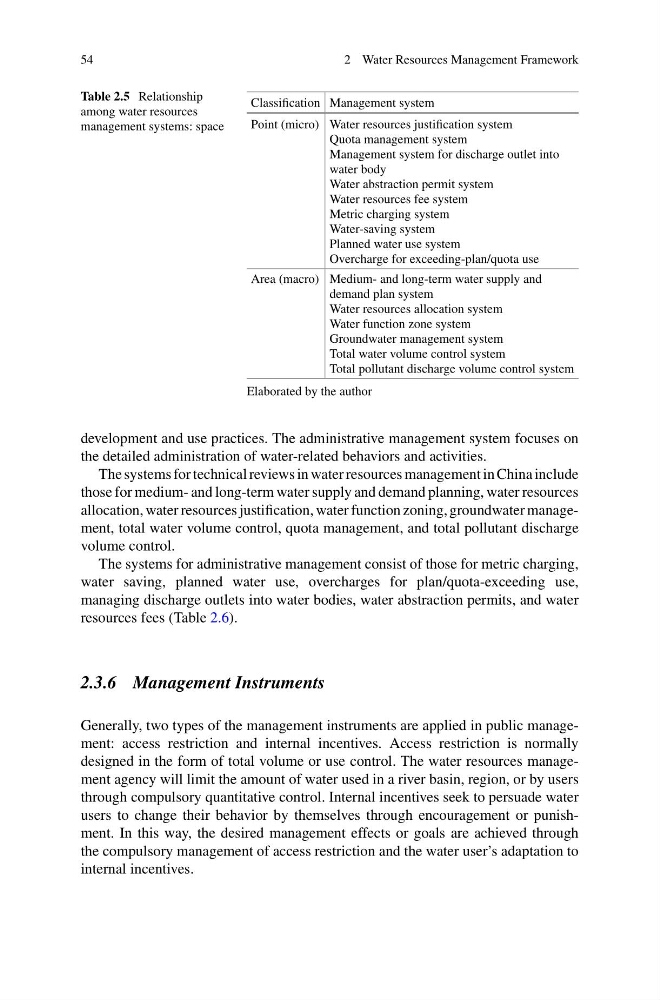
The systems for technical reviews in water resources management in China include
those for medium- and long-term water supply and demand planning, water resources
allocation, water resources justification, water function zoning, groundwater management, total water volume control, quota management, and total pollutant discharge
volume control.
The systems for administrative management consist of those for metric charging,
water saving, planned water use, overcharges for plan/quota-exceeding use,
managing discharge outlets into water bodies, water abstraction permits, and water
resources fees (Table 2.6).
2.3.6 Management Instruments
Generally, two types of the management instruments are applied in public management: access restriction and internal incentives. Access restriction is normally
designed in the form of total volume or use control. The water resources management agency will limit the amount of water used in a river basin, region, or by users
through compulsory quantitative control. Internal incentives seek to persuade water
users to change their behavior by themselves through encouragement or punishment. In this way, the desired management effects or goals are achieved through
the compulsory management of access restriction and the water user’s adaptation to
internal incentives.
2 Water Resources Management Framework
Table 2.5 Relationship
among water resources
management systems: space
Classification Management system
Point (micro) Water resources justification system
Quota management system
Management system for discharge outlet into
water body
Water abstraction permit system
Water resources fee system
Metric charging system
Water-saving system
Planned water use system
Overcharge for exceeding-plan/quota use
Area (macro) Medium- and long-term water supply and
demand plan system
Water resources allocation system
Water function zone system
Groundwater management system
Total water volume control system
Total pollutant discharge volume control system
Elaborated by the author
development and use practices. The administrative management system focuses on
the detailed administration of water-related behaviors and activities.
The systems for technical reviews in water resources management in China include
those for medium- and long-term water supply and demand planning, water resources
allocation, water resources justification, water function zoning, groundwater management, total water volume control, quota management, and total pollutant discharge
volume control.
The systems for administrative management consist of those for metric charging,
water saving, planned water use, overcharges for plan/quota-exceeding use,
managing discharge outlets into water bodies, water abstraction permits, and water
resources fees (Table 2.6).
2.3.6 Management Instruments
Generally, two types of the management instruments are applied in public management: access restriction and internal incentives. Access restriction is normally
designed in the form of total volume or use control. The water resources management agency will limit the amount of water used in a river basin, region, or by users
through compulsory quantitative control. Internal incentives seek to persuade water
users to change their behavior by themselves through encouragement or punishment. In this way, the desired management effects or goals are achieved through
the compulsory management of access restriction and the water user’s adaptation to
internal incentives.