

17.3 Environmental Flow Assessment and Water Resources…
403
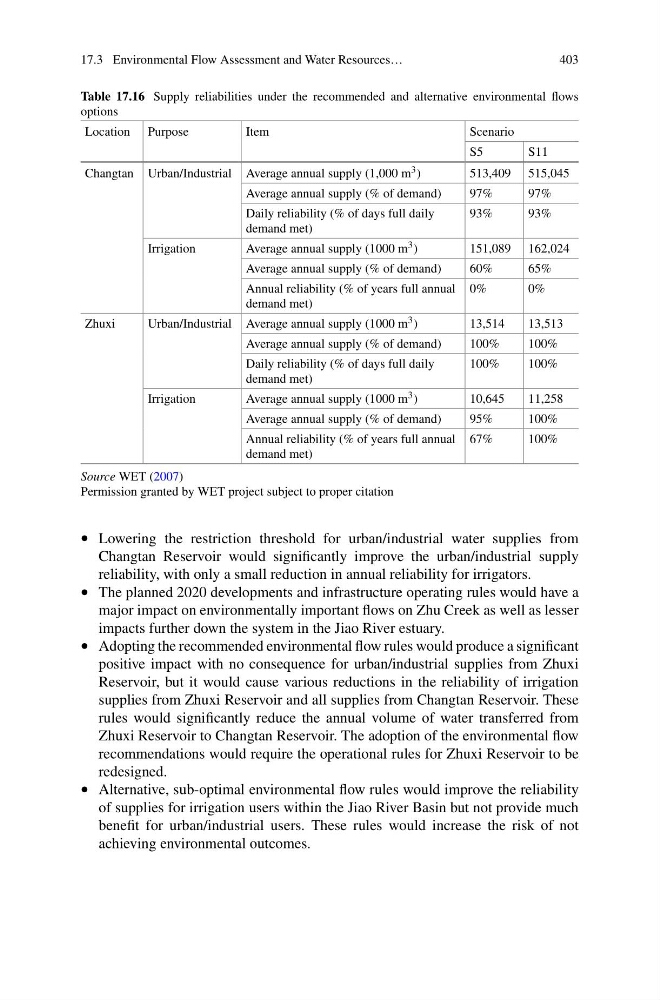
Table 17.16 Supply reliabilities under the recommended and alternative environmental flows
options
Location Purpose
Item
Scenario
S5
S11
Changtan Urban/Industrial Average annual supply (1,000 m 3 )
513,409 515,045
Average annual supply (% of demand)
97%
97%
Daily reliability (% of days full daily
demand met)
93%
93%
Irrigation
Average annual supply (1000 m 3 )
151,089 162,024
Average annual supply (% of demand)
60%
65%
Annual reliability (% of years full annual
demand met)
0%
0%
Zhuxi
Urban/Industrial Average annual supply (1000 m 3 )
13,514
13,513
Average annual supply (% of demand)
100%
100%
Daily reliability (% of days full daily
demand met)
100%
100%
Irrigation
Average annual supply (1000 m 3 )
10,645
11,258
Average annual supply (% of demand)
95%
100%
Annual reliability (% of years full annual
demand met)
67%
100%
Source WET (2007)
Permission granted by WET project subject to proper citation
• Lowering the restriction threshold for urban/industrial water supplies from
Changtan Reservoir would significantly improve the urban/industrial supply
reliability, with only a small reduction in annual reliability for irrigators.
• The planned 2020 developments and infrastructure operating rules would have a
major impact on environmentally important flows on Zhu Creek as well as lesser
impacts further down the system in the Jiao River estuary.
• Adopting the recommended environmental flow rules would produce a significant
positive impact with no consequence for urban/industrial supplies from Zhuxi
Reservoir, but it would cause various reductions in the reliability of irrigation
supplies from Zhuxi Reservoir and all supplies from Changtan Reservoir. These
rules would significantly reduce the annual volume of water transferred from
Zhuxi Reservoir to Changtan Reservoir. The adoption of the environmental flow
recommendations would require the operational rules for Zhuxi Reservoir to be
redesigned.
• Alternative, sub-optimal environmental flow rules would improve the reliability
of supplies for irrigation users within the Jiao River Basin but not provide much
benefit for urban/industrial users. These rules would increase the risk of not
achieving environmental outcomes.
403
Table 17.16 Supply reliabilities under the recommended and alternative environmental flows
options
Location Purpose
Item
Scenario
S5
S11
Changtan Urban/Industrial Average annual supply (1,000 m 3 )
513,409 515,045
Average annual supply (% of demand)
97%
97%
Daily reliability (% of days full daily
demand met)
93%
93%
Irrigation
Average annual supply (1000 m 3 )
151,089 162,024
Average annual supply (% of demand)
60%
65%
Annual reliability (% of years full annual
demand met)
0%
0%
Zhuxi
Urban/Industrial Average annual supply (1000 m 3 )
13,514
13,513
Average annual supply (% of demand)
100%
100%
Daily reliability (% of days full daily
demand met)
100%
100%
Irrigation
Average annual supply (1000 m 3 )
10,645
11,258
Average annual supply (% of demand)
95%
100%
Annual reliability (% of years full annual
demand met)
67%
100%
Source WET (2007)
Permission granted by WET project subject to proper citation
• Lowering the restriction threshold for urban/industrial water supplies from
Changtan Reservoir would significantly improve the urban/industrial supply
reliability, with only a small reduction in annual reliability for irrigators.
• The planned 2020 developments and infrastructure operating rules would have a
major impact on environmentally important flows on Zhu Creek as well as lesser
impacts further down the system in the Jiao River estuary.
• Adopting the recommended environmental flow rules would produce a significant
positive impact with no consequence for urban/industrial supplies from Zhuxi
Reservoir, but it would cause various reductions in the reliability of irrigation
supplies from Zhuxi Reservoir and all supplies from Changtan Reservoir. These
rules would significantly reduce the annual volume of water transferred from
Zhuxi Reservoir to Changtan Reservoir. The adoption of the environmental flow
recommendations would require the operational rules for Zhuxi Reservoir to be
redesigned.
• Alternative, sub-optimal environmental flow rules would improve the reliability
of supplies for irrigation users within the Jiao River Basin but not provide much
benefit for urban/industrial users. These rules would increase the risk of not
achieving environmental outcomes.