

310
15 Agricultural Water Management in Northern China
0
50
100
150
200
250
300
0
5000
10000
15000
20000
25000
30000
35000
40000
45000
50000
1985
1990
1995
2000
2005
2010
2015
2020
Effective Irrigation Area (1000 ha)
Total Grain Yield (10 thousand ton)
Agricultural Water Use (billion m3)
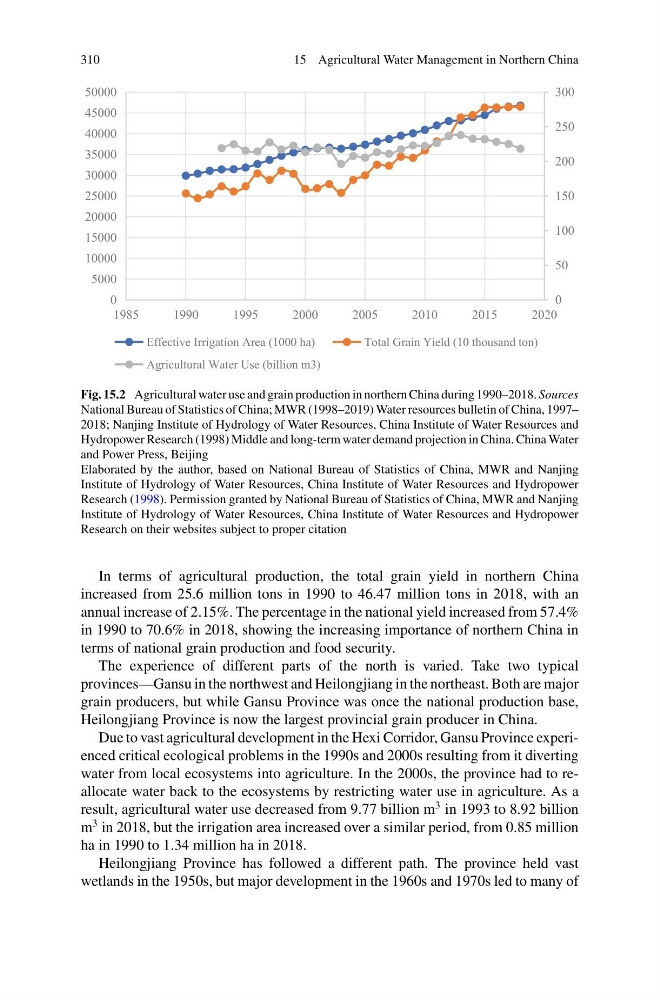
Fig. 15.2 Agricultural water use and grain production in northern China during 1990–2018. Sources
National Bureau of Statistics of China; MWR (1998–2019) Water resources bulletin of China, 1997–
2018; Nanjing Institute of Hydrology of Water Resources, China Institute of Water Resources and
Hydropower Research (1998) Middle and long-term water demand projection in China. China Water
and Power Press, Beijing
Elaborated by the author, based on National Bureau of Statistics of China, MWR and Nanjing
Institute of Hydrology of Water Resources, China Institute of Water Resources and Hydropower
Research (1998). Permission granted by National Bureau of Statistics of China, MWR and Nanjing
Institute of Hydrology of Water Resources, China Institute of Water Resources and Hydropower
Research on their websites subject to proper citation
In terms of agricultural production, the total grain yield in northern China
increased from 25.6 million tons in 1990 to 46.47 million tons in 2018, with an
annual increase of 2.15%. The percentage in the national yield increased from 57.4%
in 1990 to 70.6% in 2018, showing the increasing importance of northern China in
terms of national grain production and food security.
The experience of different parts of the north is varied. Take two typical
provinces—Gansu in the northwest and Heilongjiang in the northeast. Both are major
grain producers, but while Gansu Province was once the national production base,
Heilongjiang Province is now the largest provincial grain producer in China.
Due to vast agricultural development in the Hexi Corridor, Gansu Province experienced critical ecological problems in the 1990s and 2000s resulting from it diverting
water from local ecosystems into agriculture. In the 2000s, the province had to reallocate water back to the ecosystems by restricting water use in agriculture. As a
result, agricultural water use decreased from 9.77 billion m
3 in 1993 to 8.92 billion
m
3 in 2018, but the irrigation area increased over a similar period, from 0.85 million
ha in 1990 to 1.34 million ha in 2018.
Heilongjiang Province has followed a different path. The province held vast
wetlands in the 1950s, but major development in the 1960s and 1970s led to many of
15 Agricultural Water Management in Northern China
0
50
100
150
200
250
300
0
5000
10000
15000
20000
25000
30000
35000
40000
45000
50000
1985
1990
1995
2000
2005
2010
2015
2020
Effective Irrigation Area (1000 ha)
Total Grain Yield (10 thousand ton)
Agricultural Water Use (billion m3)
Fig. 15.2 Agricultural water use and grain production in northern China during 1990–2018. Sources
National Bureau of Statistics of China; MWR (1998–2019) Water resources bulletin of China, 1997–
2018; Nanjing Institute of Hydrology of Water Resources, China Institute of Water Resources and
Hydropower Research (1998) Middle and long-term water demand projection in China. China Water
and Power Press, Beijing
Elaborated by the author, based on National Bureau of Statistics of China, MWR and Nanjing
Institute of Hydrology of Water Resources, China Institute of Water Resources and Hydropower
Research (1998). Permission granted by National Bureau of Statistics of China, MWR and Nanjing
Institute of Hydrology of Water Resources, China Institute of Water Resources and Hydropower
Research on their websites subject to proper citation
In terms of agricultural production, the total grain yield in northern China
increased from 25.6 million tons in 1990 to 46.47 million tons in 2018, with an
annual increase of 2.15%. The percentage in the national yield increased from 57.4%
in 1990 to 70.6% in 2018, showing the increasing importance of northern China in
terms of national grain production and food security.
The experience of different parts of the north is varied. Take two typical
provinces—Gansu in the northwest and Heilongjiang in the northeast. Both are major
grain producers, but while Gansu Province was once the national production base,
Heilongjiang Province is now the largest provincial grain producer in China.
Due to vast agricultural development in the Hexi Corridor, Gansu Province experienced critical ecological problems in the 1990s and 2000s resulting from it diverting
water from local ecosystems into agriculture. In the 2000s, the province had to reallocate water back to the ecosystems by restricting water use in agriculture. As a
result, agricultural water use decreased from 9.77 billion m
3 in 1993 to 8.92 billion
m
3 in 2018, but the irrigation area increased over a similar period, from 0.85 million
ha in 1990 to 1.34 million ha in 2018.
Heilongjiang Province has followed a different path. The province held vast
wetlands in the 1950s, but major development in the 1960s and 1970s led to many of