

24
1.4.2 Adsorption
Adsorption is the process in which molecules/ions in one phase tend to attach as
well as concentrate on the surface of another phase. The opposite process is called
desorption. The adsorbed material is called adsorbate. The adsorbing substance is
called adsorbent. Adsorption is an exothermic process, whereas desorption is
endothermic; for this reason, heat must be applied to separate the adsorbate from the
adsorbent.
Activated carbon, silica gel, alumina, as well as zeolites (molecular sieves) are
used widely as adsorbents in pollution control (Chandrappa and Kulshrestha 2015).
Adsorption process is used both in air pollution control and water/wastewater treatment to remove various components.
Adsorbents are also used in permeable reactive barrier wherein polluted groundwater is made to flow through a barrier of adsorbent or reactive substance for decontaminating the polluted groundwater (Santisukkasaem and Das 2019).
Adsorption of toxic substance on human body from environment has direct link
to human health.
1.5 Inorganic Chemistry
Inorganic chemistry is a specialization of chemistry that covers the synthesis and
behavior of inorganic and organometallic compounds.
This specialization of chemistry is concerned with all chemical compounds
except the myriad of organic compounds (carbon-based compounds, usually containing C–H bonds, are dealt with in organic chemistry). Organic and inorganic
chemistry overlap especially in the sub-specialization of organometallic chemistry.
Environmental professionals often come across inorganic chemistry (which
overlaps with other branches of chemistry) while dealing with pollutants in the environment and its effect on living and non-living components of environment.
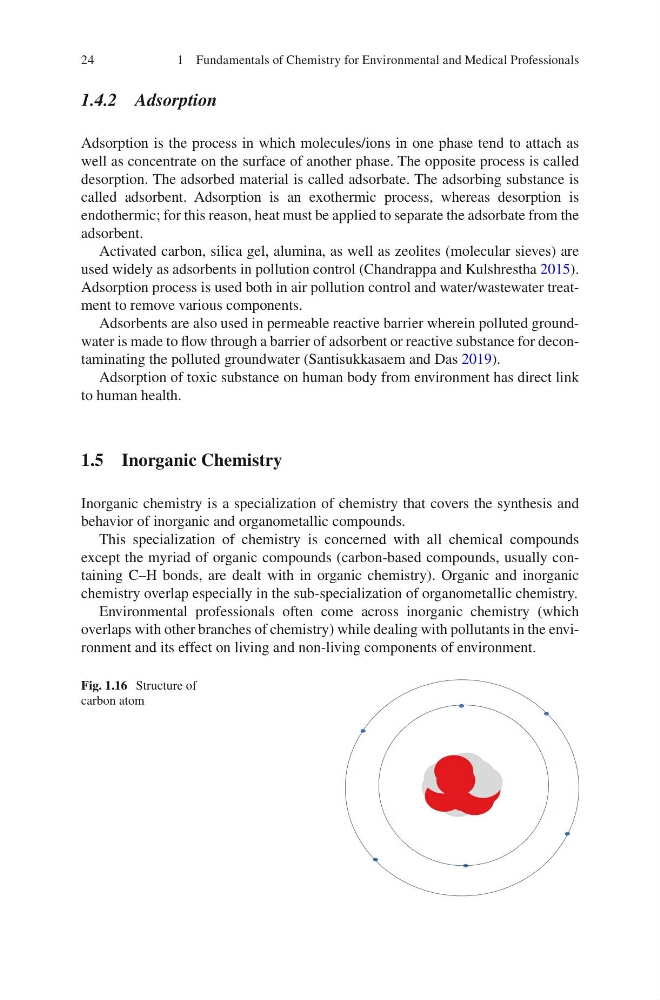
Fig. 1.16 Structure of
carbon atom
1 Fundamentals of Chemistry for Environmental and Medical Professionals
1.4.2 Adsorption
Adsorption is the process in which molecules/ions in one phase tend to attach as
well as concentrate on the surface of another phase. The opposite process is called
desorption. The adsorbed material is called adsorbate. The adsorbing substance is
called adsorbent. Adsorption is an exothermic process, whereas desorption is
endothermic; for this reason, heat must be applied to separate the adsorbate from the
adsorbent.
Activated carbon, silica gel, alumina, as well as zeolites (molecular sieves) are
used widely as adsorbents in pollution control (Chandrappa and Kulshrestha 2015).
Adsorption process is used both in air pollution control and water/wastewater treatment to remove various components.
Adsorbents are also used in permeable reactive barrier wherein polluted groundwater is made to flow through a barrier of adsorbent or reactive substance for decontaminating the polluted groundwater (Santisukkasaem and Das 2019).
Adsorption of toxic substance on human body from environment has direct link
to human health.
1.5 Inorganic Chemistry
Inorganic chemistry is a specialization of chemistry that covers the synthesis and
behavior of inorganic and organometallic compounds.
This specialization of chemistry is concerned with all chemical compounds
except the myriad of organic compounds (carbon-based compounds, usually containing C–H bonds, are dealt with in organic chemistry). Organic and inorganic
chemistry overlap especially in the sub-specialization of organometallic chemistry.
Environmental professionals often come across inorganic chemistry (which
overlaps with other branches of chemistry) while dealing with pollutants in the environment and its effect on living and non-living components of environment.
Fig. 1.16 Structure of
carbon atom
1 Fundamentals of Chemistry for Environmental and Medical Professionals