

19
can be manipulated to safeguard human health by changing reaction kinetics and
thermodynamics.
1.3.1 Thermochemical Reactions
Reactions showing changes in both matter and energy are called thermochemical
reactions.
Reactions can be exothermic or endothermic. Exothermic reactions are those that
releases heat (e.g., combustion of fuel generating mixture of gases). Endothermic
reactions are those that absorb heat (e.g., dissolving table salt in water).
Chemical reactions are spontaneous when they continue on their own. Reactions
may need initiation with a spark and/or other source of energy. Photosynthesis and
biodegradation are examples of exothermic reaction.
Most spontaneous reactions are also exothermic, which produce heat and/or
other forms of energy, as in the case of fire. However, a few reactions are endothermic, which consume energy from their environment.
Physical states of reactants/products are sometimes indicated in chemical equations, as shown in the above equations. Notations s, l, g, and aq in such equations
stand for solid, liquid, gas, and aqueous solution (dissolved in water), respectively.
Examples:
C s O g
CO g
kcal
( )+ ( ) →
( )+
2
2
94
2
116
2
2
2
2
H O g
kcal
H g O g
( )+
→
( )+ ( )
Intermolecular forces also cause another phenomenon called capillary action,
which is the tendency of a polar liquid to ascend against gravity into a capillary tube
(small-diameter tube).
He
V = 22.41 L
P = 1 atm
O2
V = 22.41 L
P = 1 atm
NH3
V = 22.41 L
P = 1 atm
CH4
V = 22.41 L
P = 1 atm
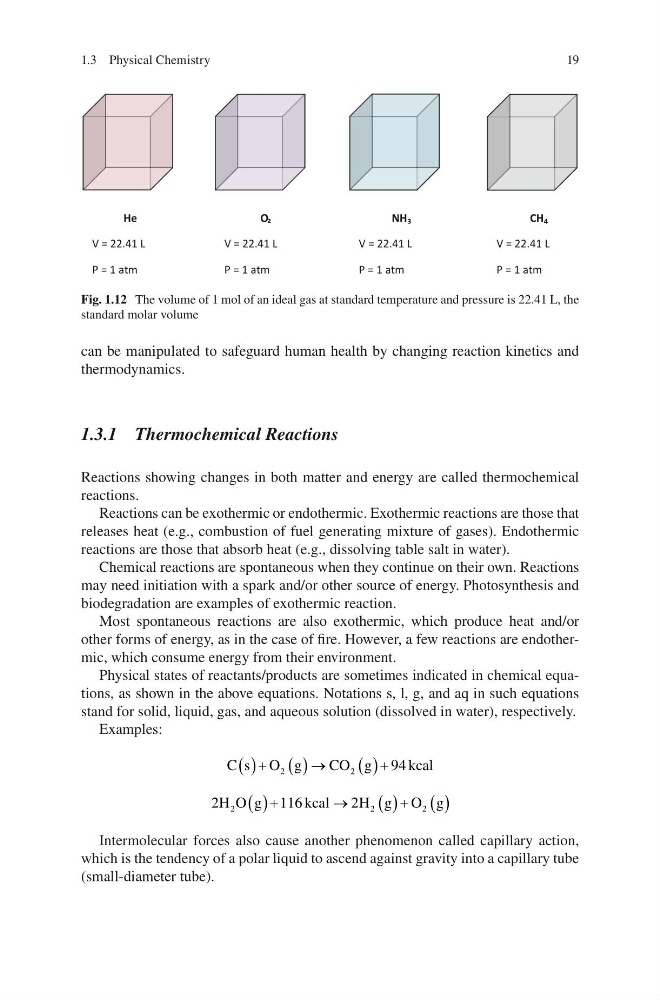
Fig. 1.12 The volume of 1 mol of an ideal gas at standard temperature and pressure is 22.41 L, the
standard molar volume
1.3 Physical Chemistry
can be manipulated to safeguard human health by changing reaction kinetics and
thermodynamics.
1.3.1 Thermochemical Reactions
Reactions showing changes in both matter and energy are called thermochemical
reactions.
Reactions can be exothermic or endothermic. Exothermic reactions are those that
releases heat (e.g., combustion of fuel generating mixture of gases). Endothermic
reactions are those that absorb heat (e.g., dissolving table salt in water).
Chemical reactions are spontaneous when they continue on their own. Reactions
may need initiation with a spark and/or other source of energy. Photosynthesis and
biodegradation are examples of exothermic reaction.
Most spontaneous reactions are also exothermic, which produce heat and/or
other forms of energy, as in the case of fire. However, a few reactions are endothermic, which consume energy from their environment.
Physical states of reactants/products are sometimes indicated in chemical equations, as shown in the above equations. Notations s, l, g, and aq in such equations
stand for solid, liquid, gas, and aqueous solution (dissolved in water), respectively.
Examples:
C s O g
CO g
kcal
( )+ ( ) →
( )+
2
2
94
2
116
2
2
2
2
H O g
kcal
H g O g
( )+
→
( )+ ( )
Intermolecular forces also cause another phenomenon called capillary action,
which is the tendency of a polar liquid to ascend against gravity into a capillary tube
(small-diameter tube).
He
V = 22.41 L
P = 1 atm
O2
V = 22.41 L
P = 1 atm
NH3
V = 22.41 L
P = 1 atm
CH4
V = 22.41 L
P = 1 atm
Fig. 1.12 The volume of 1 mol of an ideal gas at standard temperature and pressure is 22.41 L, the
standard molar volume
1.3 Physical Chemistry