

18
V = the volume of gas.
N = the number of gas molecules.
k = the Boltzmann constant (1.381 × 10
−23
J·K
−1
in SI units).
T = the absolute temperature.
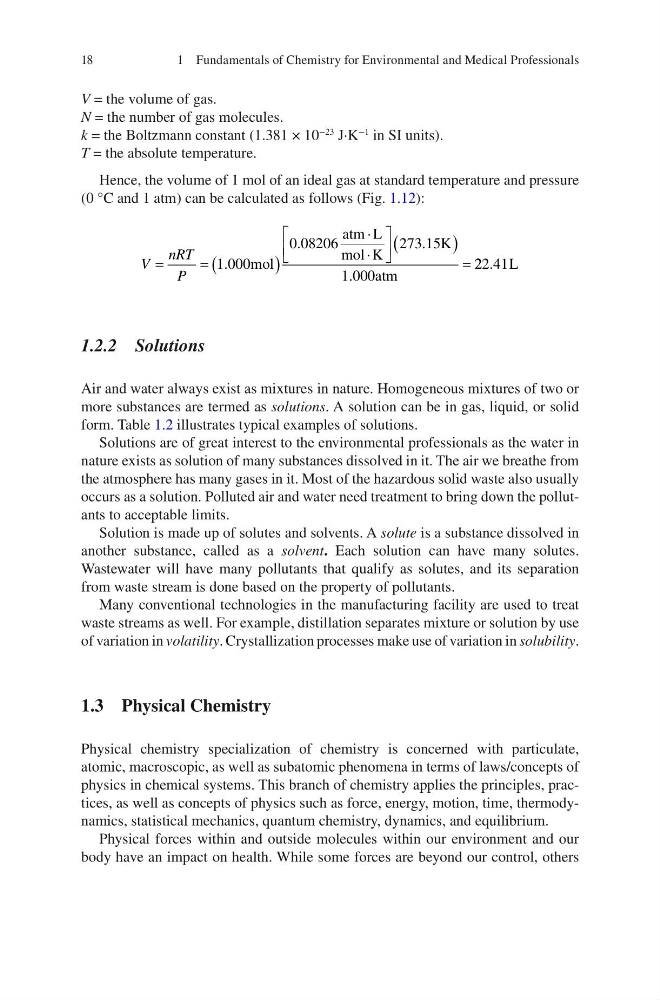
Hence, the volume of 1 mol of an ideal gas at standard temperature and pressure
(0 °C and 1 atm) can be calculated as follows (Fig. 1.12):
V
nRT
P
=
=(
)
⋅
⋅
(
)
=
1 000
0 08206
273 15
1 000
.
.
.
.
mol
atm L
mol K
K
atm
2 22 41
. L
1.2.2 Solutions
Air and water always exist as mixtures in nature. Homogeneous mixtures of two or
more substances are termed as solutions. A solution can be in gas, liquid, or solid
form. Table 1.2 illustrates typical examples of solutions.
Solutions are of great interest to the environmental professionals as the water in
nature exists as solution of many substances dissolved in it. The air we breathe from
the atmosphere has many gases in it. Most of the hazardous solid waste also usually
occurs as a solution. Polluted air and water need treatment to bring down the pollutants to acceptable limits.
Solution is made up of solutes and solvents. A solute is a substance dissolved in
another substance, called as a solvent. Each solution can have many solutes.
Wastewater will have many pollutants that qualify as solutes, and its separation
from waste stream is done based on the property of pollutants.
Many conventional technologies in the manufacturing facility are used to treat
waste streams as well. For example, distillation separates mixture or solution by use
of variation in volatility. Crystallization processes make use of variation in solubility.
1.3 Physical Chemistry
Physical chemistry specialization of chemistry is concerned with particulate,
atomic, macroscopic, as well as subatomic phenomena in terms of laws/concepts of
physics in chemical systems. This branch of chemistry applies the principles, practices, as well as concepts of physics such as force, energy, motion, time, thermodynamics, statistical mechanics, quantum chemistry, dynamics, and equilibrium.
Physical forces within and outside molecules within our environment and our
body have an impact on health. While some forces are beyond our control, others
1 Fundamentals of Chemistry for Environmental and Medical Professionals
V = the volume of gas.
N = the number of gas molecules.
k = the Boltzmann constant (1.381 × 10
−23
J·K
−1
in SI units).
T = the absolute temperature.
Hence, the volume of 1 mol of an ideal gas at standard temperature and pressure
(0 °C and 1 atm) can be calculated as follows (Fig. 1.12):
V
nRT
P
=
=(
)
⋅
⋅
(
)
=
1 000
0 08206
273 15
1 000
.
.
.
.
mol
atm L
mol K
K
atm
2 22 41
. L
1.2.2 Solutions
Air and water always exist as mixtures in nature. Homogeneous mixtures of two or
more substances are termed as solutions. A solution can be in gas, liquid, or solid
form. Table 1.2 illustrates typical examples of solutions.
Solutions are of great interest to the environmental professionals as the water in
nature exists as solution of many substances dissolved in it. The air we breathe from
the atmosphere has many gases in it. Most of the hazardous solid waste also usually
occurs as a solution. Polluted air and water need treatment to bring down the pollutants to acceptable limits.
Solution is made up of solutes and solvents. A solute is a substance dissolved in
another substance, called as a solvent. Each solution can have many solutes.
Wastewater will have many pollutants that qualify as solutes, and its separation
from waste stream is done based on the property of pollutants.
Many conventional technologies in the manufacturing facility are used to treat
waste streams as well. For example, distillation separates mixture or solution by use
of variation in volatility. Crystallization processes make use of variation in solubility.
1.3 Physical Chemistry
Physical chemistry specialization of chemistry is concerned with particulate,
atomic, macroscopic, as well as subatomic phenomena in terms of laws/concepts of
physics in chemical systems. This branch of chemistry applies the principles, practices, as well as concepts of physics such as force, energy, motion, time, thermodynamics, statistical mechanics, quantum chemistry, dynamics, and equilibrium.
Physical forces within and outside molecules within our environment and our
body have an impact on health. While some forces are beyond our control, others
1 Fundamentals of Chemistry for Environmental and Medical Professionals