

270
annoyance, hypertension, as well as sleep disturbance (Das et al. 1999). The control
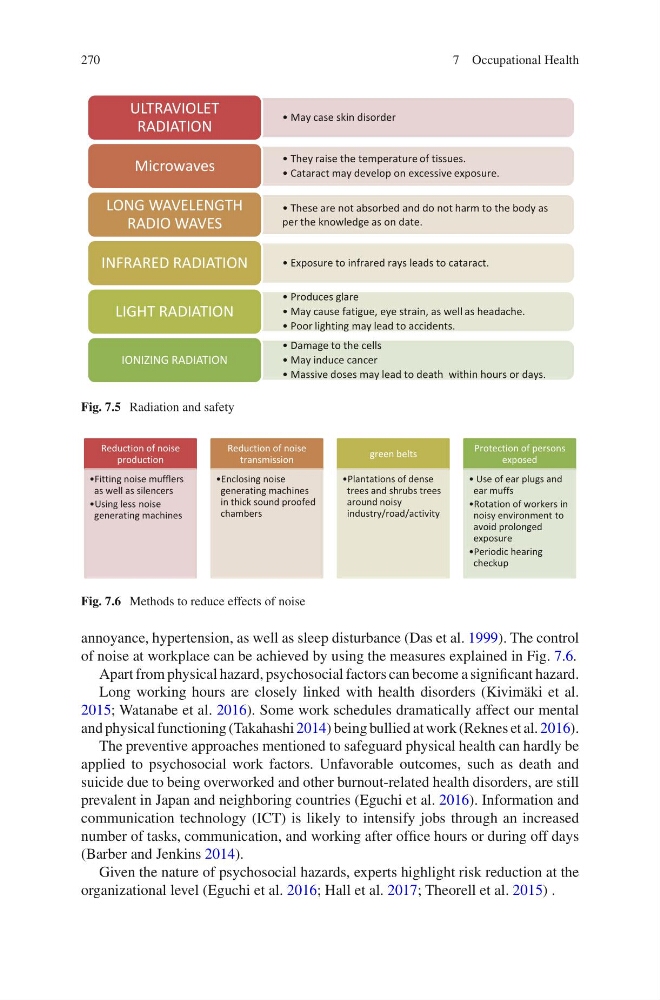
of noise at workplace can be achieved by using the measures explained in Fig. 7.6.
Apart from physical hazard, psychosocial factors can become a significant hazard.
Long working hours are closely linked with health disorders (Kivimäki et al.
2015; Watanabe et al. 2016). Some work schedules dramatically affect our mental
and physical functioning (Takahashi 2014) being bullied at work (Reknes et al. 2016).
The preventive approaches mentioned to safeguard physical health can hardly be
applied to psychosocial work factors. Unfavorable outcomes, such as death and
suicide due to being overworked and other burnout-related health disorders, are still
prevalent in Japan and neighboring countries (Eguchi et al. 2016). Information and
communication technology (ICT) is likely to intensify jobs through an increased
number of tasks, communication, and working after office hours or during off days
(Barber and Jenkins 2014).
Given the nature of psychosocial hazards, experts highlight risk reduction at the
organizational level (Eguchi et al. 2016; Hall et al. 2017; Theorell et al. 2015) .
• May case skin disorder
ULTRAVIOLET
RADIATION
• They raise the temperature of tissues.
• Cataract may develop on excessive exposure.
Microwaves
• These are not absorbed and do not harm to the body as
per the knowledge as on date.
LONG WAVELENGTH
RADIO WAVES
• Exposure to infrared rays leads to cataract.
INFRARED RADIATION
• Produces glare
• May cause fatigue, eye strain, as well as headache.
• Poor lighting may lead to accidents.
LIGHT RADIATION
• Damage to the cells
• May induce cancer
• Massive doses may lead to death within hours or days.
IONIZING RADIATION
Fig. 7.5 Radiation and safety
Reduction of noise
production
•Fitting noise mufflers
as well as silencers
•Using less noise
generating machines
Reduction of noise
transmission
•Enclosing noise
generating machines
in thick sound proofed
chambers
green belts
•Plantations of dense
trees and shrubs trees
around noisy
industry/road/activity
Protection of persons
exposed
• Use of ear plugs and
ear muffs
•Rotation of workers in
noisy environment to
avoid prolonged
exposure
•Periodic hearing
checkup
Fig. 7.6 Methods to reduce effects of noise
7 Occupational Health
annoyance, hypertension, as well as sleep disturbance (Das et al. 1999). The control
of noise at workplace can be achieved by using the measures explained in Fig. 7.6.
Apart from physical hazard, psychosocial factors can become a significant hazard.
Long working hours are closely linked with health disorders (Kivimäki et al.
2015; Watanabe et al. 2016). Some work schedules dramatically affect our mental
and physical functioning (Takahashi 2014) being bullied at work (Reknes et al. 2016).
The preventive approaches mentioned to safeguard physical health can hardly be
applied to psychosocial work factors. Unfavorable outcomes, such as death and
suicide due to being overworked and other burnout-related health disorders, are still
prevalent in Japan and neighboring countries (Eguchi et al. 2016). Information and
communication technology (ICT) is likely to intensify jobs through an increased
number of tasks, communication, and working after office hours or during off days
(Barber and Jenkins 2014).
Given the nature of psychosocial hazards, experts highlight risk reduction at the
organizational level (Eguchi et al. 2016; Hall et al. 2017; Theorell et al. 2015) .
• May case skin disorder
ULTRAVIOLET
RADIATION
• They raise the temperature of tissues.
• Cataract may develop on excessive exposure.
Microwaves
• These are not absorbed and do not harm to the body as
per the knowledge as on date.
LONG WAVELENGTH
RADIO WAVES
• Exposure to infrared rays leads to cataract.
INFRARED RADIATION
• Produces glare
• May cause fatigue, eye strain, as well as headache.
• Poor lighting may lead to accidents.
LIGHT RADIATION
• Damage to the cells
• May induce cancer
• Massive doses may lead to death within hours or days.
IONIZING RADIATION
Fig. 7.5 Radiation and safety
Reduction of noise
production
•Fitting noise mufflers
as well as silencers
•Using less noise
generating machines
Reduction of noise
transmission
•Enclosing noise
generating machines
in thick sound proofed
chambers
green belts
•Plantations of dense
trees and shrubs trees
around noisy
industry/road/activity
Protection of persons
exposed
• Use of ear plugs and
ear muffs
•Rotation of workers in
noisy environment to
avoid prolonged
exposure
•Periodic hearing
checkup
Fig. 7.6 Methods to reduce effects of noise
7 Occupational Health