

241
Slaughtering in public places for religious sacrifices is common in many places
of the world. The informal and illegal slaughtering in developing nations will result
in the disposal of slaughterhouse wastes with municipal wastes leading to public
health risks besides rise in population of scavenging animals.
In some cases, slaughterhouse wastes are used for feeding fish farms or dumped
in the street or to attract aquatic animals like fish/crab in natural water bodies for
catching them. Animal waste and poultry litter (Fig. 6.14) are also used as manure
without composting process, resulting in spread of disease through crops.
As per Green Cross and Blacksmith Institute (2012) the most universal and dangerous pollutants in municipal dumpsite are lead and chromium that are responsible
for neurological diseases, problems in lung cancer, and cardiovascular disease
affecting almost 1.2 million people. Other pollutants in the report include multiple
types of pesticides, arsenic, cadmium, and VOCs.
Studies in 373 toxic waste dump sites in the Philippines, Indonesia, and India
revealed exposure to asbestos, hexavalent chromium, lead, besides other hazardous
substances by about 8.6 million people (Chatham et al. 2013).
Physical injuries due to discarded sharps are major risk linked with health-care
workers may directly transmit microbial infection in addition to risks due to release
of toxic emission in accidental fires or open burning in dump sites (WHO 2004).
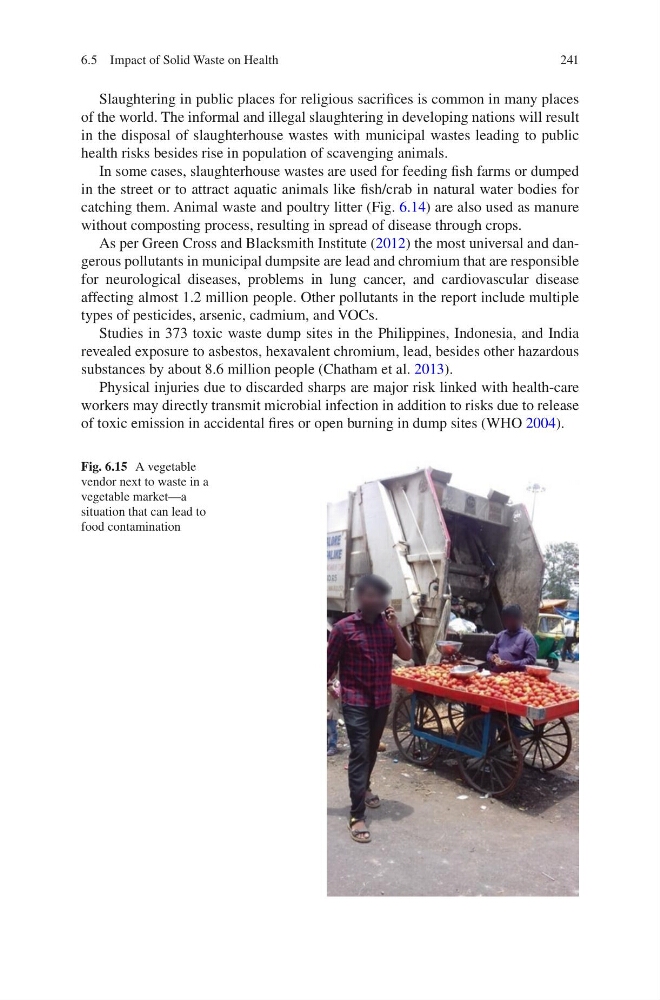
Fig. 6.15 A vegetable
vendor next to waste in a
vegetable market—a
situation that can lead to
food contamination
6.5 Impact of Solid Waste on Health
Slaughtering in public places for religious sacrifices is common in many places
of the world. The informal and illegal slaughtering in developing nations will result
in the disposal of slaughterhouse wastes with municipal wastes leading to public
health risks besides rise in population of scavenging animals.
In some cases, slaughterhouse wastes are used for feeding fish farms or dumped
in the street or to attract aquatic animals like fish/crab in natural water bodies for
catching them. Animal waste and poultry litter (Fig. 6.14) are also used as manure
without composting process, resulting in spread of disease through crops.
As per Green Cross and Blacksmith Institute (2012) the most universal and dangerous pollutants in municipal dumpsite are lead and chromium that are responsible
for neurological diseases, problems in lung cancer, and cardiovascular disease
affecting almost 1.2 million people. Other pollutants in the report include multiple
types of pesticides, arsenic, cadmium, and VOCs.
Studies in 373 toxic waste dump sites in the Philippines, Indonesia, and India
revealed exposure to asbestos, hexavalent chromium, lead, besides other hazardous
substances by about 8.6 million people (Chatham et al. 2013).
Physical injuries due to discarded sharps are major risk linked with health-care
workers may directly transmit microbial infection in addition to risks due to release
of toxic emission in accidental fires or open burning in dump sites (WHO 2004).
Fig. 6.15 A vegetable
vendor next to waste in a
vegetable market—a
situation that can lead to
food contamination
6.5 Impact of Solid Waste on Health