

240
Health of populations was driving forces behind waste management in the developed world since as the link between health and waste became clear.
Solid waste disposal by open burning and dumping was the practice in most
developing nations until beginning of twenty-first century and it is still being practiced dominantly in low-income besides upper middle-income nations where 40%
of the waste produced is disposed of (ISWA 2012).
Apart from rural livestock and poultry production in rural area, large-scale livestock rearing is increasing around urban areas, close to urban areas, peri-urban
households as well as urban slums linking to potential source of disease (World
Bank 2004).
Many of the human infectious sicknesses and emerging human ailments like
avian flu, swine flu, severe acute respiratory syndrome (SARS), encephalopathy
from mad cow disease, avian influenza, west Nile, Ebola, and Lyme disease start
from animal sources.
Many slaughterhouses and livestock markets in developing countries are situated
in thickly populated urban areas, resulting in nuisance due to odors, traffic
congestion, and pollution. Utility services are not inadequate beside poor water supply and lighting. Hot water is seldom provided furthermore slaughter utensils are
improperly cleaned and sterilized (World Bank 2004).
Studies in Alighar, India, revealed the existence of illegal slaughterhouses inside
individual households apart from other slaughterhouses resulting in body ache,
headache, breathiness, coughing, nausea/vomiting, other air borne and waterborne
diseases (Singh et al. 2014).
Home slaughter is regular practice in some nations for certain holidays, festivals,
as well as special occasions. Antemortem and postmortem by trained meat inspectors or veterinary staff are usually non-existent. Where inspection is done, it will not
be adequate and hindered by poor lighting conditions resulting in food safety risk
(World Bank 2004).
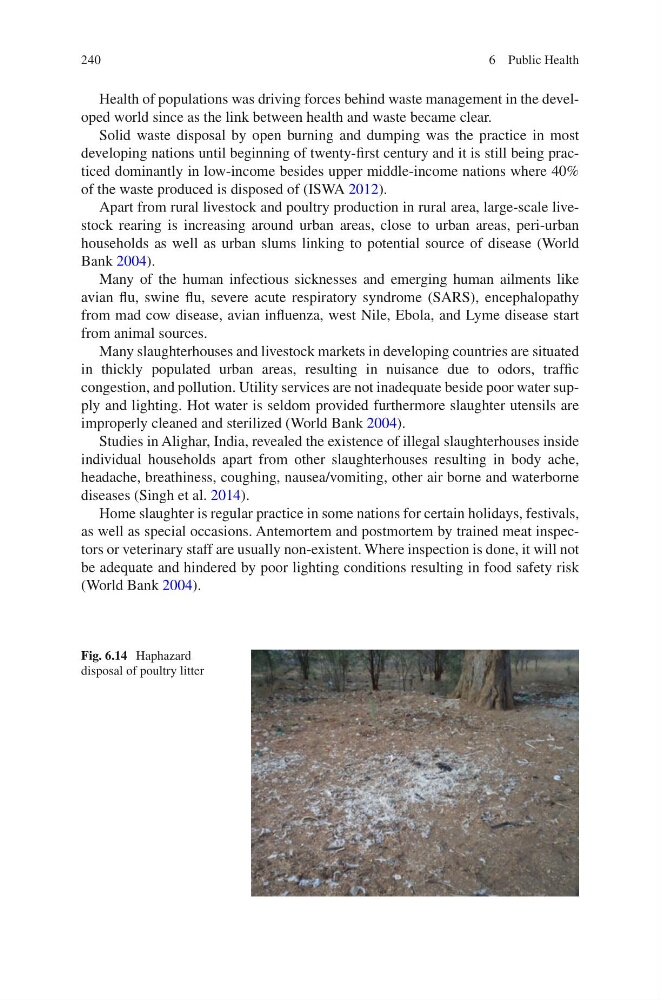
Fig. 6.14 Haphazard
disposal of poultry litter
6 Public Health
Health of populations was driving forces behind waste management in the developed world since as the link between health and waste became clear.
Solid waste disposal by open burning and dumping was the practice in most
developing nations until beginning of twenty-first century and it is still being practiced dominantly in low-income besides upper middle-income nations where 40%
of the waste produced is disposed of (ISWA 2012).
Apart from rural livestock and poultry production in rural area, large-scale livestock rearing is increasing around urban areas, close to urban areas, peri-urban
households as well as urban slums linking to potential source of disease (World
Bank 2004).
Many of the human infectious sicknesses and emerging human ailments like
avian flu, swine flu, severe acute respiratory syndrome (SARS), encephalopathy
from mad cow disease, avian influenza, west Nile, Ebola, and Lyme disease start
from animal sources.
Many slaughterhouses and livestock markets in developing countries are situated
in thickly populated urban areas, resulting in nuisance due to odors, traffic
congestion, and pollution. Utility services are not inadequate beside poor water supply and lighting. Hot water is seldom provided furthermore slaughter utensils are
improperly cleaned and sterilized (World Bank 2004).
Studies in Alighar, India, revealed the existence of illegal slaughterhouses inside
individual households apart from other slaughterhouses resulting in body ache,
headache, breathiness, coughing, nausea/vomiting, other air borne and waterborne
diseases (Singh et al. 2014).
Home slaughter is regular practice in some nations for certain holidays, festivals,
as well as special occasions. Antemortem and postmortem by trained meat inspectors or veterinary staff are usually non-existent. Where inspection is done, it will not
be adequate and hindered by poor lighting conditions resulting in food safety risk
(World Bank 2004).
Fig. 6.14 Haphazard
disposal of poultry litter
6 Public Health