

231
of new chemicals are mandatory only in few high-income countries (Landrigan
et al. 2018).
There is hardly any treatment of wastewater from informal and illegal livestock
markets as well as slaughterhouses in developing countries resulting in discharge to
drains that leads to local water bodies often affecting the poor at downstream who
may use the water for washing clothes, bathing, drinking, and cooking.
The food contamination can occur due to exposure of crops to pollutants or
through biomagnifications (Table 6.2). Concentrations of mercury and lead in gold
mining area of Tongguan, Shaanxi, China posed risk to health of people from consumption of locally produced vegetables and grains (Xiao et al. 2017).
More than two billion people rely on seafood globally the consumption is
increasing (FAO 1999). Marine pollution due to contaminated freshwater runoff,
entry of air pollutants, industrial and solid waste dumping contaminate sea food by
toxic heavy metal, synthetic, organic chemicals and microorganisms.
Reduction in food production can occur due to decrease in metabolism in plants
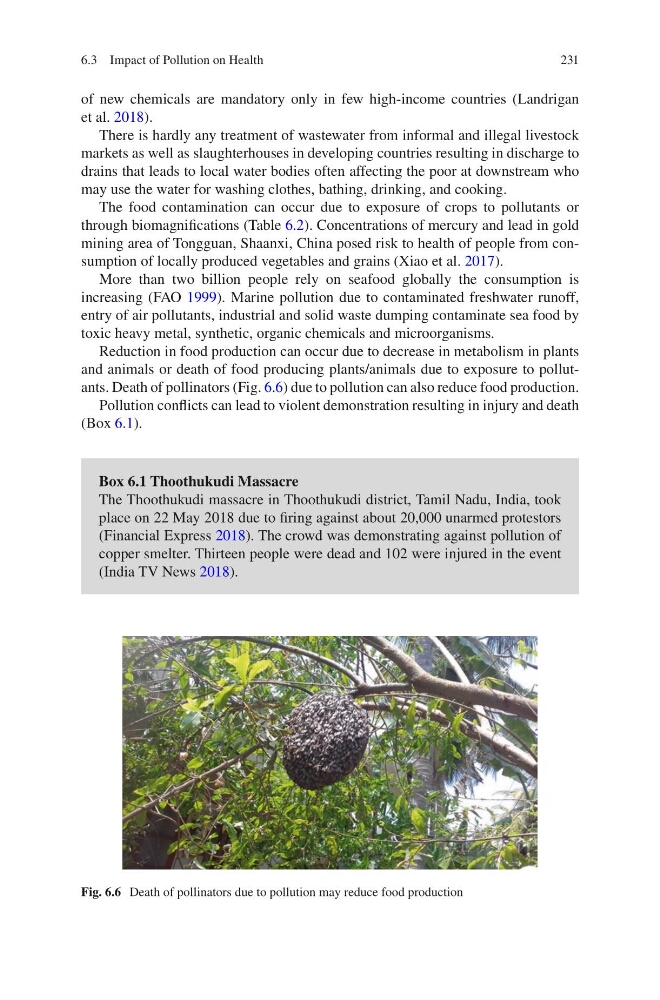
and animals or death of food producing plants/animals due to exposure to pollutants. Death of pollinators (Fig. 6.6) due to pollution can also reduce food production.
Pollution conflicts can lead to violent demonstration resulting in injury and death
(Box 6.1).
Fig. 6.6 Death of pollinators due to pollution may reduce food production
Box 6.1 Thoothukudi Massacre
The Thoothukudi massacre in Thoothukudi district, Tamil Nadu, India, took
place on 22 May 2018 due to firing against about 20,000 unarmed protestors
(Financial Express 2018). The crowd was demonstrating against pollution of
copper smelter. Thirteen people were dead and 102 were injured in the event
(India TV News 2018).
6.3 Impact of Pollution on Health
of new chemicals are mandatory only in few high-income countries (Landrigan
et al. 2018).
There is hardly any treatment of wastewater from informal and illegal livestock
markets as well as slaughterhouses in developing countries resulting in discharge to
drains that leads to local water bodies often affecting the poor at downstream who
may use the water for washing clothes, bathing, drinking, and cooking.
The food contamination can occur due to exposure of crops to pollutants or
through biomagnifications (Table 6.2). Concentrations of mercury and lead in gold
mining area of Tongguan, Shaanxi, China posed risk to health of people from consumption of locally produced vegetables and grains (Xiao et al. 2017).
More than two billion people rely on seafood globally the consumption is
increasing (FAO 1999). Marine pollution due to contaminated freshwater runoff,
entry of air pollutants, industrial and solid waste dumping contaminate sea food by
toxic heavy metal, synthetic, organic chemicals and microorganisms.
Reduction in food production can occur due to decrease in metabolism in plants
and animals or death of food producing plants/animals due to exposure to pollutants. Death of pollinators (Fig. 6.6) due to pollution can also reduce food production.
Pollution conflicts can lead to violent demonstration resulting in injury and death
(Box 6.1).
Fig. 6.6 Death of pollinators due to pollution may reduce food production
Box 6.1 Thoothukudi Massacre
The Thoothukudi massacre in Thoothukudi district, Tamil Nadu, India, took
place on 22 May 2018 due to firing against about 20,000 unarmed protestors
(Financial Express 2018). The crowd was demonstrating against pollution of
copper smelter. Thirteen people were dead and 102 were injured in the event
(India TV News 2018).
6.3 Impact of Pollution on Health