

204
5.24 Immunology
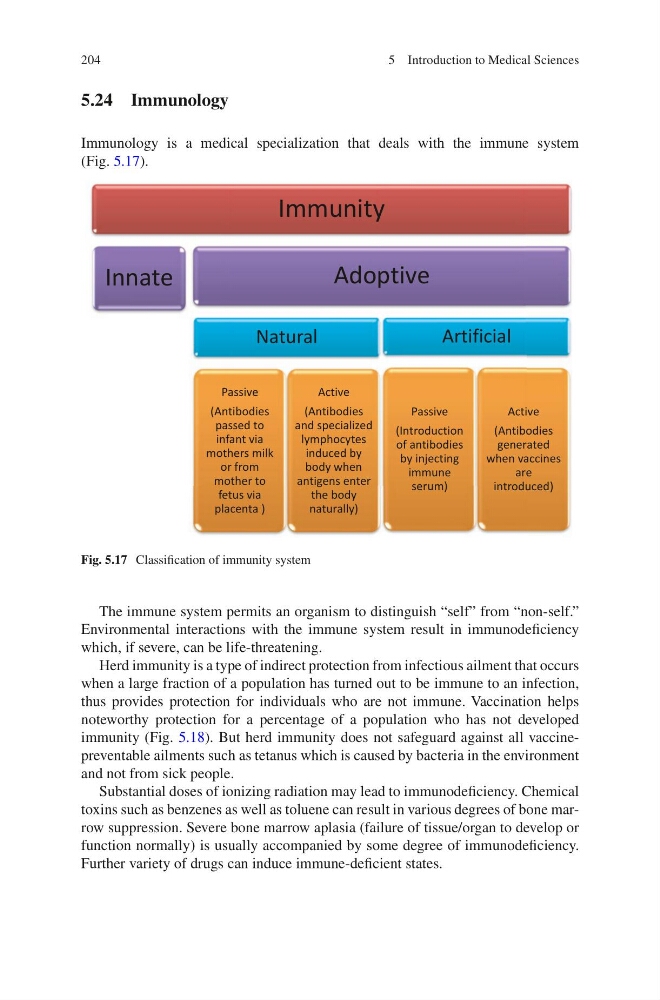
Immunology is a medical specialization that deals with the immune system
(Fig. 5.17).
The immune system permits an organism to distinguish “self” from “non-self.”
Environmental interactions with the immune system result in immunodeficiency
which, if severe, can be life-threatening.
Herd immunity is a type of indirect protection from infectious ailment that occurs
when a large fraction of a population has turned out to be immune to an infection,
thus provides protection for individuals who are not immune. Vaccination helps
noteworthy protection for a percentage of a population who has not developed
immunity (Fig. 5.18). But herd immunity does not safeguard against all vaccinepreventable ailments such as tetanus which is caused by bacteria in the environment
and not from sick people.
Substantial doses of ionizing radiation may lead to immunodeficiency. Chemical
toxins such as benzenes as well as toluene can result in various degrees of bone marrow suppression. Severe bone marrow aplasia (failure of tissue/organ to develop or
function normally) is usually accompanied by some degree of immunodeficiency.
Further variety of drugs can induce immune-deficient states.
Immunity
Innate
Adoptive
Natural
Passive
(Antibodies
passed to
infant via
mothers milk
or from
mother to
fetus via
placenta )
Active
(Antibodies
and specialized
lymphocytes
induced by
body when
antigens enter
the body
naturally)
Artificial
Passive
(Introduction
of antibodies
by injecting
immune
serum)
Active
(Antibodies
generated
when vaccines
are
introduced)
Fig. 5.17 Classification of immunity system
5 Introduction to Medical Sciences
5.24 Immunology
Immunology is a medical specialization that deals with the immune system
(Fig. 5.17).
The immune system permits an organism to distinguish “self” from “non-self.”
Environmental interactions with the immune system result in immunodeficiency
which, if severe, can be life-threatening.
Herd immunity is a type of indirect protection from infectious ailment that occurs
when a large fraction of a population has turned out to be immune to an infection,
thus provides protection for individuals who are not immune. Vaccination helps
noteworthy protection for a percentage of a population who has not developed
immunity (Fig. 5.18). But herd immunity does not safeguard against all vaccinepreventable ailments such as tetanus which is caused by bacteria in the environment
and not from sick people.
Substantial doses of ionizing radiation may lead to immunodeficiency. Chemical
toxins such as benzenes as well as toluene can result in various degrees of bone marrow suppression. Severe bone marrow aplasia (failure of tissue/organ to develop or
function normally) is usually accompanied by some degree of immunodeficiency.
Further variety of drugs can induce immune-deficient states.
Immunity
Innate
Adoptive
Natural
Passive
(Antibodies
passed to
infant via
mothers milk
or from
mother to
fetus via
placenta )
Active
(Antibodies
and specialized
lymphocytes
induced by
body when
antigens enter
the body
naturally)
Artificial
Passive
(Introduction
of antibodies
by injecting
immune
serum)
Active
(Antibodies
generated
when vaccines
are
introduced)
Fig. 5.17 Classification of immunity system
5 Introduction to Medical Sciences