

156
shows a view of waste dump site, which are unscientific disposal methods and can
lead to health hazards as discussed in Box 4.2.
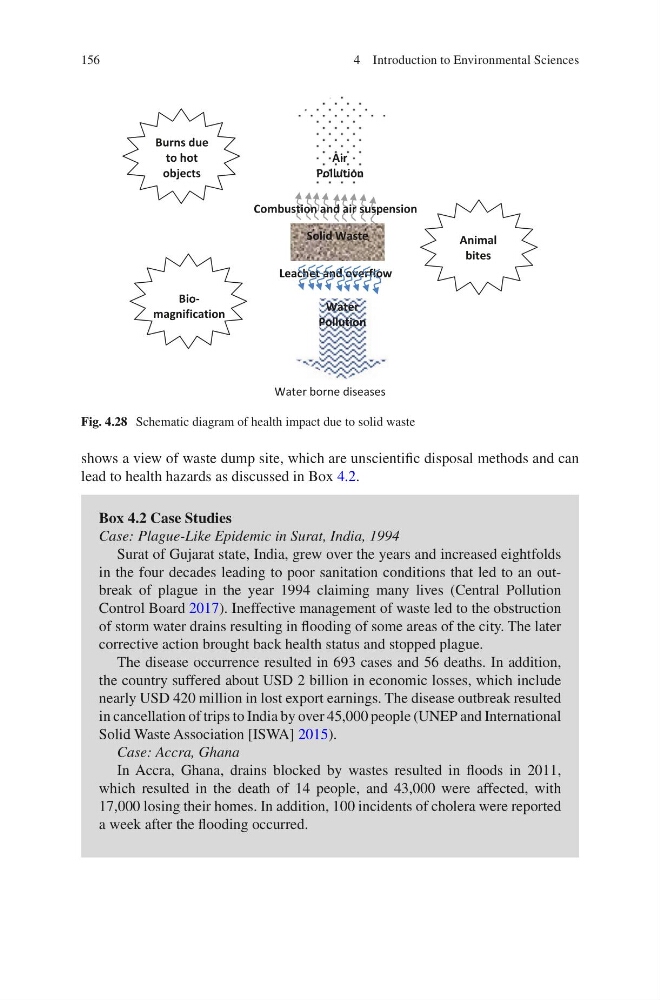
Solid Waste
Air
Pollution
Water
Pollution
Leachet and overflow
Combustion and air suspension
Water borne diseases
Animal
bites
Burns due
to hot
objects
Biomagnification
Fig. 4.28 Schematic diagram of health impact due to solid waste
Box 4.2 Case Studies
Case: Plague-Like Epidemic in Surat, India, 1994
Surat of Gujarat state, India, grew over the years and increased eightfolds
in the four decades leading to poor sanitation conditions that led to an outbreak of plague in the year 1994 claiming many lives (Central Pollution
Control Board 2017). Ineffective management of waste led to the obstruction
of storm water drains resulting in flooding of some areas of the city. The later
corrective action brought back health status and stopped plague.
The disease occurrence resulted in 693 cases and 56 deaths. In addition,
the country suffered about USD 2 billion in economic losses, which include
nearly USD 420 million in lost export earnings. The disease outbreak resulted
in cancellation of trips to India by over 45,000 people (UNEP and International
Solid Waste Association [ISWA] 2015).
Case: Accra, Ghana
In Accra, Ghana, drains blocked by wastes resulted in floods in 2011,
which resulted in the death of 14 people, and 43,000 were affected, with
17,000 losing their homes. In addition, 100 incidents of cholera were reported
a week after the flooding occurred.
4 Introduction to Environmental Sciences
shows a view of waste dump site, which are unscientific disposal methods and can
lead to health hazards as discussed in Box 4.2.
Solid Waste
Air
Pollution
Water
Pollution
Leachet and overflow
Combustion and air suspension
Water borne diseases
Animal
bites
Burns due
to hot
objects
Biomagnification
Fig. 4.28 Schematic diagram of health impact due to solid waste
Box 4.2 Case Studies
Case: Plague-Like Epidemic in Surat, India, 1994
Surat of Gujarat state, India, grew over the years and increased eightfolds
in the four decades leading to poor sanitation conditions that led to an outbreak of plague in the year 1994 claiming many lives (Central Pollution
Control Board 2017). Ineffective management of waste led to the obstruction
of storm water drains resulting in flooding of some areas of the city. The later
corrective action brought back health status and stopped plague.
The disease occurrence resulted in 693 cases and 56 deaths. In addition,
the country suffered about USD 2 billion in economic losses, which include
nearly USD 420 million in lost export earnings. The disease outbreak resulted
in cancellation of trips to India by over 45,000 people (UNEP and International
Solid Waste Association [ISWA] 2015).
Case: Accra, Ghana
In Accra, Ghana, drains blocked by wastes resulted in floods in 2011,
which resulted in the death of 14 people, and 43,000 were affected, with
17,000 losing their homes. In addition, 100 incidents of cholera were reported
a week after the flooding occurred.
4 Introduction to Environmental Sciences