

155
Schematic diagram of health impact due to solid waste is given in Fig. 4.28.
Apart from water-borne diseases, mismanagement of solid waste can also encourage rodents and vectors. The waste can also host snakes and other species such as
scorpions, resulting in snake bites and scorpion bites. The animals near waste dump
can also attract carnivorous animals such as panther leading to man and wildlife
conflict. The hot objects due to burning of solid waste could result in burns. Several
published papers on health issues associated with solid waste mainly concern cancer, birth outcomes, snake bite, dog bite, respiratory diseases, as well as annoyance
due to improper solid waste disposal (Dolk et al. 1998; Vrijheid 2000; Hu and Shy
2001; Jarup et al. 2002; Rushton 2003; DEFRA 2004; Chandrappa and Das 2012;
Ashworth et al. 2014; WHO 2015d; EMPRI 2018a, b).
Solid waste can be classified into many types and subtypes. Examples of solid
waste categorization and health hazard are given in Table 4.3.
Indiscriminate disposal of solid waste can result in biomagnification, wherein
chemicals can accumulate in each level of food chain. The chemicals can enter milk
through ingestion/inhalation of chemicals by cow/buffalo. The chemicals also find
its way into egg of hen/ducks, which consume contaminated food from waste heaps.
Figure 4.29 shows cathode ray tube of television disposed on road and Fig. 4.30
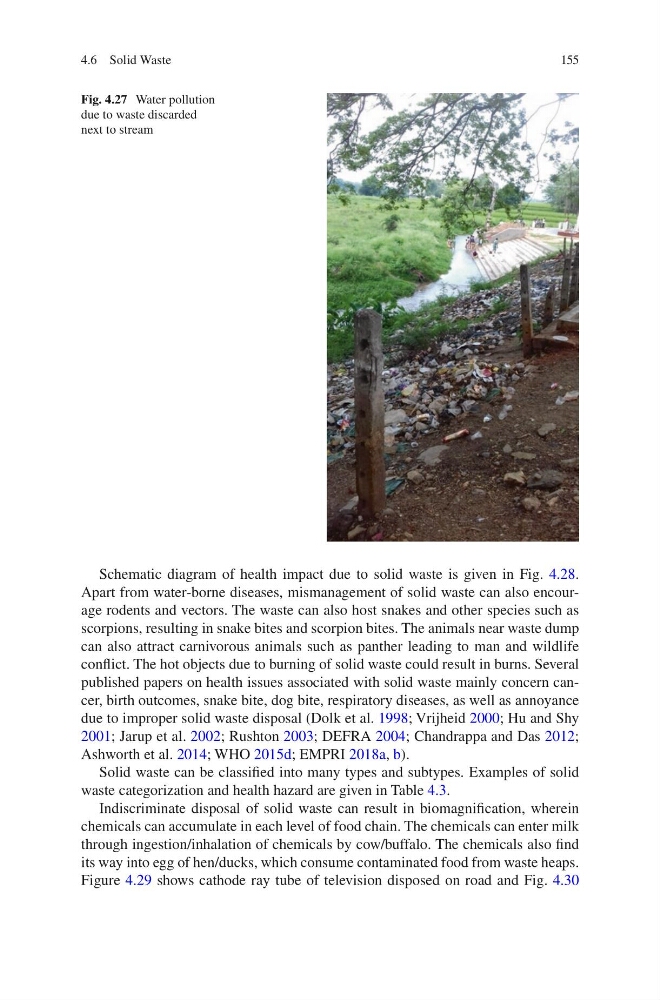
Fig. 4.27 Water pollution
due to waste discarded
next to stream
4.6 Solid Waste
Schematic diagram of health impact due to solid waste is given in Fig. 4.28.
Apart from water-borne diseases, mismanagement of solid waste can also encourage rodents and vectors. The waste can also host snakes and other species such as
scorpions, resulting in snake bites and scorpion bites. The animals near waste dump
can also attract carnivorous animals such as panther leading to man and wildlife
conflict. The hot objects due to burning of solid waste could result in burns. Several
published papers on health issues associated with solid waste mainly concern cancer, birth outcomes, snake bite, dog bite, respiratory diseases, as well as annoyance
due to improper solid waste disposal (Dolk et al. 1998; Vrijheid 2000; Hu and Shy
2001; Jarup et al. 2002; Rushton 2003; DEFRA 2004; Chandrappa and Das 2012;
Ashworth et al. 2014; WHO 2015d; EMPRI 2018a, b).
Solid waste can be classified into many types and subtypes. Examples of solid
waste categorization and health hazard are given in Table 4.3.
Indiscriminate disposal of solid waste can result in biomagnification, wherein
chemicals can accumulate in each level of food chain. The chemicals can enter milk
through ingestion/inhalation of chemicals by cow/buffalo. The chemicals also find
its way into egg of hen/ducks, which consume contaminated food from waste heaps.
Figure 4.29 shows cathode ray tube of television disposed on road and Fig. 4.30
Fig. 4.27 Water pollution
due to waste discarded
next to stream
4.6 Solid Waste