

97
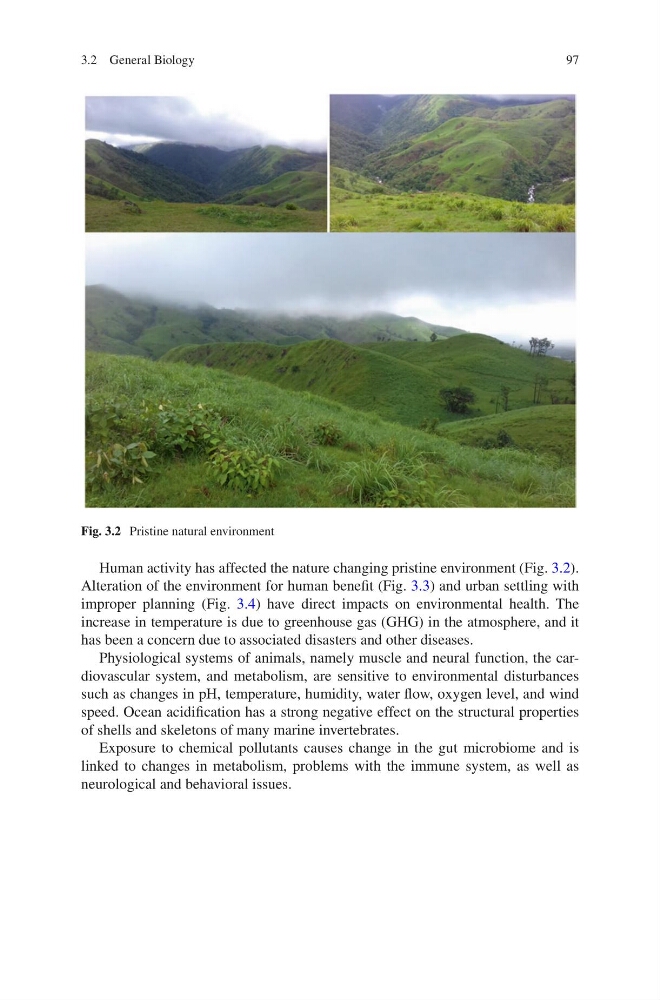
Human activity has affected the nature changing pristine environment (Fig. 3.2).
Alteration of the environment for human benefit (Fig. 3.3) and urban settling with
improper planning (Fig. 3.4) have direct impacts on environmental health. The
increase in temperature is due to greenhouse gas (GHG) in the atmosphere, and it
has been a concern due to associated disasters and other diseases.
Physiological systems of animals, namely muscle and neural function, the cardiovascular system, and metabolism, are sensitive to environmental disturbances
such as changes in pH, temperature, humidity, water flow, oxygen level, and wind
speed. Ocean acidification has a strong negative effect on the structural properties
of shells and skeletons of many marine invertebrates.
Exposure to chemical pollutants causes change in the gut microbiome and is
linked to changes in metabolism, problems with the immune system, as well as
neurological and behavioral issues.
Fig. 3.2 Pristine natural environment
3.2 General Biology
Human activity has affected the nature changing pristine environment (Fig. 3.2).
Alteration of the environment for human benefit (Fig. 3.3) and urban settling with
improper planning (Fig. 3.4) have direct impacts on environmental health. The
increase in temperature is due to greenhouse gas (GHG) in the atmosphere, and it
has been a concern due to associated disasters and other diseases.
Physiological systems of animals, namely muscle and neural function, the cardiovascular system, and metabolism, are sensitive to environmental disturbances
such as changes in pH, temperature, humidity, water flow, oxygen level, and wind
speed. Ocean acidification has a strong negative effect on the structural properties
of shells and skeletons of many marine invertebrates.
Exposure to chemical pollutants causes change in the gut microbiome and is
linked to changes in metabolism, problems with the immune system, as well as
neurological and behavioral issues.
Fig. 3.2 Pristine natural environment
3.2 General Biology