

96
cium ions; or pH of extracellular fluid. These variables should be kept within certain
pre-set limits (homeostatic range) and need to be regulated despite changes in the
environmental conditions.
Alteration or pollution of water body could lead to epidemics, floods, and other
incidents, which may affect health of individuals.
The term “disease causative agent” refers to the any agent such as toxic chemical
and biological pathogens that causes disease. Disease could be communicable disease or noncommunicable disease or injury, which can be further subcategorized.
The disease causative agent is part of the environment. The natural (animal attack,
natural disaster, etc.) and anthropogenic activities (industrial activity, waste management, etc.) can cause sickness.
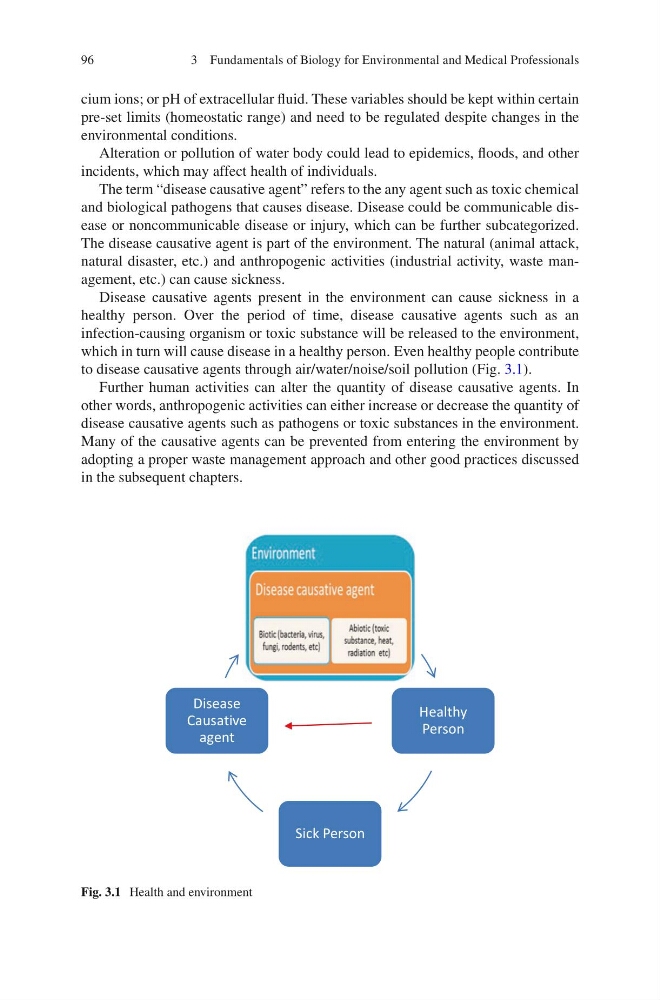
Disease causative agents present in the environment can cause sickness in a
healthy person. Over the period of time, disease causative agents such as an
infection- causing organism or toxic substance will be released to the environment,
which in turn will cause disease in a healthy person. Even healthy people contribute
to disease causative agents through air/water/noise/soil pollution (Fig. 3.1).
Further human activities can alter the quantity of disease causative agents. In
other words, anthropogenic activities can either increase or decrease the quantity of
disease causative agents such as pathogens or toxic substances in the environment.
Many of the causative agents can be prevented from entering the environment by
adopting a proper waste management approach and other good practices discussed
in the subsequent chapters.
Healthy
Person
Sick Person
Disease
Causative
agent
Fig. 3.1 Health and environment
3 Fundamentals of Biology for Environmental and Medical Professionals
cium ions; or pH of extracellular fluid. These variables should be kept within certain
pre-set limits (homeostatic range) and need to be regulated despite changes in the
environmental conditions.
Alteration or pollution of water body could lead to epidemics, floods, and other
incidents, which may affect health of individuals.
The term “disease causative agent” refers to the any agent such as toxic chemical
and biological pathogens that causes disease. Disease could be communicable disease or noncommunicable disease or injury, which can be further subcategorized.
The disease causative agent is part of the environment. The natural (animal attack,
natural disaster, etc.) and anthropogenic activities (industrial activity, waste management, etc.) can cause sickness.
Disease causative agents present in the environment can cause sickness in a
healthy person. Over the period of time, disease causative agents such as an
infection- causing organism or toxic substance will be released to the environment,
which in turn will cause disease in a healthy person. Even healthy people contribute
to disease causative agents through air/water/noise/soil pollution (Fig. 3.1).
Further human activities can alter the quantity of disease causative agents. In
other words, anthropogenic activities can either increase or decrease the quantity of
disease causative agents such as pathogens or toxic substances in the environment.
Many of the causative agents can be prevented from entering the environment by
adopting a proper waste management approach and other good practices discussed
in the subsequent chapters.
Healthy
Person
Sick Person
Disease
Causative
agent
Fig. 3.1 Health and environment
3 Fundamentals of Biology for Environmental and Medical Professionals