

64
Fundamentals of Corrosion
internal decarburization above 342°F (200°C). Hydrogen attack can take several forms within the metal structure, depending upon the severity of the
attack, stress, and the presence of inclusions in the steel.
When stress is absent, a component may undergo a general surface attack.
Areas of high-stress concentrations are often the initiation point of hydrogen
attack. Isolated decarburized and fissured areas are often found adjacent to
weldments. Severe hydrogen attack may also result in laminations and the
formation of blisters.
The stability of carbides determines the resistance of steels to hydrogen
attack. Alloying with carbide-stabilizing elements such as chromium, molybdenum, vanadium, and titanium has beneficial effects. Austenitic stainless
steels are not subject to hydrogen attack.
Hydrogen attack was first recognized as a major problem in the petrochemical industry in 1940 and 1949. Nelson published a classic paper
on that subject, entitled “Hydrogenation Plant Steel,” in the Proceedings of
the American Petroleum Institute, Refining Division. The purpose of Nelson’s
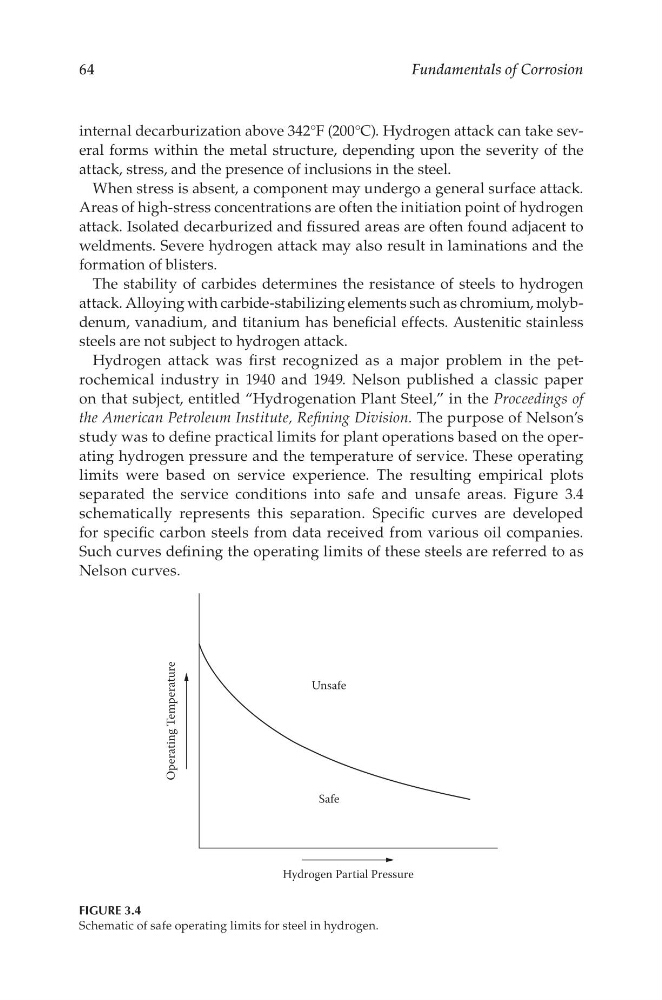
study was to define practical limits for plant operations based on the operating hydrogen pressure and the temperature of service. These operating
limits were based on service experience. The resulting empirical plots
separated the service conditions into safe and unsafe areas. Figure 3.4
schematically represents this separation. Specific curves are developed
for specific carbon steels from data received from various oil companies.
Such curves defining the operating limits of these steels are referred to as
Nelson curves.
Unsafe
Safe
Operating Temperature
Hydrogen Partial Pressure
FigurE 3.4
Schematic of safe operating limits for steel in hydrogen.
Fundamentals of Corrosion
internal decarburization above 342°F (200°C). Hydrogen attack can take several forms within the metal structure, depending upon the severity of the
attack, stress, and the presence of inclusions in the steel.
When stress is absent, a component may undergo a general surface attack.
Areas of high-stress concentrations are often the initiation point of hydrogen
attack. Isolated decarburized and fissured areas are often found adjacent to
weldments. Severe hydrogen attack may also result in laminations and the
formation of blisters.
The stability of carbides determines the resistance of steels to hydrogen
attack. Alloying with carbide-stabilizing elements such as chromium, molybdenum, vanadium, and titanium has beneficial effects. Austenitic stainless
steels are not subject to hydrogen attack.
Hydrogen attack was first recognized as a major problem in the petrochemical industry in 1940 and 1949. Nelson published a classic paper
on that subject, entitled “Hydrogenation Plant Steel,” in the Proceedings of
the American Petroleum Institute, Refining Division. The purpose of Nelson’s
study was to define practical limits for plant operations based on the operating hydrogen pressure and the temperature of service. These operating
limits were based on service experience. The resulting empirical plots
separated the service conditions into safe and unsafe areas. Figure 3.4
schematically represents this separation. Specific curves are developed
for specific carbon steels from data received from various oil companies.
Such curves defining the operating limits of these steels are referred to as
Nelson curves.
Unsafe
Safe
Operating Temperature
Hydrogen Partial Pressure
FigurE 3.4
Schematic of safe operating limits for steel in hydrogen.