

Forms of Metallic Corrosion
63
Hydrogen blistering literally means the formation of surface bulges resembling a blister. The generation of hydrogen gas in voids or other defect sites
located near the surface can lead to such a condition. The blisters often rupture, producing surface cracks. Internal hydrogen blistering along grain
boundaries (fissures) can lead to hydrogen-induced stepwise cracking.
Killed steels are more susceptible to blistering than semi-killed steels because
of greater hydrogen intake after deoxidation, but the nature and size of inclusion are overriding factors. Rimmed steels are highly susceptible because of
the inherent presence of voids. Sulfur-bearing steels are also especially prone
because sulfur favors hydrogen entry by acting as a cathodic poison.
Hydrogen blistering is encountered mostly during acid pickling operations. Corrosion-generated hydrogen causes blistering of steel in oil-well
equipment and petrochemical storage and refining equipment.
3.10.2.3 Flakes, Fisheyes, and Shatter Cracks
Flaking refers to small internal fissures that occur in steels when cooled from
temperatures on the order of 2012°F (1100°C) in hydrogen atmospheres. These
are also described as fish eyes, shatter cracks, or snowflakes, and are common hydrogen damage found on forgings, weldments, and castings.
The extent of the damage depends on the time of exposure in a hydrogen-containing environment. The cracks produced are readily detectable by
radiographic or ultrasonic inspection, or by visual and microscopic observation of traverse sectors.
3.10.2.4 Hydrogen Attack
Hydrogen attack is a form of damage that occurs in carbon and low-alloy steels
exposed to high-pressure gas at high temperatures for extended periods of
time. The damage may result in the formation of cracks and fissures or loss
in strength of the alloy. This condition is prevalent above 392°F (200°C). The
reaction takes place between absorbed hydrogen and the iron carbide or the
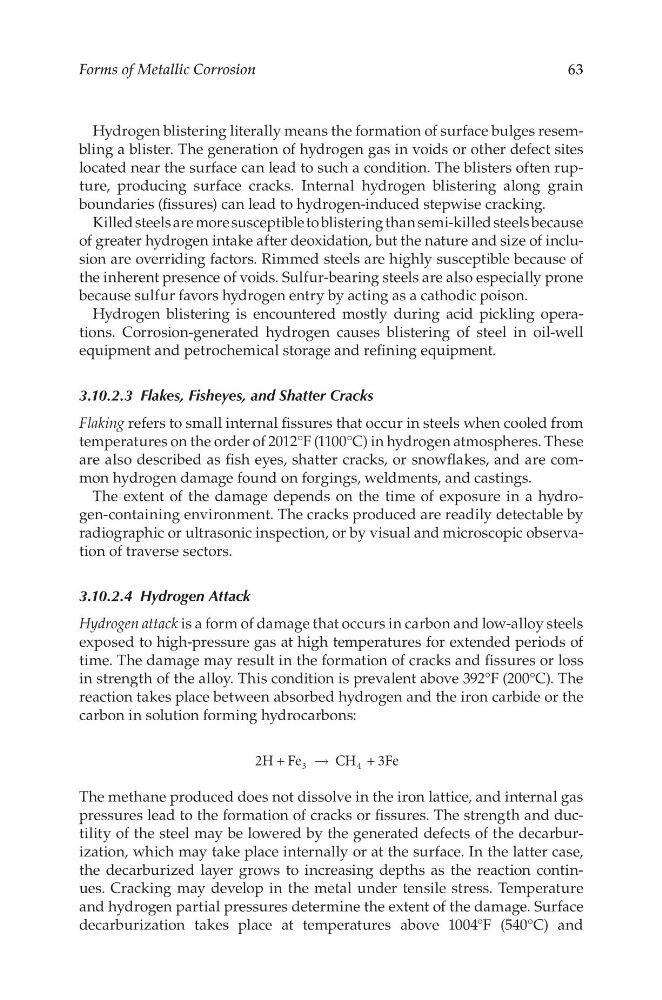
carbon in solution forming hydrocarbons:
2H + Fe
CH +3Fe
3
4
→
The methane produced does not dissolve in the iron lattice, and internal gas
pressures lead to the formation of cracks or fissures. The strength and ductility of the steel may be lowered by the generated defects of the decarburization, which may take place internally or at the surface. In the latter case,
the decarburized layer grows to increasing depths as the reaction continues. Cracking may develop in the metal under tensile stress. Temperature
and hydrogen partial pressures determine the extent of the damage. Surface
decarburization takes place at temperatures above 1004°F (540°C) and
63
Hydrogen blistering literally means the formation of surface bulges resembling a blister. The generation of hydrogen gas in voids or other defect sites
located near the surface can lead to such a condition. The blisters often rupture, producing surface cracks. Internal hydrogen blistering along grain
boundaries (fissures) can lead to hydrogen-induced stepwise cracking.
Killed steels are more susceptible to blistering than semi-killed steels because
of greater hydrogen intake after deoxidation, but the nature and size of inclusion are overriding factors. Rimmed steels are highly susceptible because of
the inherent presence of voids. Sulfur-bearing steels are also especially prone
because sulfur favors hydrogen entry by acting as a cathodic poison.
Hydrogen blistering is encountered mostly during acid pickling operations. Corrosion-generated hydrogen causes blistering of steel in oil-well
equipment and petrochemical storage and refining equipment.
3.10.2.3 Flakes, Fisheyes, and Shatter Cracks
Flaking refers to small internal fissures that occur in steels when cooled from
temperatures on the order of 2012°F (1100°C) in hydrogen atmospheres. These
are also described as fish eyes, shatter cracks, or snowflakes, and are common hydrogen damage found on forgings, weldments, and castings.
The extent of the damage depends on the time of exposure in a hydrogen-containing environment. The cracks produced are readily detectable by
radiographic or ultrasonic inspection, or by visual and microscopic observation of traverse sectors.
3.10.2.4 Hydrogen Attack
Hydrogen attack is a form of damage that occurs in carbon and low-alloy steels
exposed to high-pressure gas at high temperatures for extended periods of
time. The damage may result in the formation of cracks and fissures or loss
in strength of the alloy. This condition is prevalent above 392°F (200°C). The
reaction takes place between absorbed hydrogen and the iron carbide or the
carbon in solution forming hydrocarbons:
2H + Fe
CH +3Fe
3
4
→
The methane produced does not dissolve in the iron lattice, and internal gas
pressures lead to the formation of cracks or fissures. The strength and ductility of the steel may be lowered by the generated defects of the decarburization, which may take place internally or at the surface. In the latter case,
the decarburized layer grows to increasing depths as the reaction continues. Cracking may develop in the metal under tensile stress. Temperature
and hydrogen partial pressures determine the extent of the damage. Surface
decarburization takes place at temperatures above 1004°F (540°C) and