

Forms of Metallic Corrosion
53
Most organisms live in the mesophilic range of 69 to 110°F (20 to 45°C),
which corresponds to the usual temperature range of the Earth.
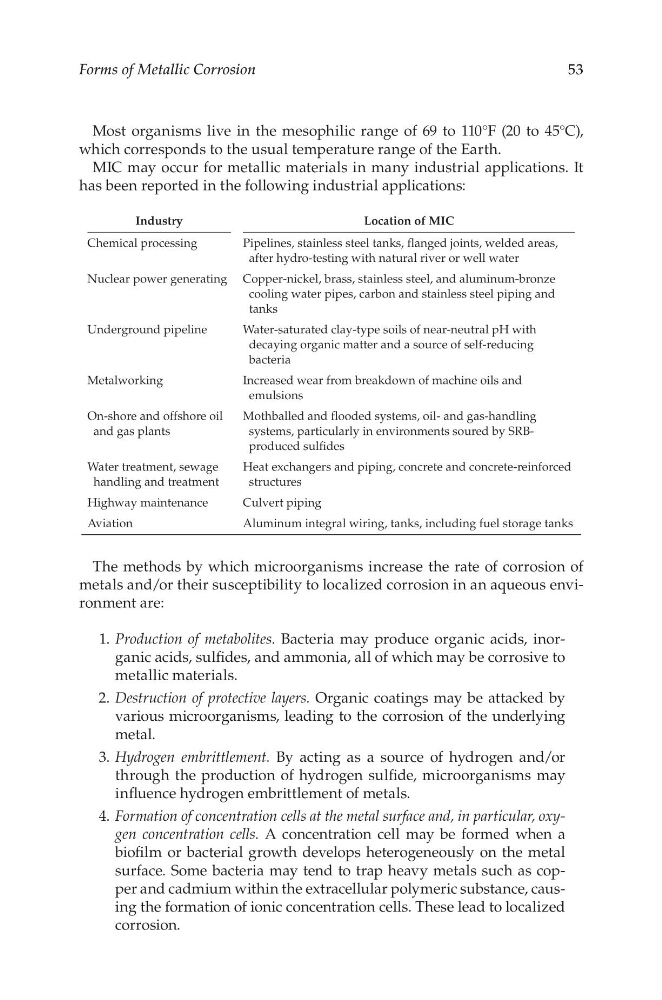
MIC may occur for metallic materials in many industrial applications. It
has been reported in the following industrial applications:
Industry
Location of MIC
Chemical processing
Pipelines, stainless steel tanks, flanged joints, welded areas,
after hydro-testing with natural river or well water
Nuclear power generating Copper-nickel, brass, stainless steel, and aluminum-bronze
cooling water pipes, carbon and stainless steel piping and
tanks
Underground pipeline
Water-saturated clay-type soils of near-neutral pH with
decaying organic matter and a source of self-reducing
bacteria
Metalworking
Increased wear from breakdown of machine oils and
emulsions
On-shore and offshore oil
and gas plants
Mothballed and flooded systems, oil- and gas-handling
systems, particularly in environments soured by SRBproduced sulfides
Water treatment, sewage
handling and treatment
Heat exchangers and piping, concrete and concrete-reinforced
structures
Highway maintenance
Culvert piping
Aviation
Aluminum integral wiring, tanks, including fuel storage tanks
The methods by which microorganisms increase the rate of corrosion of
metals and/or their susceptibility to localized corrosion in an aqueous environment are:
1. Production of metabolites. Bacteria may produce organic acids, inorganic acids, sulfides, and ammonia, all of which may be corrosive to
metallic materials.
2. Destruction of protective layers. Organic coatings may be attacked by
various microorganisms, leading to the corrosion of the underlying
metal.
3. Hydrogen embrittlement. By acting as a source of hydrogen and/or
through the production of hydrogen sulfide, microorganisms may
influence hydrogen embrittlement of metals.
4. Formation of concentration cells at the metal surface and, in particular, oxygen concentration cells. A concentration cell may be formed when a
biofilm or bacterial growth develops heterogeneously on the metal
surface. Some bacteria may tend to trap heavy metals such as copper and cadmium within the extracellular polymeric substance, causing the formation of ionic concentration cells. These lead to localized
corrosion.
53
Most organisms live in the mesophilic range of 69 to 110°F (20 to 45°C),
which corresponds to the usual temperature range of the Earth.
MIC may occur for metallic materials in many industrial applications. It
has been reported in the following industrial applications:
Industry
Location of MIC
Chemical processing
Pipelines, stainless steel tanks, flanged joints, welded areas,
after hydro-testing with natural river or well water
Nuclear power generating Copper-nickel, brass, stainless steel, and aluminum-bronze
cooling water pipes, carbon and stainless steel piping and
tanks
Underground pipeline
Water-saturated clay-type soils of near-neutral pH with
decaying organic matter and a source of self-reducing
bacteria
Metalworking
Increased wear from breakdown of machine oils and
emulsions
On-shore and offshore oil
and gas plants
Mothballed and flooded systems, oil- and gas-handling
systems, particularly in environments soured by SRBproduced sulfides
Water treatment, sewage
handling and treatment
Heat exchangers and piping, concrete and concrete-reinforced
structures
Highway maintenance
Culvert piping
Aviation
Aluminum integral wiring, tanks, including fuel storage tanks
The methods by which microorganisms increase the rate of corrosion of
metals and/or their susceptibility to localized corrosion in an aqueous environment are:
1. Production of metabolites. Bacteria may produce organic acids, inorganic acids, sulfides, and ammonia, all of which may be corrosive to
metallic materials.
2. Destruction of protective layers. Organic coatings may be attacked by
various microorganisms, leading to the corrosion of the underlying
metal.
3. Hydrogen embrittlement. By acting as a source of hydrogen and/or
through the production of hydrogen sulfide, microorganisms may
influence hydrogen embrittlement of metals.
4. Formation of concentration cells at the metal surface and, in particular, oxygen concentration cells. A concentration cell may be formed when a
biofilm or bacterial growth develops heterogeneously on the metal
surface. Some bacteria may tend to trap heavy metals such as copper and cadmium within the extracellular polymeric substance, causing the formation of ionic concentration cells. These lead to localized
corrosion.