

52
Fundamentals of Corrosion
Because life cannot exist without water, water is an essential requirement
for microbial life and growth. Requirements differ as to the amount of water
needed. A solid material is surrounded by three types of water: hygroscopic,
pellicular, and gravitational. Only gravitational and pellicular water are
biologically available and can be used by microorganisms. The biologically
available water is usually measured as the water activity:
a =
V
P
W
S
W
where V S is the vapor pressure of the solution and Ρ W is the vapor pressure
of pure water at the same temperature. Most bacteria require an a W value in
excess of 0.90.
Hydrogen ion concentration is another important factor affecting growth.
Microorganisms are classified as to their ability to grow under acidic, neutral, or alkaline conditions, being given such titles as acidophiles or alkalophiles. Most microorganisms thrive in the neutral pH range of 6 to 8.
Microbial growth is also affected by redox potential. Under standard conditions, hydrogen is assumed to have a redox potential of –42 nV and oxygen has a redox potential of 820 nV. Metabolism can take place within that
range.
Available oxygen is another factor influencing microbial growth.
Microbial growth is possible under aerated as well as under totally oxygenfree conditions.
Those organisms living with the amount of oxygen contained in the air
are called aerobes, whereas those that perform their metabolism without any
trace of oxygen are called anaerobes. The latter are able to use bound oxygen
(sulfate, carbon dioxide) or to ferment oxygen compounds.
Temperature is another important factor affecting microbial growth.
Microbial life is possible within the range of 21 to 230°F (–5 to 110°C).
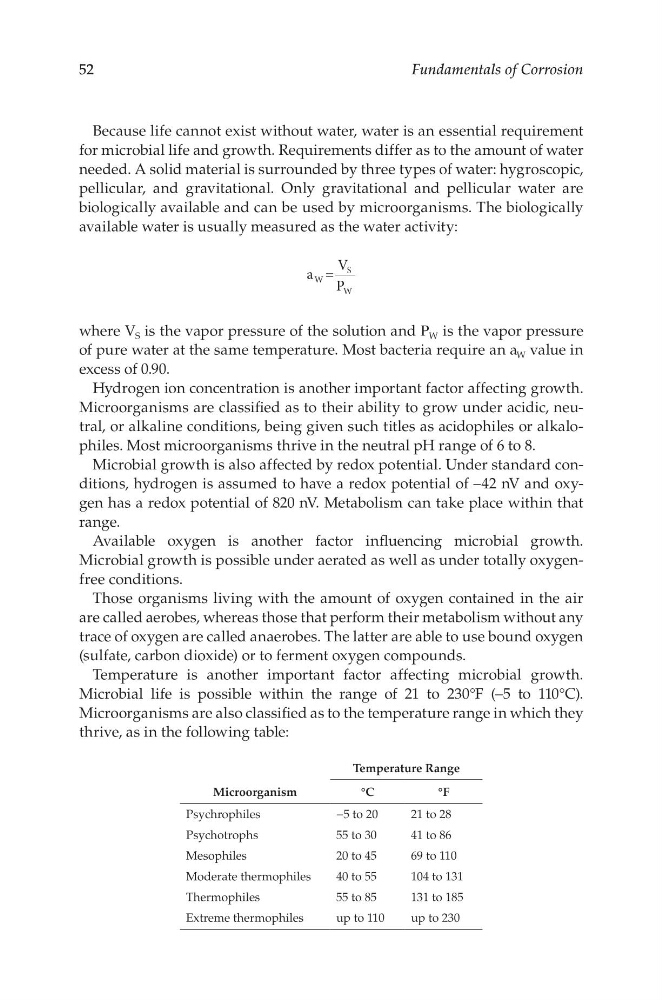
Microorganisms are also classified as to the temperature range in which they
thrive, as in the following table:
Microorganism
Temperature Range
°C
°F
Psychrophiles
−5 to 20
21 to 28
Psychotrophs
55 to 30
41 to 86
Mesophiles
20 to 45
69 to 110
Moderate thermophiles
40 to 55
104 to 131
Thermophiles
55 to 85
131 to 185
Extreme thermophiles
up to 110
up to 230
Fundamentals of Corrosion
Because life cannot exist without water, water is an essential requirement
for microbial life and growth. Requirements differ as to the amount of water
needed. A solid material is surrounded by three types of water: hygroscopic,
pellicular, and gravitational. Only gravitational and pellicular water are
biologically available and can be used by microorganisms. The biologically
available water is usually measured as the water activity:
a =
V
P
W
S
W
where V S is the vapor pressure of the solution and Ρ W is the vapor pressure
of pure water at the same temperature. Most bacteria require an a W value in
excess of 0.90.
Hydrogen ion concentration is another important factor affecting growth.
Microorganisms are classified as to their ability to grow under acidic, neutral, or alkaline conditions, being given such titles as acidophiles or alkalophiles. Most microorganisms thrive in the neutral pH range of 6 to 8.
Microbial growth is also affected by redox potential. Under standard conditions, hydrogen is assumed to have a redox potential of –42 nV and oxygen has a redox potential of 820 nV. Metabolism can take place within that
range.
Available oxygen is another factor influencing microbial growth.
Microbial growth is possible under aerated as well as under totally oxygenfree conditions.
Those organisms living with the amount of oxygen contained in the air
are called aerobes, whereas those that perform their metabolism without any
trace of oxygen are called anaerobes. The latter are able to use bound oxygen
(sulfate, carbon dioxide) or to ferment oxygen compounds.
Temperature is another important factor affecting microbial growth.
Microbial life is possible within the range of 21 to 230°F (–5 to 110°C).
Microorganisms are also classified as to the temperature range in which they
thrive, as in the following table:
Microorganism
Temperature Range
°C
°F
Psychrophiles
−5 to 20
21 to 28
Psychotrophs
55 to 30
41 to 86
Mesophiles
20 to 45
69 to 110
Moderate thermophiles
40 to 55
104 to 131
Thermophiles
55 to 85
131 to 185
Extreme thermophiles
up to 110
up to 230