

Forms of Metallic Corrosion
43
7. Most pitting is associated with halide ions (chlorides, bromides) and
hypochlorites, which are particularly aggressive. Cupric, ferric, and
mercuric halides are extremely aggressive because their cations are
cathodically reduced and sustain attack.
Performance in the area of pitting and crevice corrosion is often measured
using critical pitting temperature (CPT), critical crevice temperature (CCT),
and pitting resistance equivalent number (PREN). As a general rule, the
higher the PREN, the better the resistance. The PREN is determined by the
chromium, molybdenum, and nitrogen contents:
PREN = %Cr + 3.3 (%Mo) + 30 (%N)
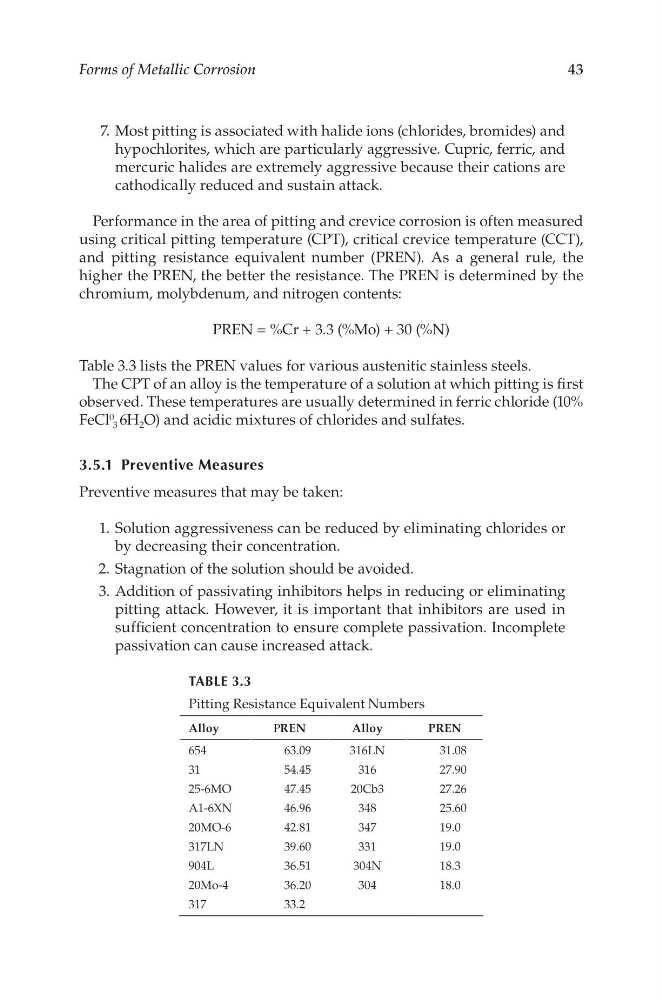
Table 3.3 lists the PREN values for various austenitic stainless steels.
The CPT of an alloy is the temperature of a solution at which pitting is first
observed. These temperatures are usually determined in ferric chloride (10%
FeCl 0
3 6H 2 O) and acidic mixtures of chlorides and sulfates.
3.5.1 Preventive Measures
Preventive measures that may be taken:
1. Solution aggressiveness can be reduced by eliminating chlorides or
by decreasing their concentration.
2. Stagnation of the solution should be avoided.
3. Addition of passivating inhibitors helps in reducing or eliminating
pitting attack. However, it is important that inhibitors are used in
sufficient concentration to ensure complete passivation. Incomplete
passivation can cause increased attack.
TabLE 3.3
Pitting Resistance Equivalent Numbers
Alloy
ΡREN
Alloy
PREN
654
63.09
316LN
31.08
31
54.45
316
27.90
25-6MO
47.45
20Cb3
27.26
A1-6XN
46.96
348
25.60
20MO-6
42.81
347
19.0
317LN
39.60
331
19.0
904L
36.51
304N
18.3
20Mo-4
36.20
304
18.0
317
33.2
43
7. Most pitting is associated with halide ions (chlorides, bromides) and
hypochlorites, which are particularly aggressive. Cupric, ferric, and
mercuric halides are extremely aggressive because their cations are
cathodically reduced and sustain attack.
Performance in the area of pitting and crevice corrosion is often measured
using critical pitting temperature (CPT), critical crevice temperature (CCT),
and pitting resistance equivalent number (PREN). As a general rule, the
higher the PREN, the better the resistance. The PREN is determined by the
chromium, molybdenum, and nitrogen contents:
PREN = %Cr + 3.3 (%Mo) + 30 (%N)
Table 3.3 lists the PREN values for various austenitic stainless steels.
The CPT of an alloy is the temperature of a solution at which pitting is first
observed. These temperatures are usually determined in ferric chloride (10%
FeCl 0
3 6H 2 O) and acidic mixtures of chlorides and sulfates.
3.5.1 Preventive Measures
Preventive measures that may be taken:
1. Solution aggressiveness can be reduced by eliminating chlorides or
by decreasing their concentration.
2. Stagnation of the solution should be avoided.
3. Addition of passivating inhibitors helps in reducing or eliminating
pitting attack. However, it is important that inhibitors are used in
sufficient concentration to ensure complete passivation. Incomplete
passivation can cause increased attack.
TabLE 3.3
Pitting Resistance Equivalent Numbers
Alloy
ΡREN
Alloy
PREN
654
63.09
316LN
31.08
31
54.45
316
27.90
25-6MO
47.45
20Cb3
27.26
A1-6XN
46.96
348
25.60
20MO-6
42.81
347
19.0
317LN
39.60
331
19.0
904L
36.51
304N
18.3
20Mo-4
36.20
304
18.0
317
33.2