

42
Fundamentals of Corrosion
material. Pitting may also develop on bare, clean metal surfaces because of
irregularities in the physical or chemical structure of the metal. Localized
dissimilar soil conditions at the surface of the steel can also create conditions
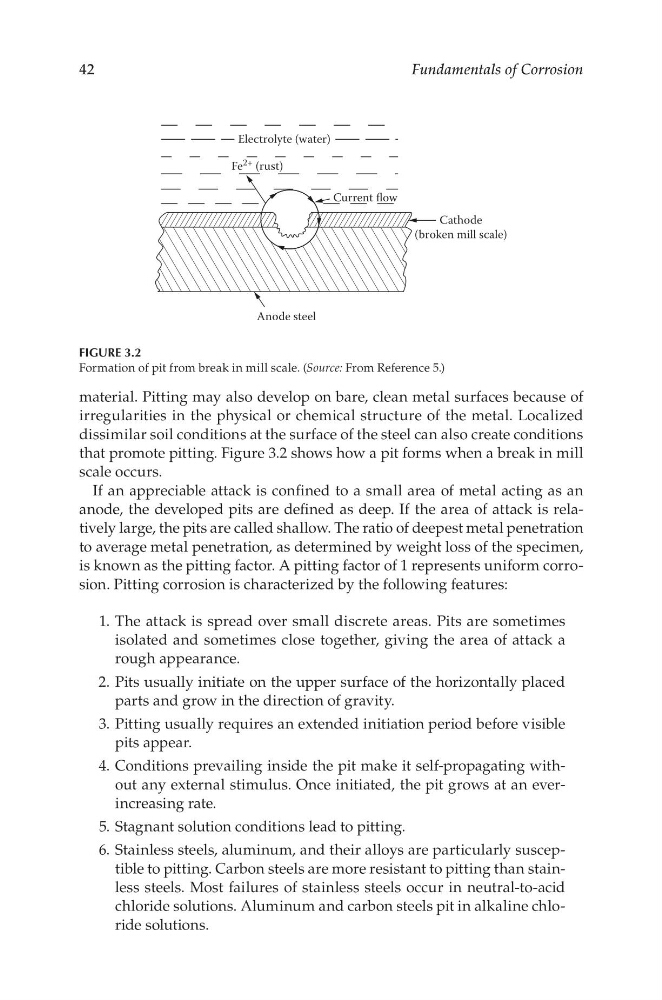
that promote pitting. Figure 3.2 shows how a pit forms when a break in mill
scale occurs.
If an appreciable attack is confined to a small area of metal acting as an
anode, the developed pits are defined as deep. If the area of attack is relatively large, the pits are called shallow. The ratio of deepest metal penetration
to average metal penetration, as determined by weight loss of the specimen,
is known as the pitting factor. A pitting factor of 1 represents uniform corrosion. Pitting corrosion is characterized by the following features:
1. The attack is spread over small discrete areas. Pits are sometimes
isolated and sometimes close together, giving the area of attack a
rough appearance.
2. Pits usually initiate on the upper surface of the horizontally placed
parts and grow in the direction of gravity.
3. Pitting usually requires an extended initiation period before visible
pits appear.
4. Conditions prevailing inside the pit make it self-propagating without any external stimulus. Once initiated, the pit grows at an everincreasing rate.
5. Stagnant solution conditions lead to pitting.
6. Stainless steels, aluminum, and their alloys are particularly susceptible to pitting. Carbon steels are more resistant to pitting than stainless steels. Most failures of stainless steels occur in neutral-to-acid
chloride solutions. Aluminum and carbon steels pit in alkaline chloride solutions.
Cathode
(broken mill scale)
Anode steel
Current flow
Electrolyte (water)
Fe
2+ (rust)
FigurE 3.2
Formation of pit from break in mill scale. (Source: From Reference 5.)
Fundamentals of Corrosion
material. Pitting may also develop on bare, clean metal surfaces because of
irregularities in the physical or chemical structure of the metal. Localized
dissimilar soil conditions at the surface of the steel can also create conditions
that promote pitting. Figure 3.2 shows how a pit forms when a break in mill
scale occurs.
If an appreciable attack is confined to a small area of metal acting as an
anode, the developed pits are defined as deep. If the area of attack is relatively large, the pits are called shallow. The ratio of deepest metal penetration
to average metal penetration, as determined by weight loss of the specimen,
is known as the pitting factor. A pitting factor of 1 represents uniform corrosion. Pitting corrosion is characterized by the following features:
1. The attack is spread over small discrete areas. Pits are sometimes
isolated and sometimes close together, giving the area of attack a
rough appearance.
2. Pits usually initiate on the upper surface of the horizontally placed
parts and grow in the direction of gravity.
3. Pitting usually requires an extended initiation period before visible
pits appear.
4. Conditions prevailing inside the pit make it self-propagating without any external stimulus. Once initiated, the pit grows at an everincreasing rate.
5. Stagnant solution conditions lead to pitting.
6. Stainless steels, aluminum, and their alloys are particularly susceptible to pitting. Carbon steels are more resistant to pitting than stainless steels. Most failures of stainless steels occur in neutral-to-acid
chloride solutions. Aluminum and carbon steels pit in alkaline chloride solutions.
Cathode
(broken mill scale)
Anode steel
Current flow
Electrolyte (water)
Fe
2+ (rust)
FigurE 3.2
Formation of pit from break in mill scale. (Source: From Reference 5.)