

40
Fundamentals of Corrosion
As the reactions proceed, the dissolved oxygen in the small volume of stagnated solution inside the crevice is consumed. However, this does not prevent
the dissolution reaction inside the crevice because the electrons reach outside
the crevice through the metal, where there is plenty of oxygen available for
reduction. A concentration cell (differential aeration) is set up between the
crevice area and the area outside the crevice.
When chloride ions are present, the situation is further aggravated. The
accumulated cations inside the crevice attract the negatively charged chloride ions from the bulk solution. Hydroxide anions also migrate but they are
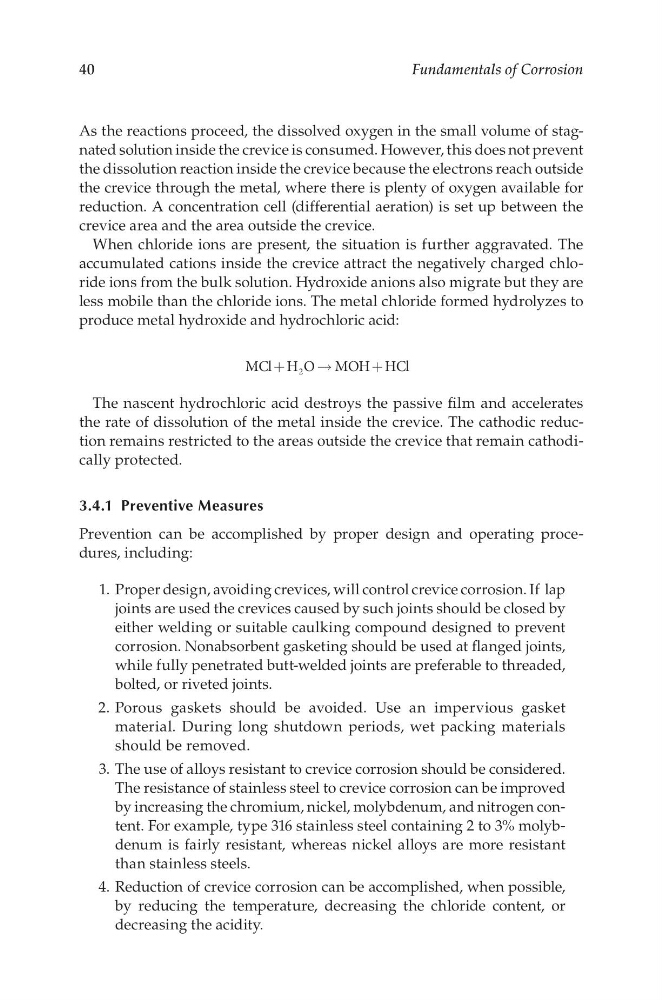
less mobile than the chloride ions. The metal chloride formed hydrolyzes to
produce metal hydroxide and hydrochloric acid:
MCl H O MOH HCl
2
+
→
+
The nascent hydrochloric acid destroys the passive film and accelerates
the rate of dissolution of the metal inside the crevice. The cathodic reduction remains restricted to the areas outside the crevice that remain cathodically protected.
3.4.1 Preventive Measures
Prevention can be accomplished by proper design and operating procedures, including:
1. Proper design, avoiding crevices, will control crevice corrosion. If lap
joints are used the crevices caused by such joints should be closed by
either welding or suitable caulking compound designed to prevent
corrosion. Nonabsorbent gasketing should be used at flanged joints,
while fully penetrated butt-welded joints are preferable to threaded,
bolted, or riveted joints.
2. Porous gaskets should be avoided. Use an impervious gasket
material. During long shutdown periods, wet packing materials
should be removed.
3. The use of alloys resistant to crevice corrosion should be considered.
The resistance of stainless steel to crevice corrosion can be improved
by increasing the chromium, nickel, molybdenum, and nitrogen content. For example, type 316 stainless steel containing 2 to 3% molybdenum is fairly resistant, whereas nickel alloys are more resistant
than stainless steels.
4. Reduction of crevice corrosion can be accomplished, when possible,
by reducing the temperature, decreasing the chloride content, or
decreasing the acidity.
Fundamentals of Corrosion
As the reactions proceed, the dissolved oxygen in the small volume of stagnated solution inside the crevice is consumed. However, this does not prevent
the dissolution reaction inside the crevice because the electrons reach outside
the crevice through the metal, where there is plenty of oxygen available for
reduction. A concentration cell (differential aeration) is set up between the
crevice area and the area outside the crevice.
When chloride ions are present, the situation is further aggravated. The
accumulated cations inside the crevice attract the negatively charged chloride ions from the bulk solution. Hydroxide anions also migrate but they are
less mobile than the chloride ions. The metal chloride formed hydrolyzes to
produce metal hydroxide and hydrochloric acid:
MCl H O MOH HCl
2
+
→
+
The nascent hydrochloric acid destroys the passive film and accelerates
the rate of dissolution of the metal inside the crevice. The cathodic reduction remains restricted to the areas outside the crevice that remain cathodically protected.
3.4.1 Preventive Measures
Prevention can be accomplished by proper design and operating procedures, including:
1. Proper design, avoiding crevices, will control crevice corrosion. If lap
joints are used the crevices caused by such joints should be closed by
either welding or suitable caulking compound designed to prevent
corrosion. Nonabsorbent gasketing should be used at flanged joints,
while fully penetrated butt-welded joints are preferable to threaded,
bolted, or riveted joints.
2. Porous gaskets should be avoided. Use an impervious gasket
material. During long shutdown periods, wet packing materials
should be removed.
3. The use of alloys resistant to crevice corrosion should be considered.
The resistance of stainless steel to crevice corrosion can be improved
by increasing the chromium, nickel, molybdenum, and nitrogen content. For example, type 316 stainless steel containing 2 to 3% molybdenum is fairly resistant, whereas nickel alloys are more resistant
than stainless steels.
4. Reduction of crevice corrosion can be accomplished, when possible,
by reducing the temperature, decreasing the chloride content, or
decreasing the acidity.