

Forms of Metallic Corrosion
39
deposits on a metal surface, gaskets, lap joints, or crevices under a bolt or around
rivet heads where small amounts of liquid can collect and become stagnant.
Crevice corrosion may take place on any metal and in any corrosive
environment. However, metals such as aluminum and stainless steels that
depend on their surface oxide film for corrosion resistance are particularly
prone to crevice corrosion, especially in environments such as seawater that
contains chloride ions.
The gap defining a crevice is usually large enough for the entrapment of a
liquid but too small to permit flow of liquid. The width is on the order of a
few thousandths of an inch, but not exceeding 3.18 mm.
The material responsible for forming the crevice need not be metallic.
Wood, plastic, rubber, glass, concrete, asbestos, wax, and living organisms
have all been reported to have caused crevice corrosion. After the attack
begins within the crevice, its progress is very rapid. It is frequently more
intense in chloride environments.
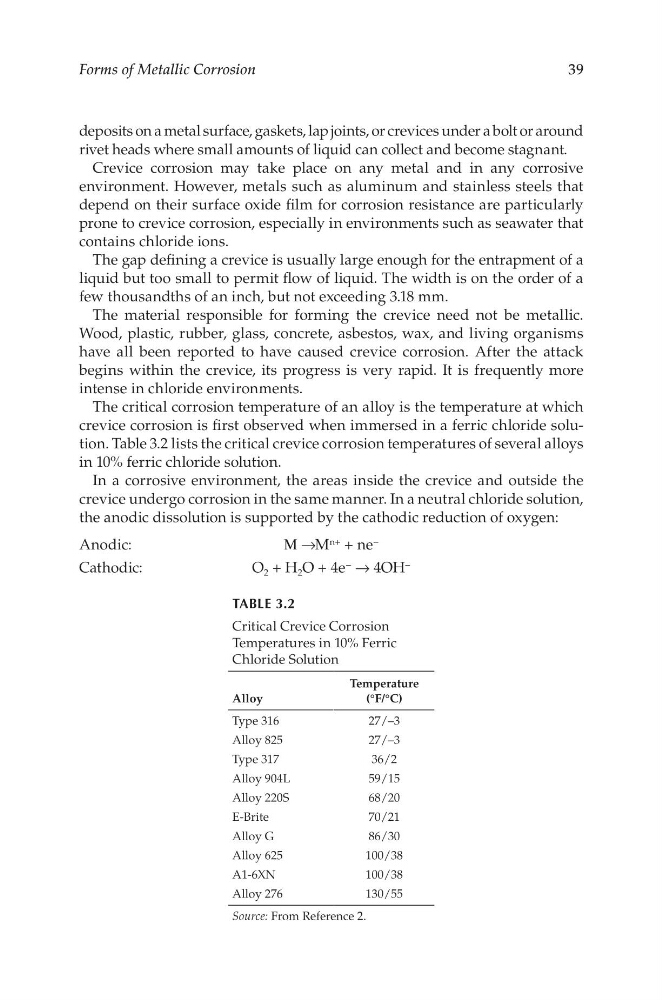
The critical corrosion temperature of an alloy is the temperature at which
crevice corrosion is first observed when immersed in a ferric chloride solution. Table 3.2 lists the critical crevice corrosion temperatures of several alloys
in 10% ferric chloride solution.
In a corrosive environment, the areas inside the crevice and outside the
crevice undergo corrosion in the same manner. In a neutral chloride solution,
the anodic dissolution is supported by the cathodic reduction of oxygen:
Anodic:
Μ →M n+ + ne −
Cathodic:
O 2 + H 2 O + 4e − → 4OH −
TabLE 3.2
Critical Crevice Corrosion
Temperatures in 10% Ferric
Chloride Solution
Alloy
Temperature
(°F/°C)
Type 316
27/–3
Alloy 825
27/–3
Type 317
36/2
Alloy 904L
59/15
Alloy 220S
68/20
E-Brite
70/21
Alloy G
86/30
Alloy 625
100/38
A1-6XN
100/38
Alloy 276
130/55
Source: From Reference 2.
39
deposits on a metal surface, gaskets, lap joints, or crevices under a bolt or around
rivet heads where small amounts of liquid can collect and become stagnant.
Crevice corrosion may take place on any metal and in any corrosive
environment. However, metals such as aluminum and stainless steels that
depend on their surface oxide film for corrosion resistance are particularly
prone to crevice corrosion, especially in environments such as seawater that
contains chloride ions.
The gap defining a crevice is usually large enough for the entrapment of a
liquid but too small to permit flow of liquid. The width is on the order of a
few thousandths of an inch, but not exceeding 3.18 mm.
The material responsible for forming the crevice need not be metallic.
Wood, plastic, rubber, glass, concrete, asbestos, wax, and living organisms
have all been reported to have caused crevice corrosion. After the attack
begins within the crevice, its progress is very rapid. It is frequently more
intense in chloride environments.
The critical corrosion temperature of an alloy is the temperature at which
crevice corrosion is first observed when immersed in a ferric chloride solution. Table 3.2 lists the critical crevice corrosion temperatures of several alloys
in 10% ferric chloride solution.
In a corrosive environment, the areas inside the crevice and outside the
crevice undergo corrosion in the same manner. In a neutral chloride solution,
the anodic dissolution is supported by the cathodic reduction of oxygen:
Anodic:
Μ →M n+ + ne −
Cathodic:
O 2 + H 2 O + 4e − → 4OH −
TabLE 3.2
Critical Crevice Corrosion
Temperatures in 10% Ferric
Chloride Solution
Alloy
Temperature
(°F/°C)
Type 316
27/–3
Alloy 825
27/–3
Type 317
36/2
Alloy 904L
59/15
Alloy 220S
68/20
E-Brite
70/21
Alloy G
86/30
Alloy 625
100/38
A1-6XN
100/38
Alloy 276
130/55
Source: From Reference 2.