

Corrosion Mechanisms
25
2.7 Corrosion Rate Measurement
Measurement of corrosion is essential for the purpose of material selection. The compatibility of a metal with its environment is a prime requirement for its reliable performance. Corrosion rate measurement may
become necessary for the evaluation and selection of materials for a specific environment, a given definite application, or for the evaluation of
a new or old metal or alloys to determine the environments in which
they are suitable. Often, the corrosive environment is treated to make it
less aggressive, and corrosion rate measurements of a specific material
in untreated environments will reflect the efficacy of the treatment. In
addition, corrosion rate measurement is also essential in the study of the
mechanisms of corrosion.
2.7.1 Corrosion rate Expressions
Corrosion involves dissolution of metal, as a result of which the metallic part loses its mass (or weight) and becomes thinner. Corrosion rate
expressions are therefore based on either weight loss or penetration into
the metal.
The most widely used weight expression, based on weight loss, is mg/
dm 2 /day (mdd) and the rate expression on penetration is inch penetration/
year (ipy) and mils penetration/year (mpy). One mil is one thousandth of
an inch. The last expression is very convenient because it does not involve a
decimal point or zeroes. Thus, 0.002 ipy is simply expressed as 2 mpy. The
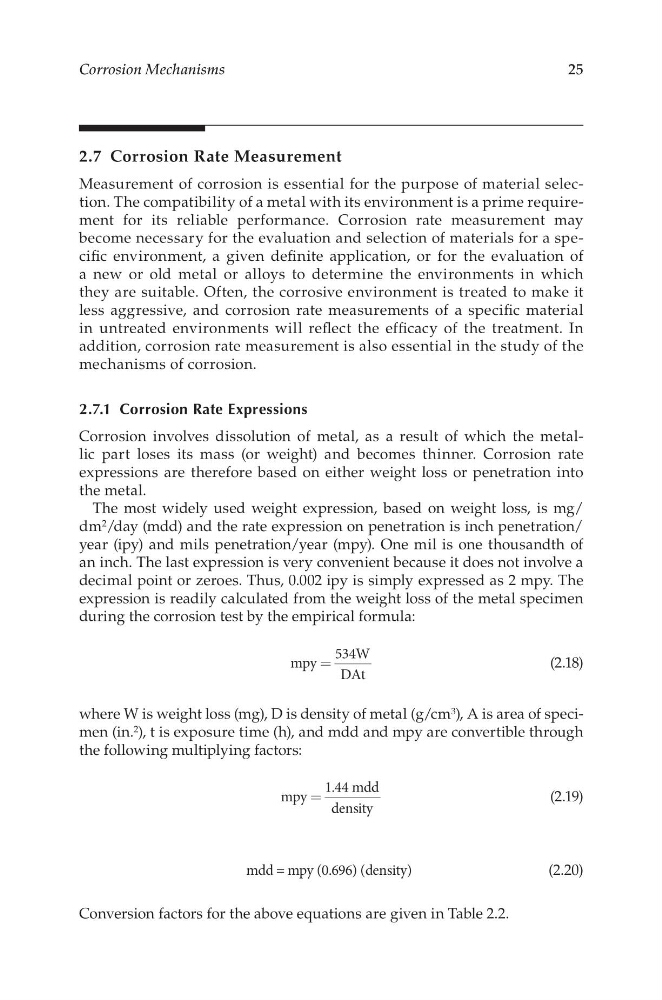
expression is readily calculated from the weight loss of the metal specimen
during the corrosion test by the empirical formula:
mpy
534W
DAt
=
(2.18)
where W is weight loss (mg), D is density of metal (g/cm 3 ), A is area of specimen (in. 2 ), t is exposure time (h), and mdd and mpy are convertible through
the following multiplying factors:
mpy
1.44 mdd
density
=
(2.19)
mdd = mpy (0.696) (density)
(2.20)
Conversion factors for the above equations are given in Table 2.2.
25
2.7 Corrosion Rate Measurement
Measurement of corrosion is essential for the purpose of material selection. The compatibility of a metal with its environment is a prime requirement for its reliable performance. Corrosion rate measurement may
become necessary for the evaluation and selection of materials for a specific environment, a given definite application, or for the evaluation of
a new or old metal or alloys to determine the environments in which
they are suitable. Often, the corrosive environment is treated to make it
less aggressive, and corrosion rate measurements of a specific material
in untreated environments will reflect the efficacy of the treatment. In
addition, corrosion rate measurement is also essential in the study of the
mechanisms of corrosion.
2.7.1 Corrosion rate Expressions
Corrosion involves dissolution of metal, as a result of which the metallic part loses its mass (or weight) and becomes thinner. Corrosion rate
expressions are therefore based on either weight loss or penetration into
the metal.
The most widely used weight expression, based on weight loss, is mg/
dm 2 /day (mdd) and the rate expression on penetration is inch penetration/
year (ipy) and mils penetration/year (mpy). One mil is one thousandth of
an inch. The last expression is very convenient because it does not involve a
decimal point or zeroes. Thus, 0.002 ipy is simply expressed as 2 mpy. The
expression is readily calculated from the weight loss of the metal specimen
during the corrosion test by the empirical formula:
mpy
534W
DAt
=
(2.18)
where W is weight loss (mg), D is density of metal (g/cm 3 ), A is area of specimen (in. 2 ), t is exposure time (h), and mdd and mpy are convertible through
the following multiplying factors:
mpy
1.44 mdd
density
=
(2.19)
mdd = mpy (0.696) (density)
(2.20)
Conversion factors for the above equations are given in Table 2.2.