

24
Fundamentals of Corrosion
The surface finish of the component also has an impact on the mode and
severity of the corrosion that can occur. Rough surfaces or tight crevices can
facilitate the formation of concentration cells. Surface cleanliness can also be
an issue, with deposits or films acting as initiation sites. Biological growths
can behave as deposits or change the underlying surface chemistry to promote corrosion.
Other variations within the metal surface on a microscopic level influence the corrosion process. Microstructural differences such as secondary
phases or grain orientation will affect the way corrosion manifests itself.
For corrosive environments where grain boundaries are attacked, the grain
size of the material plays a significant role in how rapidly the material’s
properties deteriorate. Chemistry variations in the matrix of weld deposits
are also a factor.
Radiation can have an effect on a material’s properties. The effect on metallic materials is very gradual and not very pronounced. Stresses, either residual or applied, impact the mode of corrosion and lower the energy needed
for corrosion to begin. Stress is a requirement for stress corrosion cracking
(which will be discussed later) or corrosion fatigue, but can also influence the
rate of general corrosion.
Finally, time is a factor in determining the severity of corrosion. Corrosion
rates are expressed using a time dimension. Some corrosion processes are
violent and rapid while most are so slow as to be imperceptable on a day-today basis. Equipment is planned to provide a useful service life. A chief goal
in understanding corrosion is the proper selection of materials, equipment,
processes, or controls to optimize our natural and financial resources.
Decreasing
concentration
polarization
Log i
V
FigurE 2.14
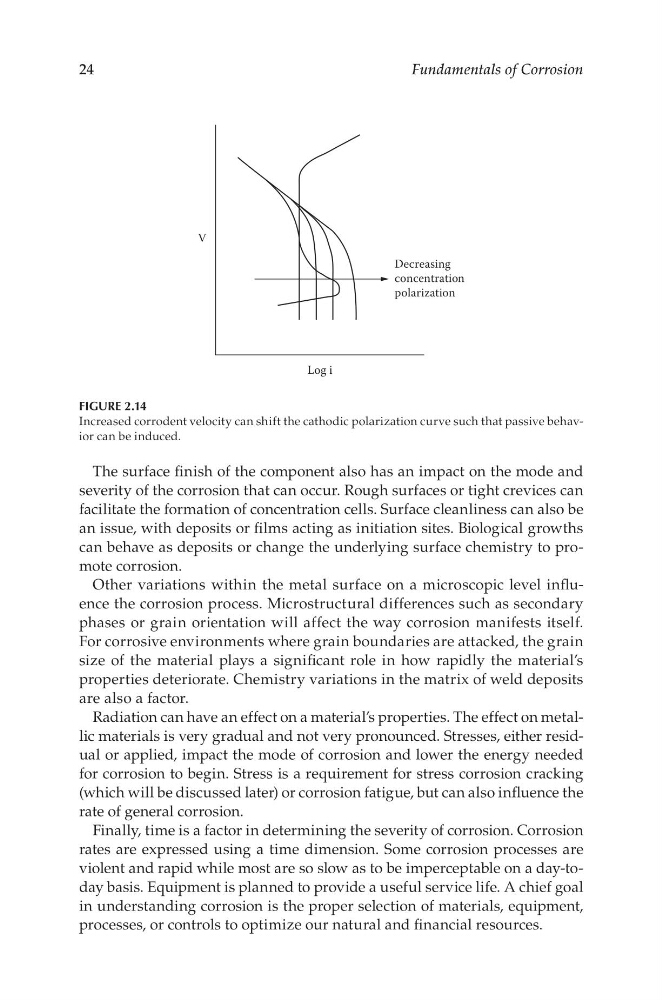
Increased corrodent velocity can shift the cathodic polarization curve such that passive behavior can be induced.
Fundamentals of Corrosion
The surface finish of the component also has an impact on the mode and
severity of the corrosion that can occur. Rough surfaces or tight crevices can
facilitate the formation of concentration cells. Surface cleanliness can also be
an issue, with deposits or films acting as initiation sites. Biological growths
can behave as deposits or change the underlying surface chemistry to promote corrosion.
Other variations within the metal surface on a microscopic level influence the corrosion process. Microstructural differences such as secondary
phases or grain orientation will affect the way corrosion manifests itself.
For corrosive environments where grain boundaries are attacked, the grain
size of the material plays a significant role in how rapidly the material’s
properties deteriorate. Chemistry variations in the matrix of weld deposits
are also a factor.
Radiation can have an effect on a material’s properties. The effect on metallic materials is very gradual and not very pronounced. Stresses, either residual or applied, impact the mode of corrosion and lower the energy needed
for corrosion to begin. Stress is a requirement for stress corrosion cracking
(which will be discussed later) or corrosion fatigue, but can also influence the
rate of general corrosion.
Finally, time is a factor in determining the severity of corrosion. Corrosion
rates are expressed using a time dimension. Some corrosion processes are
violent and rapid while most are so slow as to be imperceptable on a day-today basis. Equipment is planned to provide a useful service life. A chief goal
in understanding corrosion is the proper selection of materials, equipment,
processes, or controls to optimize our natural and financial resources.
Decreasing
concentration
polarization
Log i
V
FigurE 2.14
Increased corrodent velocity can shift the cathodic polarization curve such that passive behavior can be induced.