

22
Fundamentals of Corrosion
at point A there is a dramatic polarizing effect that drops the current to a
point where corrosion is essentially halted. As this potential is increased
further, there is little change in current flow until the next critical stage B,
where a breakdown of the passive film occurs and the current again begins
to rise.
Even with an established anodic polarization behavior, the performance of
a material can vary greatly with relatively minor changes in the corrodent.
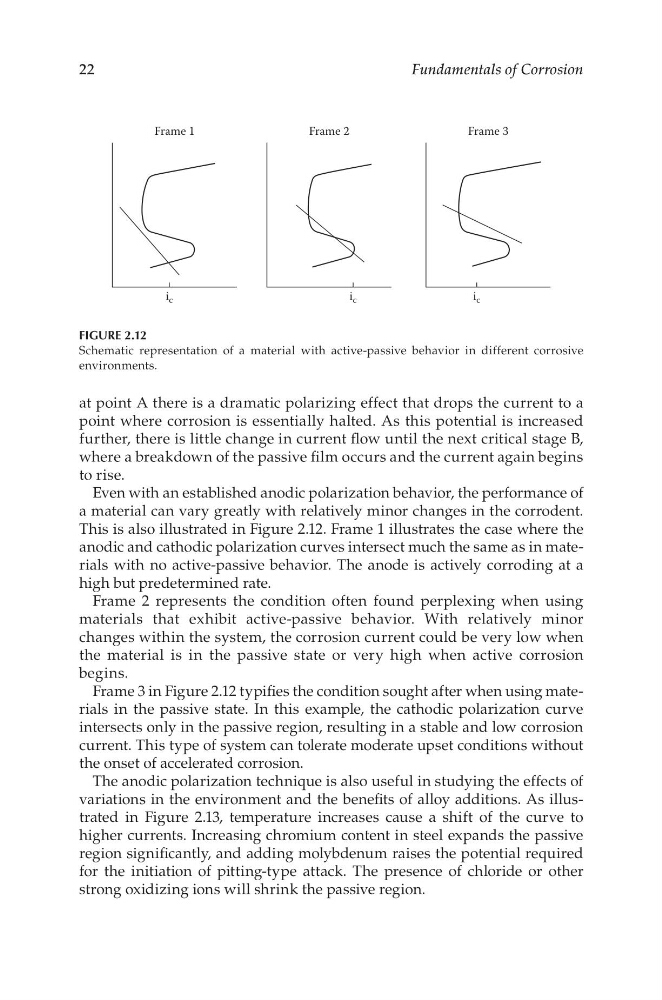
This is also illustrated in Figure 2.12. Frame 1 illustrates the case where the
anodic and cathodic polarization curves intersect much the same as in materials with no active-passive behavior. The anode is actively corroding at a
high but predetermined rate.
Frame 2 represents the condition often found perplexing when using
materials that exhibit active-passive behavior. With relatively minor
changes within the system, the corrosion current could be very low when
the material is in the passive state or very high when active corrosion
begins.
Frame 3 in Figure 2.12 typifies the condition sought after when using materials in the passive state. In this example, the cathodic polarization curve
intersects only in the passive region, resulting in a stable and low corrosion
current. This type of system can tolerate moderate upset conditions without
the onset of accelerated corrosion.
The anodic polarization technique is also useful in studying the effects of
variations in the environment and the benefits of alloy additions. As illustrated in Figure 2.13, temperature increases cause a shift of the curve to
higher currents. Increasing chromium content in steel expands the passive
region significantly, and adding molybdenum raises the potential required
for the initiation of pitting-type attack. The presence of chloride or other
strong oxidizing ions will shrink the passive region.
Frame 3
Frame 2
i c
i c
i c
Frame 1
FigurE 2.12
Schematic representation of a material with active-passive behavior in different corrosive
environments.
Fundamentals of Corrosion
at point A there is a dramatic polarizing effect that drops the current to a
point where corrosion is essentially halted. As this potential is increased
further, there is little change in current flow until the next critical stage B,
where a breakdown of the passive film occurs and the current again begins
to rise.
Even with an established anodic polarization behavior, the performance of
a material can vary greatly with relatively minor changes in the corrodent.
This is also illustrated in Figure 2.12. Frame 1 illustrates the case where the
anodic and cathodic polarization curves intersect much the same as in materials with no active-passive behavior. The anode is actively corroding at a
high but predetermined rate.
Frame 2 represents the condition often found perplexing when using
materials that exhibit active-passive behavior. With relatively minor
changes within the system, the corrosion current could be very low when
the material is in the passive state or very high when active corrosion
begins.
Frame 3 in Figure 2.12 typifies the condition sought after when using materials in the passive state. In this example, the cathodic polarization curve
intersects only in the passive region, resulting in a stable and low corrosion
current. This type of system can tolerate moderate upset conditions without
the onset of accelerated corrosion.
The anodic polarization technique is also useful in studying the effects of
variations in the environment and the benefits of alloy additions. As illustrated in Figure 2.13, temperature increases cause a shift of the curve to
higher currents. Increasing chromium content in steel expands the passive
region significantly, and adding molybdenum raises the potential required
for the initiation of pitting-type attack. The presence of chloride or other
strong oxidizing ions will shrink the passive region.
Frame 3
Frame 2
i c
i c
i c
Frame 1
FigurE 2.12
Schematic representation of a material with active-passive behavior in different corrosive
environments.