

Corrosion Mechanisms
21
materials can exhibit both a highly corrosion-resistant behavior and that of
a material that corrodes actively, while in the same corrodent. Metals that
commonly exhibit this type of behavior include iron, titanium, aluminum,
chromium, and nickel. Alloys of these materials are also subject to this type
of behavior.
Active-passive behavior depends on the material–corrodent combination
and is a function of the anodic or cathodic polarization effects that occur in
that specific combination. In most situations where active-passive behavior
occurs, there is a thin layer at the metal surface that is more resistant to the
media than the underlying metal. In stainless steels, this layer is composed
of various chromium and/or nickel oxides that exhibit substantially different electrochemical characteristics than the underlying alloy. If this resistant,
or passive layer is damaged while in aggressive media, active corrosion of
the freshly exposed surface will occur. The damage to this layer can be either
mechanical or electrochemical in nature.
The behavior of iron in nitric acid underscores the importance of recognizing the nature of passivity. Iron is resistant to corrosion in nitric acid at
concentrations around 70%. Once passivated under these conditions, it can
also exhibit low rates of corrosion as the nitric acid is diluted. However, if this
passive film is disturbed, rapid corrosion will begin and repassivation will not
be possible until the nitric acid concentration is raised to a sufficient level.
2.5.1 anodic Polarization
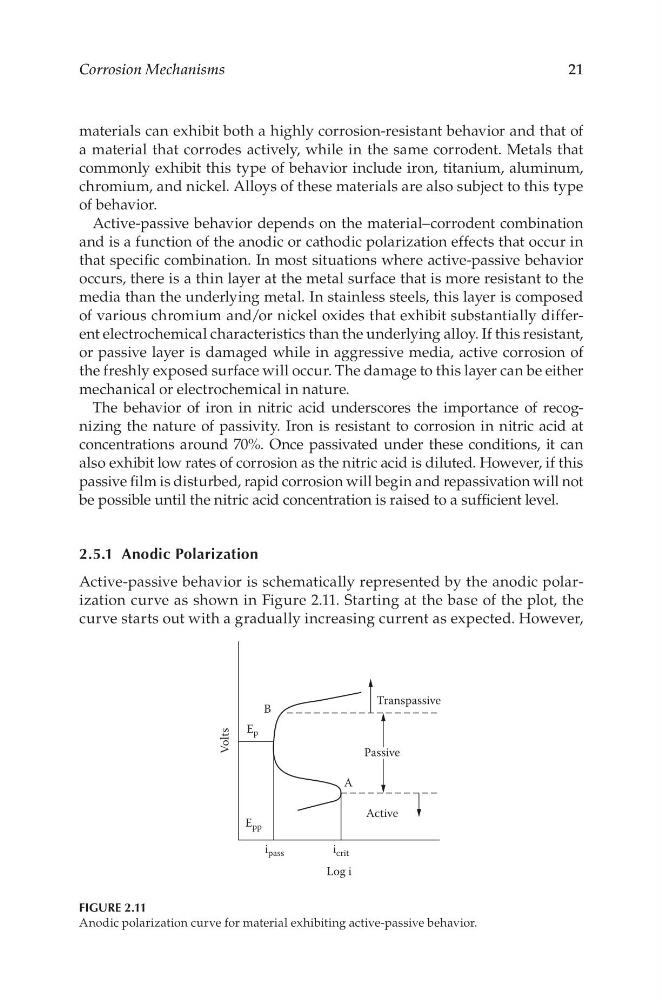
Active-passive behavior is schematically represented by the anodic polarization curve as shown in Figure 2.11. Starting at the base of the plot, the
curve starts out with a gradually increasing current as expected. However,
Transpassive
Passive
Active
i crit
Log i
i pass
E pp
E p
B
Volts
A
FigurE 2.11
Anodic polarization curve for material exhibiting active-passive behavior.
21
materials can exhibit both a highly corrosion-resistant behavior and that of
a material that corrodes actively, while in the same corrodent. Metals that
commonly exhibit this type of behavior include iron, titanium, aluminum,
chromium, and nickel. Alloys of these materials are also subject to this type
of behavior.
Active-passive behavior depends on the material–corrodent combination
and is a function of the anodic or cathodic polarization effects that occur in
that specific combination. In most situations where active-passive behavior
occurs, there is a thin layer at the metal surface that is more resistant to the
media than the underlying metal. In stainless steels, this layer is composed
of various chromium and/or nickel oxides that exhibit substantially different electrochemical characteristics than the underlying alloy. If this resistant,
or passive layer is damaged while in aggressive media, active corrosion of
the freshly exposed surface will occur. The damage to this layer can be either
mechanical or electrochemical in nature.
The behavior of iron in nitric acid underscores the importance of recognizing the nature of passivity. Iron is resistant to corrosion in nitric acid at
concentrations around 70%. Once passivated under these conditions, it can
also exhibit low rates of corrosion as the nitric acid is diluted. However, if this
passive film is disturbed, rapid corrosion will begin and repassivation will not
be possible until the nitric acid concentration is raised to a sufficient level.
2.5.1 anodic Polarization
Active-passive behavior is schematically represented by the anodic polarization curve as shown in Figure 2.11. Starting at the base of the plot, the
curve starts out with a gradually increasing current as expected. However,
Transpassive
Passive
Active
i crit
Log i
i pass
E pp
E p
B
Volts
A
FigurE 2.11
Anodic polarization curve for material exhibiting active-passive behavior.