

18
Fundamentals of Corrosion
where i l is called the limiting diffusion current density (amp/cm 2 ), D is the
diffusion coefficient for Η + ion, n is the number of electrons transferred, F is
the Faraday number, C is the bulk concentration of Η + ions in the solution,
and x is the thickness of the diffusion layer adjacent to the electrode surface
through which the concentration of the reacting species (H + ions) changes
from C in the bulk to zero at the electrode surface.
A mathematical expression for concentration polarization involves i l and
is given by:
η c
l
RT
F
i
i
=
−
2 3
1
.
log
(2.17)
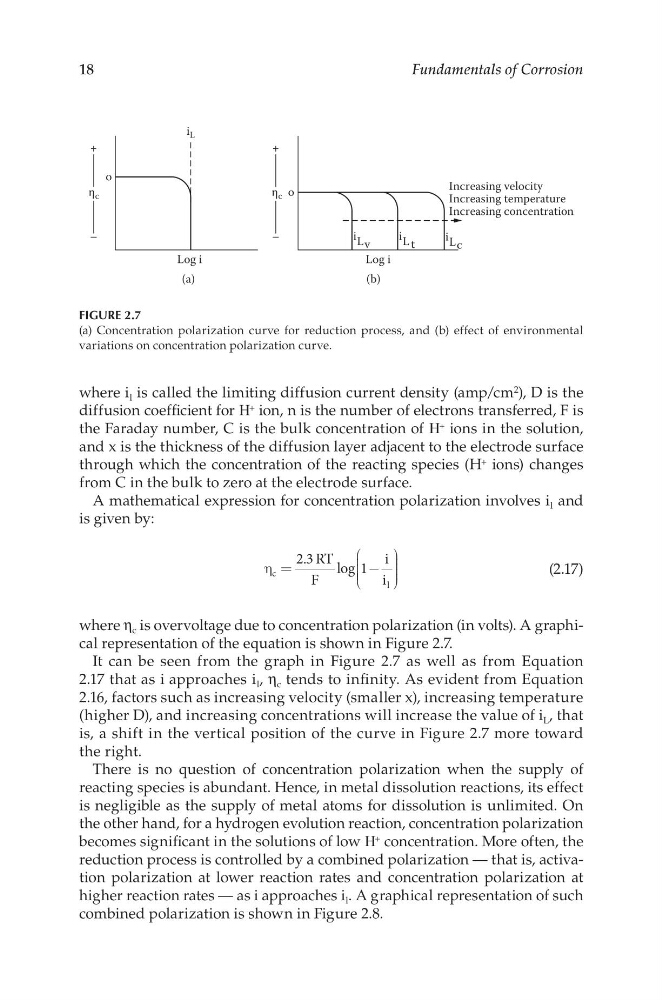
where η c is overvoltage due to concentration polarization (in volts). A graphical representation of the equation is shown in Figure 2.7.
It can be seen from the graph in Figure 2.7 as well as from Equation
2.17 that as i approaches i l , η c tends to infinity. As evident from Equation
2.16, factors such as increasing velocity (smaller x), increasing temperature
(higher D), and increasing concentrations will increase the value of i L , that
is, a shift in the vertical position of the curve in Figure 2.7 more toward
the right.
There is no question of concentration polarization when the supply of
reacting species is abundant. Hence, in metal dissolution reactions, its effect
is negligible as the supply of metal atoms for dissolution is unlimited. On
the other hand, for a hydrogen evolution reaction, concentration polarization
becomes significant in the solutions of low Η + concentration. More often, the
reduction process is controlled by a combined polarization — that is, activation polarization at lower reaction rates and concentration polarization at
higher reaction rates — as i approaches i l . A graphical representation of such
combined polarization is shown in Figure 2.8.
Increasing velocity
Increasing temperature
Increasing concentration
Log i
Log i
(b)
(a)
i L t
i L c
i
i L
L
o
o
η c
+
–
v
η c
+
–
FigurE 2.7
(a) Concentration polarization curve for reduction process, and (b) effect of environmental
variations on concentration polarization curve.
Fundamentals of Corrosion
where i l is called the limiting diffusion current density (amp/cm 2 ), D is the
diffusion coefficient for Η + ion, n is the number of electrons transferred, F is
the Faraday number, C is the bulk concentration of Η + ions in the solution,
and x is the thickness of the diffusion layer adjacent to the electrode surface
through which the concentration of the reacting species (H + ions) changes
from C in the bulk to zero at the electrode surface.
A mathematical expression for concentration polarization involves i l and
is given by:
η c
l
RT
F
i
i
=
−
2 3
1
.
log
(2.17)
where η c is overvoltage due to concentration polarization (in volts). A graphical representation of the equation is shown in Figure 2.7.
It can be seen from the graph in Figure 2.7 as well as from Equation
2.17 that as i approaches i l , η c tends to infinity. As evident from Equation
2.16, factors such as increasing velocity (smaller x), increasing temperature
(higher D), and increasing concentrations will increase the value of i L , that
is, a shift in the vertical position of the curve in Figure 2.7 more toward
the right.
There is no question of concentration polarization when the supply of
reacting species is abundant. Hence, in metal dissolution reactions, its effect
is negligible as the supply of metal atoms for dissolution is unlimited. On
the other hand, for a hydrogen evolution reaction, concentration polarization
becomes significant in the solutions of low Η + concentration. More often, the
reduction process is controlled by a combined polarization — that is, activation polarization at lower reaction rates and concentration polarization at
higher reaction rates — as i approaches i l . A graphical representation of such
combined polarization is shown in Figure 2.8.
Increasing velocity
Increasing temperature
Increasing concentration
Log i
Log i
(b)
(a)
i L t
i L c
i
i L
L
o
o
η c
+
–
v
η c
+
–
FigurE 2.7
(a) Concentration polarization curve for reduction process, and (b) effect of environmental
variations on concentration polarization curve.