

The Equipment Design Process
367
Low dosages (about 2 to 4 mg/L) of glassy phosphates, such as sodium
hexametaphosphate, have long been used to solve red-water problems. In
such cases, the addition of glassy phosphates makes the color, and the water
appears clear because the iron is tied up as a complex ion. The corrosive
symptoms are removed but the corrosion rates are not reduced. Controlling
actual metal loss requires dosages up to 10 times higher (20 to 40 mg/L)
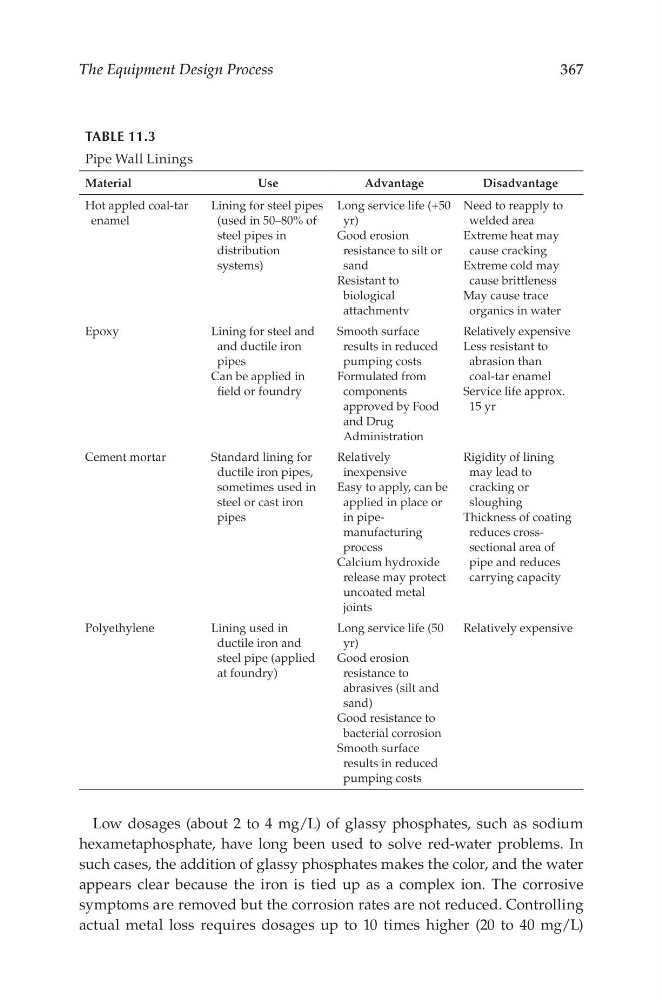
TabLE 11.3
Pipe Wall Linings
Material
Use
Advantage
Disadvantage
Hot appled coal-tar
enamel
Lining for steel pipes
(used in 50–80% of
steel pipes in
distribution
systems)
Long service life (+50
yr)
Good erosion
resistance to silt or
sand
Resistant to
biological
attachmentv
Need to reapply to
welded area
Extreme heat may
cause cracking
Extreme cold may
cause brittleness
May cause trace
organics in water
Epoxy
Lining for steel and
and ductile iron
pipes
Can be applied in
field or foundry
Smooth surface
results in reduced
pumping costs
Formulated from
components
approved by Food
and Drug
Administration
Relatively expensive
Less resistant to
abrasion than
coal-tar enamel
Service life approx.
15 yr
Cement mortar
Standard lining for
ductile iron pipes,
sometimes used in
steel or cast iron
pipes
Relatively
inexpensive
Easy to apply, can be
applied in place or
in pipemanufacturing
process
Calcium hydroxide
release may protect
uncoated metal
joints
Rigidity of lining
may lead to
cracking or
sloughing
Thickness of coating
reduces crosssectional area of
pipe and reduces
carrying capacity
Polyethylene
Lining used in
ductile iron and
steel pipe (applied
at foundry)
Long service life (50
yr)
Good erosion
resistance to
abrasives (silt and
sand)
Good resistance to
bacterial corrosion
Smooth surface
results in reduced
pumping costs
Relatively expensive
367
Low dosages (about 2 to 4 mg/L) of glassy phosphates, such as sodium
hexametaphosphate, have long been used to solve red-water problems. In
such cases, the addition of glassy phosphates makes the color, and the water
appears clear because the iron is tied up as a complex ion. The corrosive
symptoms are removed but the corrosion rates are not reduced. Controlling
actual metal loss requires dosages up to 10 times higher (20 to 40 mg/L)
TabLE 11.3
Pipe Wall Linings
Material
Use
Advantage
Disadvantage
Hot appled coal-tar
enamel
Lining for steel pipes
(used in 50–80% of
steel pipes in
distribution
systems)
Long service life (+50
yr)
Good erosion
resistance to silt or
sand
Resistant to
biological
attachmentv
Need to reapply to
welded area
Extreme heat may
cause cracking
Extreme cold may
cause brittleness
May cause trace
organics in water
Epoxy
Lining for steel and
and ductile iron
pipes
Can be applied in
field or foundry
Smooth surface
results in reduced
pumping costs
Formulated from
components
approved by Food
and Drug
Administration
Relatively expensive
Less resistant to
abrasion than
coal-tar enamel
Service life approx.
15 yr
Cement mortar
Standard lining for
ductile iron pipes,
sometimes used in
steel or cast iron
pipes
Relatively
inexpensive
Easy to apply, can be
applied in place or
in pipemanufacturing
process
Calcium hydroxide
release may protect
uncoated metal
joints
Rigidity of lining
may lead to
cracking or
sloughing
Thickness of coating
reduces crosssectional area of
pipe and reduces
carrying capacity
Polyethylene
Lining used in
ductile iron and
steel pipe (applied
at foundry)
Long service life (50
yr)
Good erosion
resistance to
abrasives (silt and
sand)
Good resistance to
bacterial corrosion
Smooth surface
results in reduced
pumping costs
Relatively expensive