

Corrosion Inhibitors
323
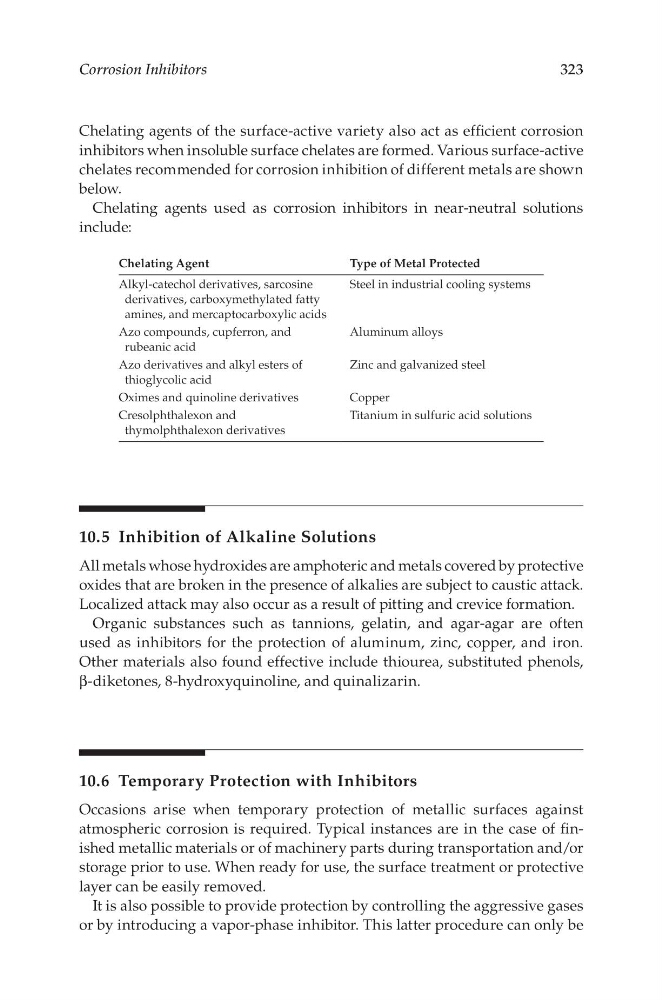
Chelating agents of the surface-active variety also act as efficient corrosion
inhibitors when insoluble surface chelates are formed. Various surface-active
chelates recommended for corrosion inhibition of different metals are shown
below.
Chelating agents used as corrosion inhibitors in near-neutral solutions
include:
Chelating Agent
Type of Metal Protected
Alkyl-catechol derivatives, sarcosine
derivatives, carboxymethylated fatty
amines, and mercaptocarboxylic acids
Steel in industrial cooling systems
Azo compounds, cupferron, and
rubeanic acid
Aluminum alloys
Azo derivatives and alkyl esters of
thioglycolic acid
Zinc and galvanized steel
Oximes and quinoline derivatives
Copper
Cresolphthalexon and
thymolphthalexon derivatives
Titanium in sulfuric acid solutions
10.5 Inhibition of Alkaline Solutions
All metals whose hydroxides are amphoteric and metals covered by protective
oxides that are broken in the presence of alkalies are subject to caustic attack.
Localized attack may also occur as a result of pitting and crevice formation.
Organic substances such as tannions, gelatin, and agar-agar are often
used as inhibitors for the protection of aluminum, zinc, copper, and iron.
Other materials also found effective include thiourea, substituted phenols,
β-diketones, 8-hydroxyquinoline, and quinalizarin.
10.6 Temporary Protection with Inhibitors
Occasions arise when temporary protection of metallic surfaces against
atmospheric corrosion is required. Typical instances are in the case of finished metallic materials or of machinery parts during transportation and/or
storage prior to use. When ready for use, the surface treatment or protective
layer can be easily removed.
It is also possible to provide protection by controlling the aggressive gases
or by introducing a vapor-phase inhibitor. This latter procedure can only be
323
Chelating agents of the surface-active variety also act as efficient corrosion
inhibitors when insoluble surface chelates are formed. Various surface-active
chelates recommended for corrosion inhibition of different metals are shown
below.
Chelating agents used as corrosion inhibitors in near-neutral solutions
include:
Chelating Agent
Type of Metal Protected
Alkyl-catechol derivatives, sarcosine
derivatives, carboxymethylated fatty
amines, and mercaptocarboxylic acids
Steel in industrial cooling systems
Azo compounds, cupferron, and
rubeanic acid
Aluminum alloys
Azo derivatives and alkyl esters of
thioglycolic acid
Zinc and galvanized steel
Oximes and quinoline derivatives
Copper
Cresolphthalexon and
thymolphthalexon derivatives
Titanium in sulfuric acid solutions
10.5 Inhibition of Alkaline Solutions
All metals whose hydroxides are amphoteric and metals covered by protective
oxides that are broken in the presence of alkalies are subject to caustic attack.
Localized attack may also occur as a result of pitting and crevice formation.
Organic substances such as tannions, gelatin, and agar-agar are often
used as inhibitors for the protection of aluminum, zinc, copper, and iron.
Other materials also found effective include thiourea, substituted phenols,
β-diketones, 8-hydroxyquinoline, and quinalizarin.
10.6 Temporary Protection with Inhibitors
Occasions arise when temporary protection of metallic surfaces against
atmospheric corrosion is required. Typical instances are in the case of finished metallic materials or of machinery parts during transportation and/or
storage prior to use. When ready for use, the surface treatment or protective
layer can be easily removed.
It is also possible to provide protection by controlling the aggressive gases
or by introducing a vapor-phase inhibitor. This latter procedure can only be