

322
Fundamentals of Corrosion
In most neutral solutions, the corrosion process of metals results in the
formation of sparingly soluble products, such as oxides, hydroxides, or salts.
The cathodic partial reaction is oxygen reduction.
Inorganic or organic compounds as well as chelating agents are used as
inhibitors in near-neutral aqueous solutions. Inorganic inhibitors can be
classified according to their mechanisms of action:
1. Formation and maintenance of protective films can be accomplished
by the addition of inorganic anions such as polyphosphates, phosphates, silicates, and borates.
2. Oxidizing inhibitors, such as chromates and nitrites, cause self-passivation of the metallic material. It is essential that the concentration
of these inhibitors be maintained above a “safe” level. If not, severe
corrosion can occur as a result of pitting or localized attack caused
by an oxidizer.
3. Precipitation of carbonates on the metal surfaces forming a protective film. This usually occurs because of the presence of Ca 2+ and
Mg 2+ ions usually present in industrial waters.
4. Modification of protective film properties is accomplished by the
addition of Ni 2+ , Co 2+ , Zn 2+ , or Fe 2+ .
The sodium salts of organic acids such as benzoate, salicylate, cinnamate,
tartrate, and azelate can be used as alternatives to the inorganic inhibitors,
particularly in ferrous solutions. When using these particular compounds
in solutions containing certain ions such as chlorides or sulfates, the inhibitor concentration necessary for effective protection will depend on the
concentration of the aggressive anions. Therefore, the critical pH value for
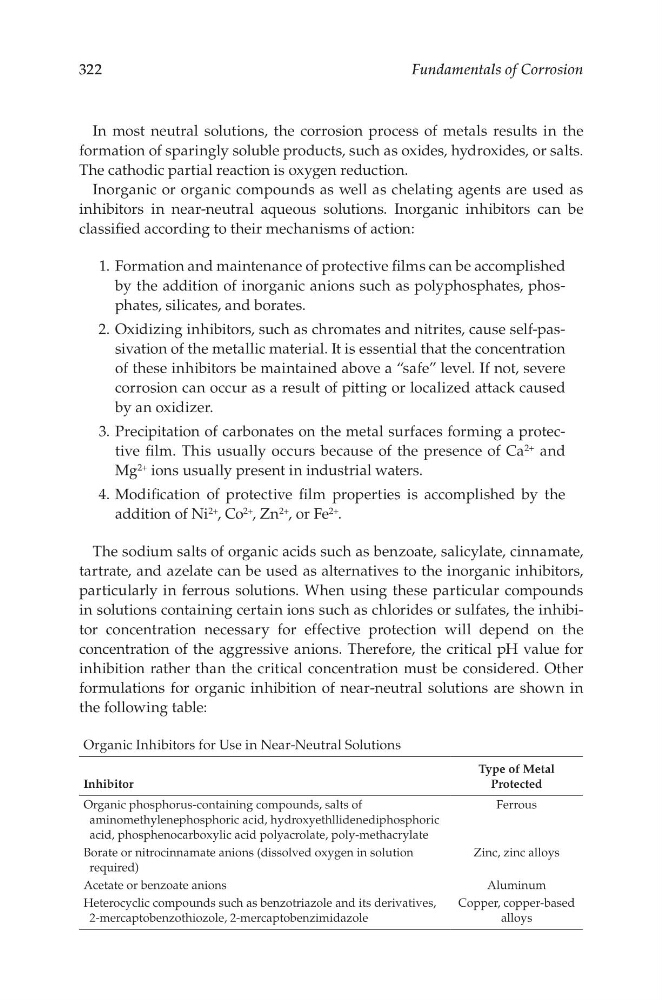
inhibition rather than the critical concentration must be considered. Other
formulations for organic inhibition of near-neutral solutions are shown in
the following table:
Organic Inhibitors for Use in Near-Neutral Solutions
Inhibitor
Type of Metal
Protected
Organic phosphorus-containing compounds, salts of
aminomethylenephosphoric acid, hydroxyethllidenediphosphoric
acid, phosphenocarboxylic acid polyacrolate, poly-methacrylate
Ferrous
Borate or nitrocinnamate anions (dissolved oxygen in solution
required)
Zinc, zinc alloys
Acetate or benzoate anions
Aluminum
Heterocyclic compounds such as benzotriazole and its derivatives,
2-mercaptobenzothiozole, 2-mercaptobenzimidazole
Copper, copper-based
alloys
Fundamentals of Corrosion
In most neutral solutions, the corrosion process of metals results in the
formation of sparingly soluble products, such as oxides, hydroxides, or salts.
The cathodic partial reaction is oxygen reduction.
Inorganic or organic compounds as well as chelating agents are used as
inhibitors in near-neutral aqueous solutions. Inorganic inhibitors can be
classified according to their mechanisms of action:
1. Formation and maintenance of protective films can be accomplished
by the addition of inorganic anions such as polyphosphates, phosphates, silicates, and borates.
2. Oxidizing inhibitors, such as chromates and nitrites, cause self-passivation of the metallic material. It is essential that the concentration
of these inhibitors be maintained above a “safe” level. If not, severe
corrosion can occur as a result of pitting or localized attack caused
by an oxidizer.
3. Precipitation of carbonates on the metal surfaces forming a protective film. This usually occurs because of the presence of Ca 2+ and
Mg 2+ ions usually present in industrial waters.
4. Modification of protective film properties is accomplished by the
addition of Ni 2+ , Co 2+ , Zn 2+ , or Fe 2+ .
The sodium salts of organic acids such as benzoate, salicylate, cinnamate,
tartrate, and azelate can be used as alternatives to the inorganic inhibitors,
particularly in ferrous solutions. When using these particular compounds
in solutions containing certain ions such as chlorides or sulfates, the inhibitor concentration necessary for effective protection will depend on the
concentration of the aggressive anions. Therefore, the critical pH value for
inhibition rather than the critical concentration must be considered. Other
formulations for organic inhibition of near-neutral solutions are shown in
the following table:
Organic Inhibitors for Use in Near-Neutral Solutions
Inhibitor
Type of Metal
Protected
Organic phosphorus-containing compounds, salts of
aminomethylenephosphoric acid, hydroxyethllidenediphosphoric
acid, phosphenocarboxylic acid polyacrolate, poly-methacrylate
Ferrous
Borate or nitrocinnamate anions (dissolved oxygen in solution
required)
Zinc, zinc alloys
Acetate or benzoate anions
Aluminum
Heterocyclic compounds such as benzotriazole and its derivatives,
2-mercaptobenzothiozole, 2-mercaptobenzimidazole
Copper, copper-based
alloys