

312
Fundamentals of Corrosion
from measurements 12–14 of residual radioactivity of a washed iron surface
after exposure to a chromate solution containing Cr 51. The following reaction applies, assuming, as measurements appear to substantiate, 15 that all
reduced chromate (or dichromate) remains on the metal surface as adsorbed
Cr 13 or as hydrated Cr 2 O 3 :
Cr O +8H +Fe surface 2Cr +4H O+O O(adsorb
2 7
–2
+
3 +
2
2
→
e ed onFe)
E =0.79 volt
0
Residual radioactivity accounts for 3 × 10 16 Cr atoms/cm 2 (1.5 × 10 −7 equivalents or 0.515 coloumb passive film substance/cm 2 ). The above equation
assumes an adsorbed passive film structure, but the same reasoning applies
whatever the structure.
Reduction of the passivator continues at a low rate after passivity is achieved
in the absence of dissolved oxygen to the value of i passive slowly forming iron
oxide and reduction products of chromate. From the observed corrosion rates
–0.5
0
0.5
1.0
H (volts)
1.5
Above critical concentration
Below critical
concentration
Log i
2.0
2.5
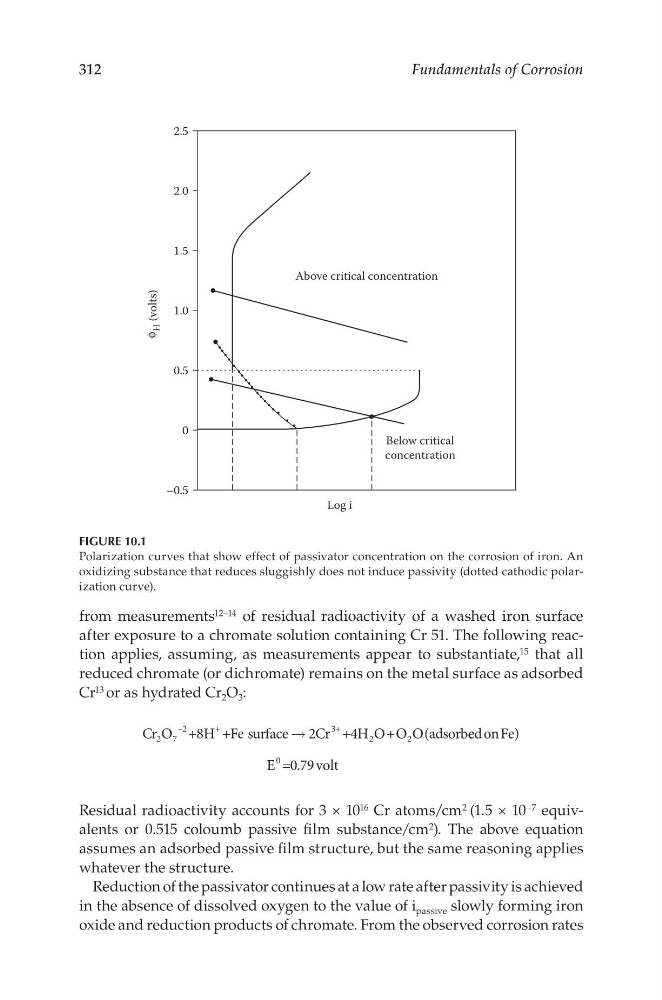
FigurE 10.1
Polarization curves that show effect of passivator concentration on the corrosion of iron. An
oxidizing substance that reduces sluggishly does not induce passivity (dotted cathodic polarization curve).
Fundamentals of Corrosion
from measurements 12–14 of residual radioactivity of a washed iron surface
after exposure to a chromate solution containing Cr 51. The following reaction applies, assuming, as measurements appear to substantiate, 15 that all
reduced chromate (or dichromate) remains on the metal surface as adsorbed
Cr 13 or as hydrated Cr 2 O 3 :
Cr O +8H +Fe surface 2Cr +4H O+O O(adsorb
2 7
–2
+
3 +
2
2
→
e ed onFe)
E =0.79 volt
0
Residual radioactivity accounts for 3 × 10 16 Cr atoms/cm 2 (1.5 × 10 −7 equivalents or 0.515 coloumb passive film substance/cm 2 ). The above equation
assumes an adsorbed passive film structure, but the same reasoning applies
whatever the structure.
Reduction of the passivator continues at a low rate after passivity is achieved
in the absence of dissolved oxygen to the value of i passive slowly forming iron
oxide and reduction products of chromate. From the observed corrosion rates
–0.5
0
0.5
1.0
H (volts)
1.5
Above critical concentration
Below critical
concentration
Log i
2.0
2.5
FigurE 10.1
Polarization curves that show effect of passivator concentration on the corrosion of iron. An
oxidizing substance that reduces sluggishly does not induce passivity (dotted cathodic polarization curve).