

Corrosion Inhibitors
311
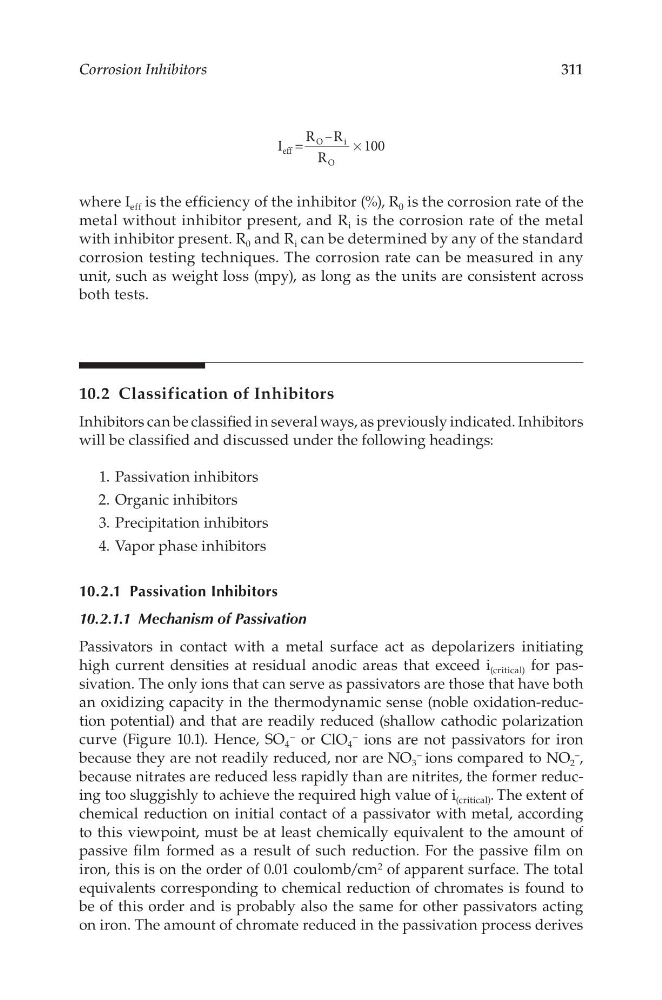
I =
R –R
R
100
eff
O
i
O
×
where I eff is the efficiency of the inhibitor (%), R 0 is the corrosion rate of the
metal without inhibitor present, and R i is the corrosion rate of the metal
with inhibitor present. R 0 and R i can be determined by any of the standard
corrosion testing techniques. The corrosion rate can be measured in any
unit, such as weight loss (mpy), as long as the units are consistent across
both tests.
10.2 Classification of Inhibitors
Inhibitors can be classified in several ways, as previously indicated. Inhibitors
will be classified and discussed under the following headings:
1. Passivation inhibitors
2. Organic inhibitors
3. Precipitation inhibitors
4. Vapor phase inhibitors
10.2.1 Passivation inhibitors
10.2.1.1 Mechanism of Passivation
Passivators in contact with a metal surface act as depolarizers initiating
high current densities at residual anodic areas that exceed i (critical) for passivation. The only ions that can serve as passivators are those that have both
an oxidizing capacity in the thermodynamic sense (noble oxidation-reduction potential) and that are readily reduced (shallow cathodic polarization
curve (Figure 10.1). Hence, SO 4
− or ClO 4
− ions are not passivators for iron
because they are not readily reduced, nor are NO 3
− ions compared to NO 2
− ,
because nitrates are reduced less rapidly than are nitrites, the former reducing too sluggishly to achieve the required high value of i (critical) . The extent of
chemical reduction on initial contact of a passivator with metal, according
to this viewpoint, must be at least chemically equivalent to the amount of
passive film formed as a result of such reduction. For the passive film on
iron, this is on the order of 0.01 coulomb/cm 2 of apparent surface. The total
equivalents corresponding to chemical reduction of chromates is found to
be of this order and is probably also the same for other passivators acting
on iron. The amount of chromate reduced in the passivation process derives
311
I =
R –R
R
100
eff
O
i
O
×
where I eff is the efficiency of the inhibitor (%), R 0 is the corrosion rate of the
metal without inhibitor present, and R i is the corrosion rate of the metal
with inhibitor present. R 0 and R i can be determined by any of the standard
corrosion testing techniques. The corrosion rate can be measured in any
unit, such as weight loss (mpy), as long as the units are consistent across
both tests.
10.2 Classification of Inhibitors
Inhibitors can be classified in several ways, as previously indicated. Inhibitors
will be classified and discussed under the following headings:
1. Passivation inhibitors
2. Organic inhibitors
3. Precipitation inhibitors
4. Vapor phase inhibitors
10.2.1 Passivation inhibitors
10.2.1.1 Mechanism of Passivation
Passivators in contact with a metal surface act as depolarizers initiating
high current densities at residual anodic areas that exceed i (critical) for passivation. The only ions that can serve as passivators are those that have both
an oxidizing capacity in the thermodynamic sense (noble oxidation-reduction potential) and that are readily reduced (shallow cathodic polarization
curve (Figure 10.1). Hence, SO 4
− or ClO 4
− ions are not passivators for iron
because they are not readily reduced, nor are NO 3
− ions compared to NO 2
− ,
because nitrates are reduced less rapidly than are nitrites, the former reducing too sluggishly to achieve the required high value of i (critical) . The extent of
chemical reduction on initial contact of a passivator with metal, according
to this viewpoint, must be at least chemically equivalent to the amount of
passive film formed as a result of such reduction. For the passive film on
iron, this is on the order of 0.01 coulomb/cm 2 of apparent surface. The total
equivalents corresponding to chemical reduction of chromates is found to
be of this order and is probably also the same for other passivators acting
on iron. The amount of chromate reduced in the passivation process derives