

300
Fundamentals of Corrosion
There are thousands of miles of buried pipelines and cables that are protected
in this manner. This form of protection is also used for the protection of water
tanks, submarines, canal gates, marine piping, condensers, and chemical
equipment.
9.2.1 Sacrificial anodes
It is possible, by the selection of an anode constructed of a metal more active
in the galvanic series than the metal to be protected, to eliminate the need for
an external DC current. A galvanic cell will be established with the current
direction exactly as described using an impressed electric current. These
sacrificial anodes are usually composed of magnesium or magnesium-based
alloys. Occasionally, zinc or aluminum has been used. Because these anodes
are essentially sources of portable electrical energy, they are particularly useful in areas where electric power is not available, or where it is uneconomical
or impractical to install power lines for this purpose.
Most sacrificial anodes in use in the United States are of magnesium construction. Approximately 10 million pounds of magnesium is annually used
for this purpose. The open-circuit potential difference between magnesium
and steel is about 1 V. This means that one anode can protect only a limited
length of pipeline. However, this low voltage can have an advantage over
higher impressed voltages in that the danger of overprotection to some portions of the structure is less; and because the total current per anode is limited,
the danger of stray-current damage to adjoining metal structures is reduced.
Magnesium anode rods have also been placed in steel hot-water tanks to
increase the life of these tanks. The greatest degree of protection is afforded
in “hard” waters where the conductivity of the water is greater than in
“soft” waters.
9.2.1.1 Anode Requirements
To provide cathodic protection, a current density of a few milliamps (mA) is
required. Therefore, to determine the anodic requirements, it is necessary to
know the energy content of the anode and its efficiency. From this data the
necessary calculations can be made to size the anode, determine its expected
life, and determine the number of anodes required. As previously indicated,
the three most common metals used are magnesium, zinc, and aluminum.
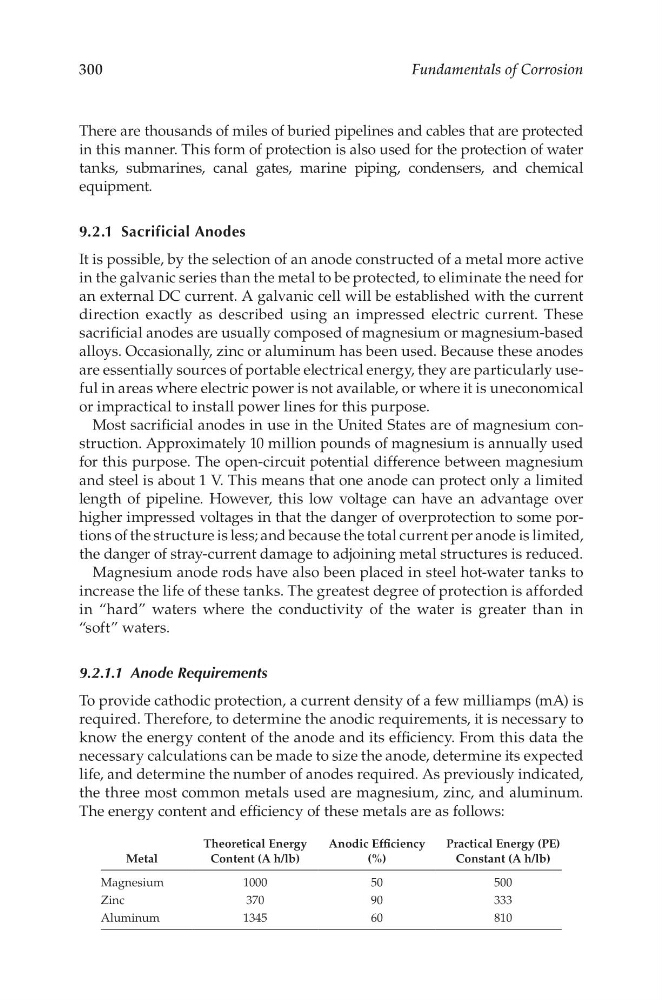
The energy content and efficiency of these metals are as follows:
Metal
Theoretical Energy
Content (A h/lb)
Anodic Efficiency
(%)
Practical Energy (PE)
Constant (A h/lb)
Magnesium
1000
50
500
Zinc
370
90
333
Aluminum
1345
60
810
Fundamentals of Corrosion
There are thousands of miles of buried pipelines and cables that are protected
in this manner. This form of protection is also used for the protection of water
tanks, submarines, canal gates, marine piping, condensers, and chemical
equipment.
9.2.1 Sacrificial anodes
It is possible, by the selection of an anode constructed of a metal more active
in the galvanic series than the metal to be protected, to eliminate the need for
an external DC current. A galvanic cell will be established with the current
direction exactly as described using an impressed electric current. These
sacrificial anodes are usually composed of magnesium or magnesium-based
alloys. Occasionally, zinc or aluminum has been used. Because these anodes
are essentially sources of portable electrical energy, they are particularly useful in areas where electric power is not available, or where it is uneconomical
or impractical to install power lines for this purpose.
Most sacrificial anodes in use in the United States are of magnesium construction. Approximately 10 million pounds of magnesium is annually used
for this purpose. The open-circuit potential difference between magnesium
and steel is about 1 V. This means that one anode can protect only a limited
length of pipeline. However, this low voltage can have an advantage over
higher impressed voltages in that the danger of overprotection to some portions of the structure is less; and because the total current per anode is limited,
the danger of stray-current damage to adjoining metal structures is reduced.
Magnesium anode rods have also been placed in steel hot-water tanks to
increase the life of these tanks. The greatest degree of protection is afforded
in “hard” waters where the conductivity of the water is greater than in
“soft” waters.
9.2.1.1 Anode Requirements
To provide cathodic protection, a current density of a few milliamps (mA) is
required. Therefore, to determine the anodic requirements, it is necessary to
know the energy content of the anode and its efficiency. From this data the
necessary calculations can be made to size the anode, determine its expected
life, and determine the number of anodes required. As previously indicated,
the three most common metals used are magnesium, zinc, and aluminum.
The energy content and efficiency of these metals are as follows:
Metal
Theoretical Energy
Content (A h/lb)
Anodic Efficiency
(%)
Practical Energy (PE)
Constant (A h/lb)
Magnesium
1000
50
500
Zinc
370
90
333
Aluminum
1345
60
810