

Cathodic Protection
299
becomes the cathode and is protected, while the anode is destroyed progressively and is called a sacrificial anode.
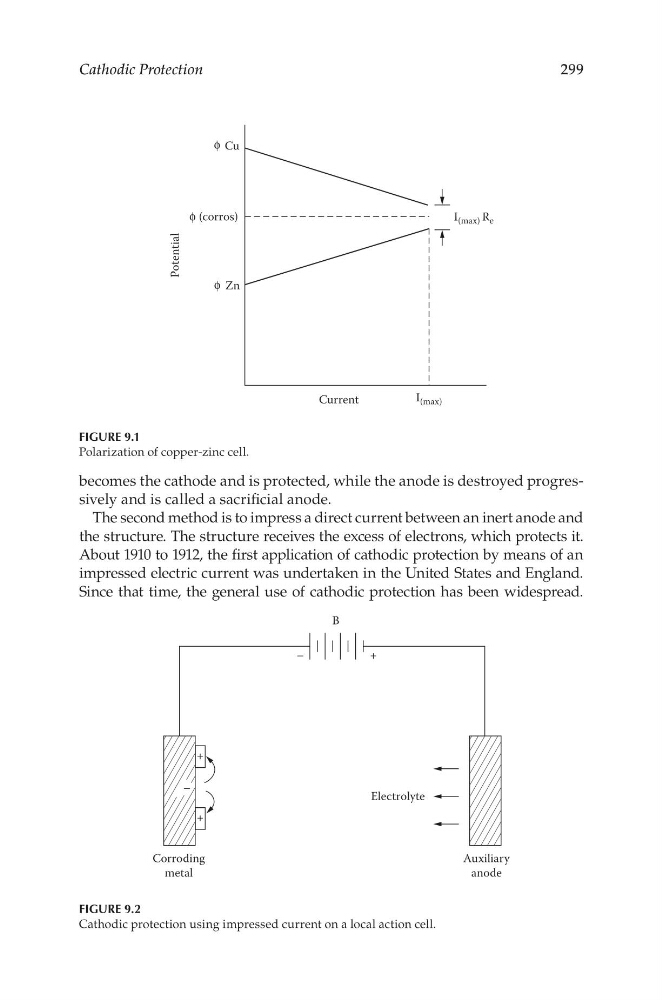
The second method is to impress a direct current between an inert anode and
the structure. The structure receives the excess of electrons, which protects it.
About 1910 to 1912, the first application of cathodic protection by means of an
impressed electric current was undertaken in the United States and England.
Since that time, the general use of cathodic protection has been widespread.
Current
Zn
Potential
I (max)
I (max) R e
Cu
(corros)
FigurE 9.1
Polarization of copper-zinc cell.
Auxiliary
anode
Corroding
metal
+
+
+
B
–
–
Electrolyte
FigurE 9.2
Cathodic protection using impressed current on a local action cell.
299
becomes the cathode and is protected, while the anode is destroyed progressively and is called a sacrificial anode.
The second method is to impress a direct current between an inert anode and
the structure. The structure receives the excess of electrons, which protects it.
About 1910 to 1912, the first application of cathodic protection by means of an
impressed electric current was undertaken in the United States and England.
Since that time, the general use of cathodic protection has been widespread.
Current
Zn
Potential
I (max)
I (max) R e
Cu
(corros)
FigurE 9.1
Polarization of copper-zinc cell.
Auxiliary
anode
Corroding
metal
+
+
+
B
–
–
Electrolyte
FigurE 9.2
Cathodic protection using impressed current on a local action cell.