

174
Fundamentals of Corrosion
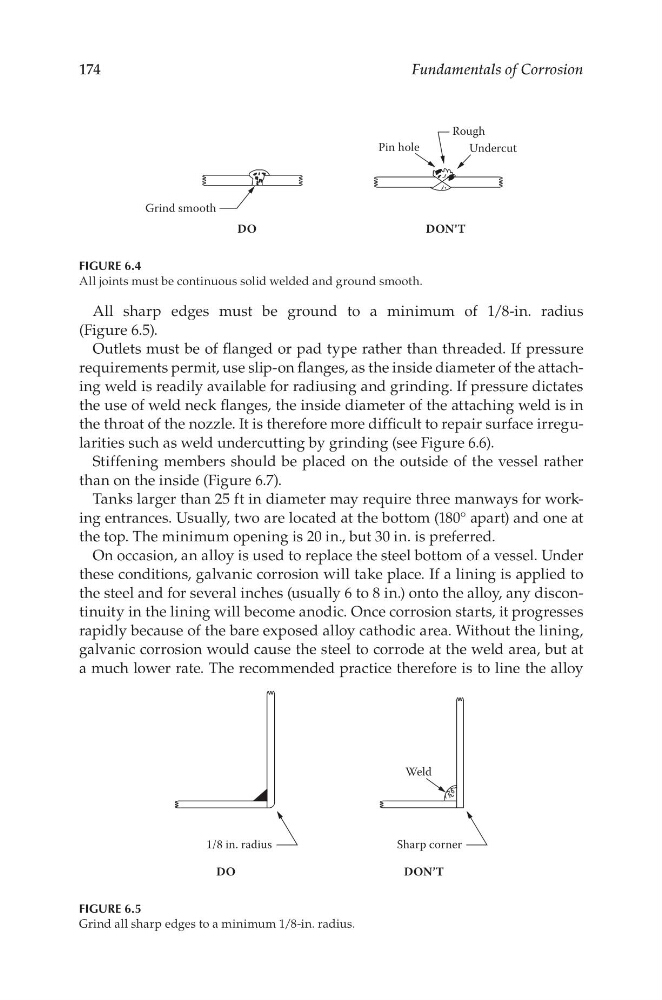
All sharp edges must be ground to a minimum of 1/8-in. radius
(Figure 6.5).
Outlets must be of flanged or pad type rather than threaded. If pressure
requirements permit, use slip-on flanges, as the inside diameter of the attaching weld is readily available for radiusing and grinding. If pressure dictates
the use of weld neck flanges, the inside diameter of the attaching weld is in
the throat of the nozzle. It is therefore more difficult to repair surface irregularities such as weld undercutting by grinding (see Figure 6.6).
Stiffening members should be placed on the outside of the vessel rather
than on the inside (Figure 6.7).
Tanks larger than 25 ft in diameter may require three manways for working entrances. Usually, two are located at the bottom (180° apart) and one at
the top. The minimum opening is 20 in., but 30 in. is preferred.
On occasion, an alloy is used to replace the steel bottom of a vessel. Under
these conditions, galvanic corrosion will take place. If a lining is applied to
the steel and for several inches (usually 6 to 8 in.) onto the alloy, any discontinuity in the lining will become anodic. Once corrosion starts, it progresses
rapidly because of the bare exposed alloy cathodic area. Without the lining,
galvanic corrosion would cause the steel to corrode at the weld area, but at
a much lower rate. The recommended practice therefore is to line the alloy
Grind smooth
DO
DON’T
Undercut
Rough
Pin hole
FigurE 6.4
All joints must be continuous solid welded and ground smooth.
DON’T
Sharp corner
1/8 in. radius
Weld
DO
FigurE 6.5
Grind all sharp edges to a minimum 1/8-in. radius.
Fundamentals of Corrosion
All sharp edges must be ground to a minimum of 1/8-in. radius
(Figure 6.5).
Outlets must be of flanged or pad type rather than threaded. If pressure
requirements permit, use slip-on flanges, as the inside diameter of the attaching weld is readily available for radiusing and grinding. If pressure dictates
the use of weld neck flanges, the inside diameter of the attaching weld is in
the throat of the nozzle. It is therefore more difficult to repair surface irregularities such as weld undercutting by grinding (see Figure 6.6).
Stiffening members should be placed on the outside of the vessel rather
than on the inside (Figure 6.7).
Tanks larger than 25 ft in diameter may require three manways for working entrances. Usually, two are located at the bottom (180° apart) and one at
the top. The minimum opening is 20 in., but 30 in. is preferred.
On occasion, an alloy is used to replace the steel bottom of a vessel. Under
these conditions, galvanic corrosion will take place. If a lining is applied to
the steel and for several inches (usually 6 to 8 in.) onto the alloy, any discontinuity in the lining will become anodic. Once corrosion starts, it progresses
rapidly because of the bare exposed alloy cathodic area. Without the lining,
galvanic corrosion would cause the steel to corrode at the weld area, but at
a much lower rate. The recommended practice therefore is to line the alloy
Grind smooth
DO
DON’T
Undercut
Rough
Pin hole
FigurE 6.4
All joints must be continuous solid welded and ground smooth.
DON’T
Sharp corner
1/8 in. radius
Weld
DO
FigurE 6.5
Grind all sharp edges to a minimum 1/8-in. radius.