

160
Fundamentals of Corrosion
1. Failure of the substrate due to corrosive attack
2. Bond failure and blistering resulting from the accumulation of fluids at the bond when the substrate is less permeable than the liner, or
from corrosion/reaction products if the substrate is attacked by the
permeant
3. Loss of contents through substrate and liner as a result of the eventual failure of the substrate (in unbonded linings it is important that
the space between the liner and the support member be vented to the
atmpsphere, not only to allow minute quantities of permeant vapors
to escape, but also to prevent expansion of entrapped air from collapsing the liner)
Permeation is a function of two variables, one relating to diffusion between
molecular chains and the other to the solubility of the permeant in the polymer. The driving force of diffusion is the partial pressure of gases and the
concentration gradient of liquids. Solubility is a function of the affinity of the
permeant for the polymer.
All polymers do not have the same rate of permeation; in fact, some polymers
are not affected by permeation. The fluoroploymers are particularly affected.
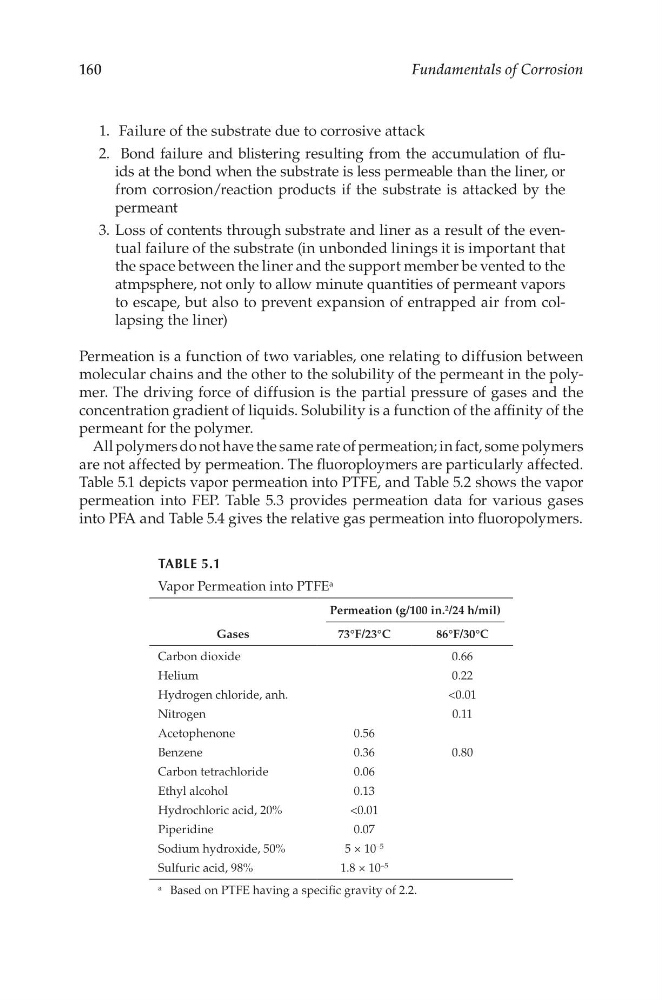
Table 5.1 depicts vapor permeation into PTFE, and Table 5.2 shows the vapor
permeation into FEP. Table 5.3 provides permeation data for various gases
into PFA and Table 5.4 gives the relative gas permeation into fluoropolymers.
TabLE 5.1
Vapor Permeation into PTFE a
Gases
Permeation (g/100 in. 2 /24 h/mil)
73°F/23°C
86°F/30°C
Carbon dioxide
0.66
Helium
0.22
Hydrogen chloride, anh.
<0.01
Nitrogen
0.11
Acetophenone
0.56
Benzene
0.36
0.80
Carbon tetrachloride
0.06
Ethyl alcohol
0.13
Hydrochloric acid, 20%
<0.01
Piperidine
0.07
Sodium hydroxide, 50%
5 × 10 –5
Sulfuric acid, 98%
1.8 × 10 –5
a Based on PTFE having a specific gravity of 2.2.
Fundamentals of Corrosion
1. Failure of the substrate due to corrosive attack
2. Bond failure and blistering resulting from the accumulation of fluids at the bond when the substrate is less permeable than the liner, or
from corrosion/reaction products if the substrate is attacked by the
permeant
3. Loss of contents through substrate and liner as a result of the eventual failure of the substrate (in unbonded linings it is important that
the space between the liner and the support member be vented to the
atmpsphere, not only to allow minute quantities of permeant vapors
to escape, but also to prevent expansion of entrapped air from collapsing the liner)
Permeation is a function of two variables, one relating to diffusion between
molecular chains and the other to the solubility of the permeant in the polymer. The driving force of diffusion is the partial pressure of gases and the
concentration gradient of liquids. Solubility is a function of the affinity of the
permeant for the polymer.
All polymers do not have the same rate of permeation; in fact, some polymers
are not affected by permeation. The fluoroploymers are particularly affected.
Table 5.1 depicts vapor permeation into PTFE, and Table 5.2 shows the vapor
permeation into FEP. Table 5.3 provides permeation data for various gases
into PFA and Table 5.4 gives the relative gas permeation into fluoropolymers.
TabLE 5.1
Vapor Permeation into PTFE a
Gases
Permeation (g/100 in. 2 /24 h/mil)
73°F/23°C
86°F/30°C
Carbon dioxide
0.66
Helium
0.22
Hydrogen chloride, anh.
<0.01
Nitrogen
0.11
Acetophenone
0.56
Benzene
0.36
0.80
Carbon tetrachloride
0.06
Ethyl alcohol
0.13
Hydrochloric acid, 20%
<0.01
Piperidine
0.07
Sodium hydroxide, 50%
5 × 10 –5
Sulfuric acid, 98%
1.8 × 10 –5
a Based on PTFE having a specific gravity of 2.2.