

Corrosion of Polymer (Plastic) Materials
159
shorter than the threshold can break the bond, but longer wavelengths of
light cannot break it, regardless of their intensity (brightness). Therefore, the
short-wavelength cutoff of a light source is of critical importance. If a particular polymer is sensitive only to UV light below 295 nm (the solar cutoff
point), it will never experience photochemical degradation outdoors.
The ability to withstand weathering depends on the polymer type and
which grades of a particular resin. Many resin grades are available with
UV-absorbing additives to improve weatherability. However, the highermolecular-weight grades of a resin generally exhibit better weatherability
than lower-molecular-weight grades with comparable additives. In addition,
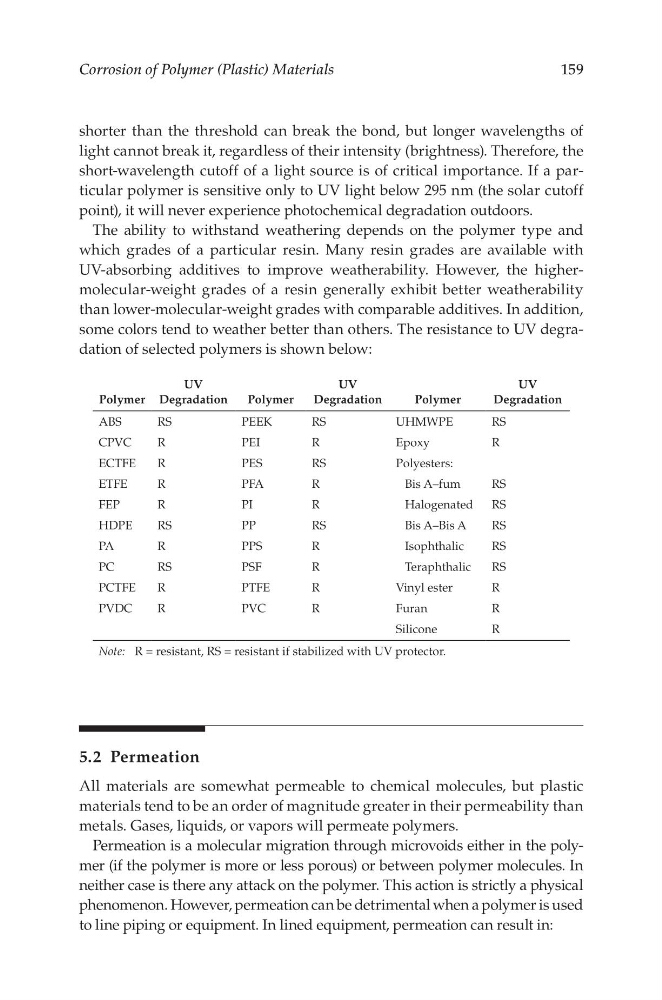
some colors tend to weather better than others. The resistance to UV degradation of selected polymers is shown below:
Polymer
UV
Degradation
Polymer
UV
Degradation
Polymer
UV
Degradation
ABS
RS
PEEK
RS
UHMWPE
RS
CPVC
R
PEI
R
Epoxy
R
ECTFE
R
PES
RS
Polyesters:
ETFE
R
PFA
R
Bis A–fum
RS
FEP
R
PI
R
Halogenated
RS
HDPE
RS
PP
RS
Bis A–Bis A
RS
PA
R
PPS
R
Isophthalic
RS
PC
RS
PSF
R
Teraphthalic
RS
PCTFE
R
PTFE
R
Vinyl ester
R
PVDC
R
PVC
R
Furan
R
Silicone
R
Note: R = resistant, RS = resistant if stabilized with UV protector.
5.2 Permeation
All materials are somewhat permeable to chemical molecules, but plastic
materials tend to be an order of magnitude greater in their permeability than
metals. Gases, liquids, or vapors will permeate polymers.
Permeation is a molecular migration through microvoids either in the polymer (if the polymer is more or less porous) or between polymer molecules. In
neither case is there any attack on the polymer. This action is strictly a physical
phenomenon. However, permeation can be detrimental when a polymer is used
to line piping or equipment. In lined equipment, permeation can result in:
159
shorter than the threshold can break the bond, but longer wavelengths of
light cannot break it, regardless of their intensity (brightness). Therefore, the
short-wavelength cutoff of a light source is of critical importance. If a particular polymer is sensitive only to UV light below 295 nm (the solar cutoff
point), it will never experience photochemical degradation outdoors.
The ability to withstand weathering depends on the polymer type and
which grades of a particular resin. Many resin grades are available with
UV-absorbing additives to improve weatherability. However, the highermolecular-weight grades of a resin generally exhibit better weatherability
than lower-molecular-weight grades with comparable additives. In addition,
some colors tend to weather better than others. The resistance to UV degradation of selected polymers is shown below:
Polymer
UV
Degradation
Polymer
UV
Degradation
Polymer
UV
Degradation
ABS
RS
PEEK
RS
UHMWPE
RS
CPVC
R
PEI
R
Epoxy
R
ECTFE
R
PES
RS
Polyesters:
ETFE
R
PFA
R
Bis A–fum
RS
FEP
R
PI
R
Halogenated
RS
HDPE
RS
PP
RS
Bis A–Bis A
RS
PA
R
PPS
R
Isophthalic
RS
PC
RS
PSF
R
Teraphthalic
RS
PCTFE
R
PTFE
R
Vinyl ester
R
PVDC
R
PVC
R
Furan
R
Silicone
R
Note: R = resistant, RS = resistant if stabilized with UV protector.
5.2 Permeation
All materials are somewhat permeable to chemical molecules, but plastic
materials tend to be an order of magnitude greater in their permeability than
metals. Gases, liquids, or vapors will permeate polymers.
Permeation is a molecular migration through microvoids either in the polymer (if the polymer is more or less porous) or between polymer molecules. In
neither case is there any attack on the polymer. This action is strictly a physical
phenomenon. However, permeation can be detrimental when a polymer is used
to line piping or equipment. In lined equipment, permeation can result in: