

146
Fundamentals of Corrosion
Stress Factor
Weathering Factor
Photo-irradiation
Photochemical degradation
Moisture changes
Dimensional changes, deformation,
cracking, leaching, hydrolysis
Wind, rain, hail, dust, pollution Erosion
Microorganisms
Discoloration
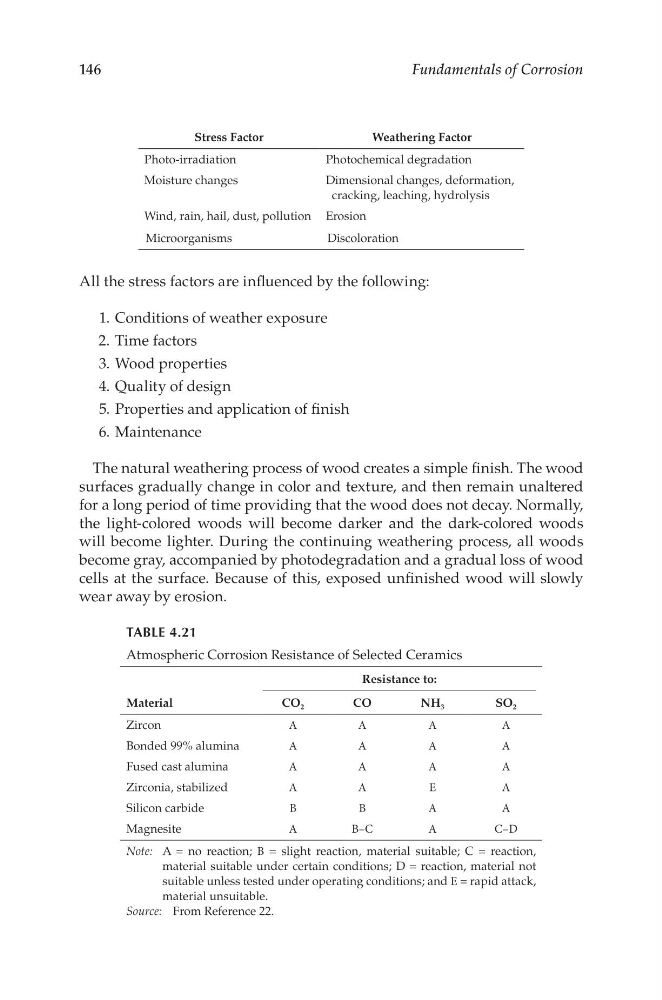
All the stress factors are influenced by the following:
1. Conditions of weather exposure
2. Time factors
3. Wood properties
4. Quality of design
5. Properties and application of finish
6. Maintenance
The natural weathering process of wood creates a simple finish. The wood
surfaces gradually change in color and texture, and then remain unaltered
for a long period of time providing that the wood does not decay. Normally,
the light-colored woods will become darker and the dark-colored woods
will become lighter. During the continuing weathering process, all woods
become gray, accompanied by photodegradation and a gradual loss of wood
cells at the surface. Because of this, exposed unfinished wood will slowly
wear away by erosion.
TabLE 4.21
Atmospheric Corrosion Resistance of Selected Ceramics
Material
Resistance to:
CO 2
CO
NH 3
SO 2
Zircon
A
A
A
A
Bonded 99% alumina
A
A
A
A
Fused cast alumina
A
A
A
A
Zirconia, stabilized
A
A
Ε
A
Silicon carbide
Β
Β
A
A
Magnesite
A
B–C
A
C–D
Note: A = no reaction; Β = slight reaction, material suitable; C = reaction,
material suitable under certain conditions; D = reaction, material not
suitable unless tested under operating conditions; and Ε = rapid attack,
material unsuitable.
Source: From Reference 22.
Fundamentals of Corrosion
Stress Factor
Weathering Factor
Photo-irradiation
Photochemical degradation
Moisture changes
Dimensional changes, deformation,
cracking, leaching, hydrolysis
Wind, rain, hail, dust, pollution Erosion
Microorganisms
Discoloration
All the stress factors are influenced by the following:
1. Conditions of weather exposure
2. Time factors
3. Wood properties
4. Quality of design
5. Properties and application of finish
6. Maintenance
The natural weathering process of wood creates a simple finish. The wood
surfaces gradually change in color and texture, and then remain unaltered
for a long period of time providing that the wood does not decay. Normally,
the light-colored woods will become darker and the dark-colored woods
will become lighter. During the continuing weathering process, all woods
become gray, accompanied by photodegradation and a gradual loss of wood
cells at the surface. Because of this, exposed unfinished wood will slowly
wear away by erosion.
TabLE 4.21
Atmospheric Corrosion Resistance of Selected Ceramics
Material
Resistance to:
CO 2
CO
NH 3
SO 2
Zircon
A
A
A
A
Bonded 99% alumina
A
A
A
A
Fused cast alumina
A
A
A
A
Zirconia, stabilized
A
A
Ε
A
Silicon carbide
Β
Β
A
A
Magnesite
A
B–C
A
C–D
Note: A = no reaction; Β = slight reaction, material suitable; C = reaction,
material suitable under certain conditions; D = reaction, material not
suitable unless tested under operating conditions; and Ε = rapid attack,
material unsuitable.
Source: From Reference 22.