

Atmospheric Corrosion
145
place through any or all of these forms, depending on the specific ceramic
and the elements of the atmosphere.
The same factors that promote the atmospheric corrosion of metals — that
is, time of wetness, atmospheric types, initial exposure conditions, sheltering,
wind velocity, and the nature of corrosion products — also affect the atmospheric corrosion of ceramics.
The porosity of ceramic materials is another factor that affects their corrosion resistance. Voids present in the ceramics provide a greater surface area for
attack and allow retention of the corrosion product, which results in mechanical failure due to the formation of voluminous corrosion products in pores.
4.8.4.2 Corrosion of Specific Ceramics
The primary problem facing ceramics in relation to atmospheric corrosion
is that of attack by atmospheric water vapor. This attack is time dependent
and degrades the mechanical properties of the ceramic. This form of attack
is referred to as weathering and is essentially attack by water vapor, CO 2 ,
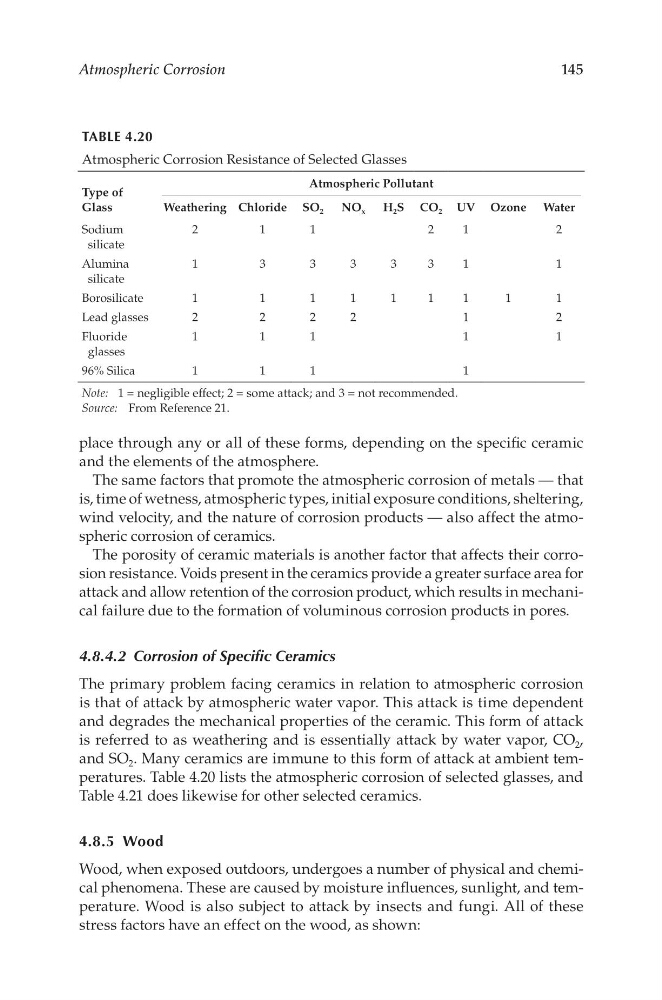
and SO 2 . Many ceramics are immune to this form of attack at ambient temperatures. Table 4.20 lists the atmospheric corrosion of selected glasses, and
Table 4.21 does likewise for other selected ceramics.
4.8.5 Wood
Wood, when exposed outdoors, undergoes a number of physical and chemical phenomena. These are caused by moisture influences, sunlight, and temperature. Wood is also subject to attack by insects and fungi. All of these
stress factors have an effect on the wood, as shown:
TabLE 4.20
Atmospheric Corrosion Resistance of Selected Glasses
Type of
Glass
Atmospheric Pollutant
Weathering Chloride SO 2 NO x H 2 S CO 2 UV Ozone Water
Sodium
silicate
2
1
1
2
1
2
Alumina
silicate
1
3
3
3
3
3
1
1
Borosilicate
1
1
1
1
1
1
1
1
1
Lead glasses
2
2
2
2
1
2
Fluoride
glasses
1
1
1
1
1
96% Silica
1
1
1
1
Note: 1 = negligible effect; 2 = some attack; and 3 = not recommended.
Source: From Reference 21.
145
place through any or all of these forms, depending on the specific ceramic
and the elements of the atmosphere.
The same factors that promote the atmospheric corrosion of metals — that
is, time of wetness, atmospheric types, initial exposure conditions, sheltering,
wind velocity, and the nature of corrosion products — also affect the atmospheric corrosion of ceramics.
The porosity of ceramic materials is another factor that affects their corrosion resistance. Voids present in the ceramics provide a greater surface area for
attack and allow retention of the corrosion product, which results in mechanical failure due to the formation of voluminous corrosion products in pores.
4.8.4.2 Corrosion of Specific Ceramics
The primary problem facing ceramics in relation to atmospheric corrosion
is that of attack by atmospheric water vapor. This attack is time dependent
and degrades the mechanical properties of the ceramic. This form of attack
is referred to as weathering and is essentially attack by water vapor, CO 2 ,
and SO 2 . Many ceramics are immune to this form of attack at ambient temperatures. Table 4.20 lists the atmospheric corrosion of selected glasses, and
Table 4.21 does likewise for other selected ceramics.
4.8.5 Wood
Wood, when exposed outdoors, undergoes a number of physical and chemical phenomena. These are caused by moisture influences, sunlight, and temperature. Wood is also subject to attack by insects and fungi. All of these
stress factors have an effect on the wood, as shown:
TabLE 4.20
Atmospheric Corrosion Resistance of Selected Glasses
Type of
Glass
Atmospheric Pollutant
Weathering Chloride SO 2 NO x H 2 S CO 2 UV Ozone Water
Sodium
silicate
2
1
1
2
1
2
Alumina
silicate
1
3
3
3
3
3
1
1
Borosilicate
1
1
1
1
1
1
1
1
1
Lead glasses
2
2
2
2
1
2
Fluoride
glasses
1
1
1
1
1
96% Silica
1
1
1
1
Note: 1 = negligible effect; 2 = some attack; and 3 = not recommended.
Source: From Reference 21.