

142
Fundamentals of Corrosion
product formed is a solid, it can form a protective layer against further corrosion. When the reaction product is a combination of a solid and a liquid, the
reaction layer can be removed.
The fundamental concepts of chemistry can assist in understanding the
corrosion of ceramics. A ceramic having a basic character tends to be attacked
by an environment with an acidic character, whereas a ceramic having an
acidic character tends to be attacked by an environment basic in character.
Also, ionic materials tend to be soluble in polar solvents, whereas covalent
materials tend to be soluble in nonpolar solvents, and the vapor pressure of
covalent materials is generally greater than that of ionic materials and therefore covalent materials tend to vaporize or sublime more quickly.
The resistance of ceramics to corrosion is due to one of three basic behaviors:
immunity, passivation, or kinetically limited corrosion. When a ceramic is
thermodynamically incapable of spontaneous reaction with its environment,
it is referred to as having immunity. When the necessary thermodynamic data
are available, this type of corrosion resistance can be predicted by calculation.
Metals, except for the precious metals such as gold, do not exhibit immunity.
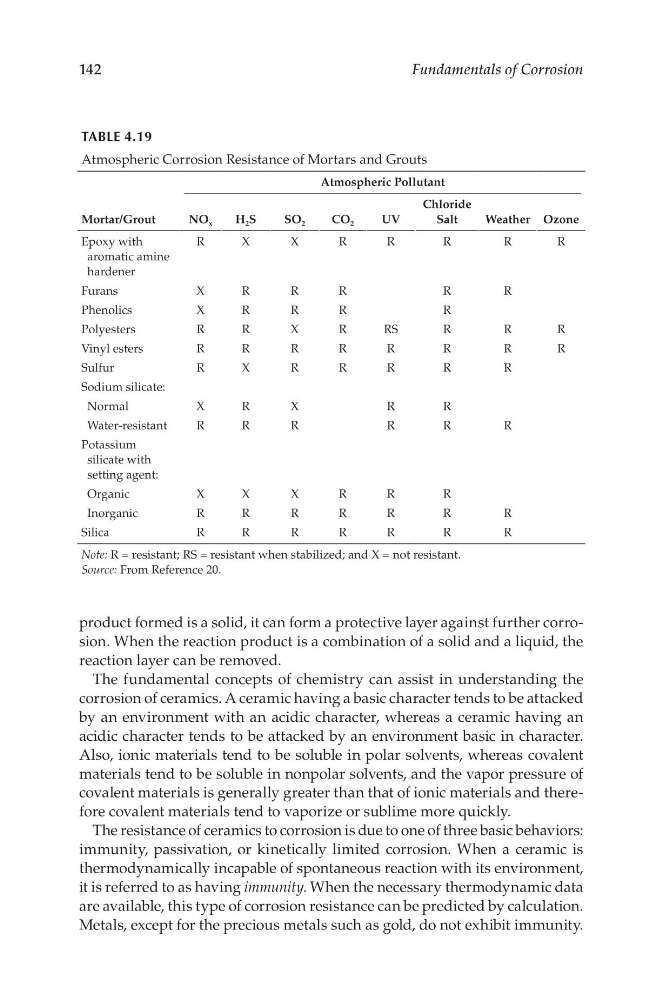
TabLE 4.19
Atmospheric Corrosion Resistance of Mortars and Grouts
Mortar/Grout
Atmospheric Pollutant
NO x
H 2 S
SO 2
CO 2
UV
Chloride
Salt
Weather Ozone
Epoxy with
aromatic amine
hardener
R
X
X
R
R
R
R
R
Furans
X
R
R
R
R
R
Phenolics
X
R
R
R
R
Polyesters
R
R
X
R
RS
R
R
R
Vinyl esters
R
R
R
R
R
R
R
R
Sulfur
R
X
R
R
R
R
R
Sodium silicate:
Normal
X
R
X
R
R
Water-resistant
R
R
R
R
R
R
Potassium
silicate with
setting agent:
Organic
X
X
X
R
R
R
Inorganic
R
R
R
R
R
R
R
Silica
R
R
R
R
R
R
R
Note: R = resistant; RS = resistant when stabilized; and X = not resistant.
Source: From Reference 20.
Fundamentals of Corrosion
product formed is a solid, it can form a protective layer against further corrosion. When the reaction product is a combination of a solid and a liquid, the
reaction layer can be removed.
The fundamental concepts of chemistry can assist in understanding the
corrosion of ceramics. A ceramic having a basic character tends to be attacked
by an environment with an acidic character, whereas a ceramic having an
acidic character tends to be attacked by an environment basic in character.
Also, ionic materials tend to be soluble in polar solvents, whereas covalent
materials tend to be soluble in nonpolar solvents, and the vapor pressure of
covalent materials is generally greater than that of ionic materials and therefore covalent materials tend to vaporize or sublime more quickly.
The resistance of ceramics to corrosion is due to one of three basic behaviors:
immunity, passivation, or kinetically limited corrosion. When a ceramic is
thermodynamically incapable of spontaneous reaction with its environment,
it is referred to as having immunity. When the necessary thermodynamic data
are available, this type of corrosion resistance can be predicted by calculation.
Metals, except for the precious metals such as gold, do not exhibit immunity.
TabLE 4.19
Atmospheric Corrosion Resistance of Mortars and Grouts
Mortar/Grout
Atmospheric Pollutant
NO x
H 2 S
SO 2
CO 2
UV
Chloride
Salt
Weather Ozone
Epoxy with
aromatic amine
hardener
R
X
X
R
R
R
R
R
Furans
X
R
R
R
R
R
Phenolics
X
R
R
R
R
Polyesters
R
R
X
R
RS
R
R
R
Vinyl esters
R
R
R
R
R
R
R
R
Sulfur
R
X
R
R
R
R
R
Sodium silicate:
Normal
X
R
X
R
R
Water-resistant
R
R
R
R
R
R
Potassium
silicate with
setting agent:
Organic
X
X
X
R
R
R
Inorganic
R
R
R
R
R
R
R
Silica
R
R
R
R
R
R
R
Note: R = resistant; RS = resistant when stabilized; and X = not resistant.
Source: From Reference 20.