

Atmospheric Corrosion
141
catalyst system that may be incorporated in the filler or added as a separate component.
A mortar is a material having a heavy consistency that can support the
weight of a brick or tile without being squeezed from between the joints
while curing.
A grout is a thin or “soupy” mortar used for filling joints between previously laid brick or tile. Chemically resistant machinery grouts contain larger
aggregates than tile grout and have a different resin viscosity.
The effectiveness and workability of a mortar or grout depends on the
proper selection of fillers, particle size, resin viscosity, reactivity of catalysts
and hardeners. Hardener systems must be formulated for application in the
temperature range of approximately 60 to 90°F (15 to 32°C). The lower the temperature, the slower the set; the higher the temperature, the faster the set.
Carbon, silica, or combinations of the two are the most popular fillers used.
Carbon is the most inert of the fillers and therefore is the one most often
selected. The most popular resin systems are some of the same used for monolithic surfacing. Refer to Table 4.19 for their atmospheric corrosion resistances.
4.8.4 Ceramics
As with metals, the corrosion of ceramics can take place by one or a combination of mechanisms. In general, a corrodent will attack a ceramic and form
a corrosion product. Whether the reaction product is a gas or a solid will
determine if the product remains on the surface or is a fugitive. Reaction
products may be gas, liquid, solid, or any combination thereof. If the reaction
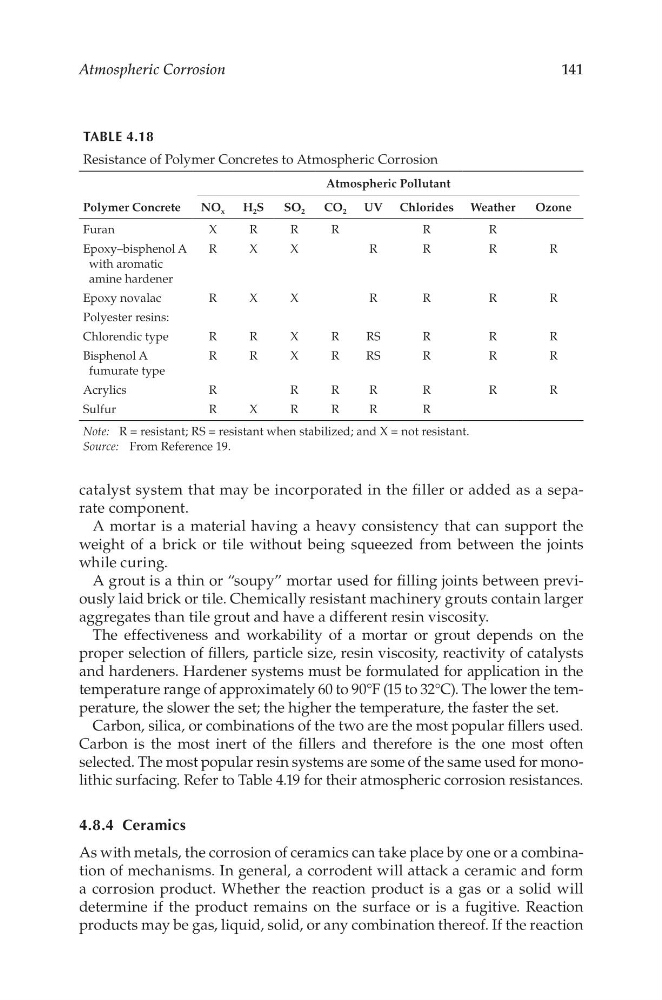
TabLE 4.18
Resistance of Polymer Concretes to Atmospheric Corrosion
Polymer Concrete
Atmospheric Pollutant
NO x
H 2 S
SO 2
CO 2 UV Chlorides Weather
Ozone
Furan
X
R
R
R
R
R
Epoxy–bisphenol A
with aromatic
amine hardener
R
X
X
R
R
R
R
Epoxy novalac
R
X
X
R
R
R
R
Polyester resins:
Chlorendic type
R
R
X
R
RS
R
R
R
Bisphenol A
fumurate type
R
R
X
R
RS
R
R
R
Acrylics
R
R
R
R
R
R
R
Sulfur
R
X
R
R
R
R
Note: R = resistant; RS = resistant when stabilized; and X = not resistant.
Source: From Reference 19.
141
catalyst system that may be incorporated in the filler or added as a separate component.
A mortar is a material having a heavy consistency that can support the
weight of a brick or tile without being squeezed from between the joints
while curing.
A grout is a thin or “soupy” mortar used for filling joints between previously laid brick or tile. Chemically resistant machinery grouts contain larger
aggregates than tile grout and have a different resin viscosity.
The effectiveness and workability of a mortar or grout depends on the
proper selection of fillers, particle size, resin viscosity, reactivity of catalysts
and hardeners. Hardener systems must be formulated for application in the
temperature range of approximately 60 to 90°F (15 to 32°C). The lower the temperature, the slower the set; the higher the temperature, the faster the set.
Carbon, silica, or combinations of the two are the most popular fillers used.
Carbon is the most inert of the fillers and therefore is the one most often
selected. The most popular resin systems are some of the same used for monolithic surfacing. Refer to Table 4.19 for their atmospheric corrosion resistances.
4.8.4 Ceramics
As with metals, the corrosion of ceramics can take place by one or a combination of mechanisms. In general, a corrodent will attack a ceramic and form
a corrosion product. Whether the reaction product is a gas or a solid will
determine if the product remains on the surface or is a fugitive. Reaction
products may be gas, liquid, solid, or any combination thereof. If the reaction
TabLE 4.18
Resistance of Polymer Concretes to Atmospheric Corrosion
Polymer Concrete
Atmospheric Pollutant
NO x
H 2 S
SO 2
CO 2 UV Chlorides Weather
Ozone
Furan
X
R
R
R
R
R
Epoxy–bisphenol A
with aromatic
amine hardener
R
X
X
R
R
R
R
Epoxy novalac
R
X
X
R
R
R
R
Polyester resins:
Chlorendic type
R
R
X
R
RS
R
R
R
Bisphenol A
fumurate type
R
R
X
R
RS
R
R
R
Acrylics
R
R
R
R
R
R
R
Sulfur
R
X
R
R
R
R
Note: R = resistant; RS = resistant when stabilized; and X = not resistant.
Source: From Reference 19.