

Atmospheric Corrosion
137
4.8.3.1 Protecting Concrete
Several steps can be taken to prolong the life of concrete. The first is to protect the reinforcing steel from corrosion by applying a rust preventative to
the surface prior to embedding in the concrete mix. This keeps the steel from
rusting if contacted by water and causing spalling of the concrete. In the past
few years there has been a tendency in some instances to use stainless steel
reinforcing rods to eliminate this potential problem.
A second approach is to provide a coating for the concrete. Before selecting an appropriate coating, consideration must be given to the condition of
the concrete and the environment to which the concrete will be exposed.
Proper surface preparation is essential. Surface preparations can be different
for freshly placed concrete and for old concrete.
When concrete is poured, it is usually held in place by means of steel or
wood forms that are removed when the concrete is still in its tender state.
To facilitate their removal, release agents are applied to the forms prior to
pouring. Oils, greases, and proprietary product release agents are left on the
surface of the poured concrete. They must be removed if they will interfere
with the adhesion of subsequent coatings.
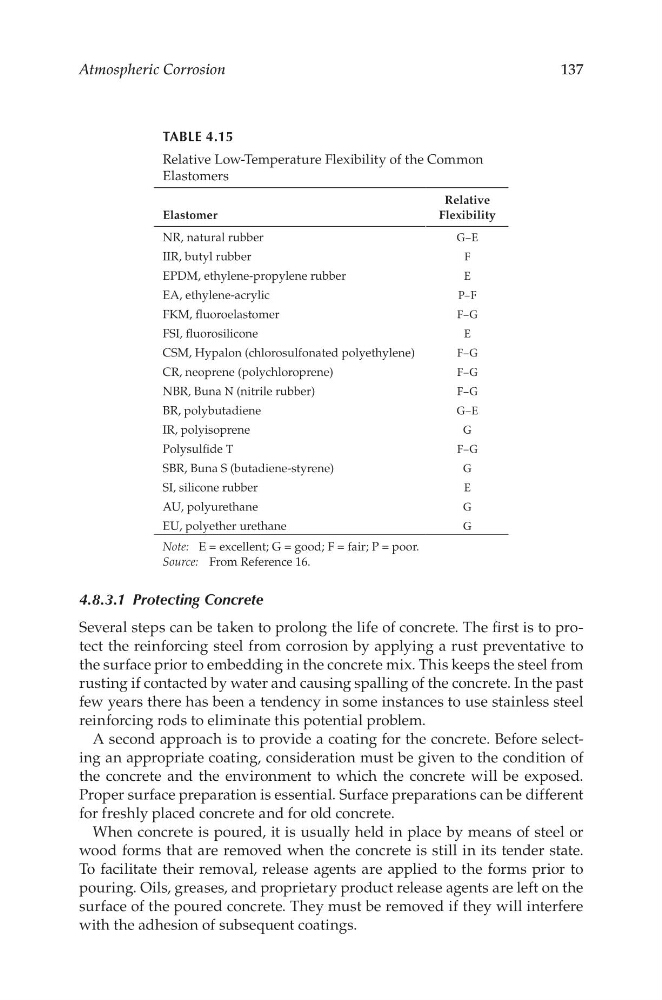
TabLE 4.15
Relative Low-Temperature Flexibility of the Common
Elastomers
Elastomer
Relative
Flexibility
NR, natural rubber
G–E
IIR, butyl rubber
F
EPDM, ethylene-propylene rubber
Ε
EA, ethylene-acrylic
P–F
FKM, fluoroelastomer
F–G
FSI, fluorosilicone
Ε
CSM, Hypalon (chlorosulfonated polyethylene)
F–G
CR, neoprene (polychloroprene)
F–G
NBR, Buna Ν (nitrile rubber)
F–G
BR, polybutadiene
G–E
IR, polyisoprene
G
Polysulfide Τ
F–G
SBR, Buna S (butadiene-styrene)
G
SI, silicone rubber
Ε
AU, polyurethane
G
EU, polyether urethane
G
Note: E = excellent; G = good; F = fair; P = poor.
Source: From Reference 16.
137
4.8.3.1 Protecting Concrete
Several steps can be taken to prolong the life of concrete. The first is to protect the reinforcing steel from corrosion by applying a rust preventative to
the surface prior to embedding in the concrete mix. This keeps the steel from
rusting if contacted by water and causing spalling of the concrete. In the past
few years there has been a tendency in some instances to use stainless steel
reinforcing rods to eliminate this potential problem.
A second approach is to provide a coating for the concrete. Before selecting an appropriate coating, consideration must be given to the condition of
the concrete and the environment to which the concrete will be exposed.
Proper surface preparation is essential. Surface preparations can be different
for freshly placed concrete and for old concrete.
When concrete is poured, it is usually held in place by means of steel or
wood forms that are removed when the concrete is still in its tender state.
To facilitate their removal, release agents are applied to the forms prior to
pouring. Oils, greases, and proprietary product release agents are left on the
surface of the poured concrete. They must be removed if they will interfere
with the adhesion of subsequent coatings.
TabLE 4.15
Relative Low-Temperature Flexibility of the Common
Elastomers
Elastomer
Relative
Flexibility
NR, natural rubber
G–E
IIR, butyl rubber
F
EPDM, ethylene-propylene rubber
Ε
EA, ethylene-acrylic
P–F
FKM, fluoroelastomer
F–G
FSI, fluorosilicone
Ε
CSM, Hypalon (chlorosulfonated polyethylene)
F–G
CR, neoprene (polychloroprene)
F–G
NBR, Buna Ν (nitrile rubber)
F–G
BR, polybutadiene
G–E
IR, polyisoprene
G
Polysulfide Τ
F–G
SBR, Buna S (butadiene-styrene)
G
SI, silicone rubber
Ε
AU, polyurethane
G
EU, polyether urethane
G
Note: E = excellent; G = good; F = fair; P = poor.
Source: From Reference 16.