

136
Fundamentals of Corrosion
of the cement solution, allowing the embedded steel to corrode. This sometimes is referred to as the carbonation of cement.
Sulfates will also cause concrete to deteriorate. In addition to being able to
produce sulfuric acid, which is highly corrosive to concrete, sulfates are also
reactive with some aggregates used in concrete mixes. Sulfate ions react with
tricalcium aluminate to form sulfoaluminate hydrate with a large crystallized water content.
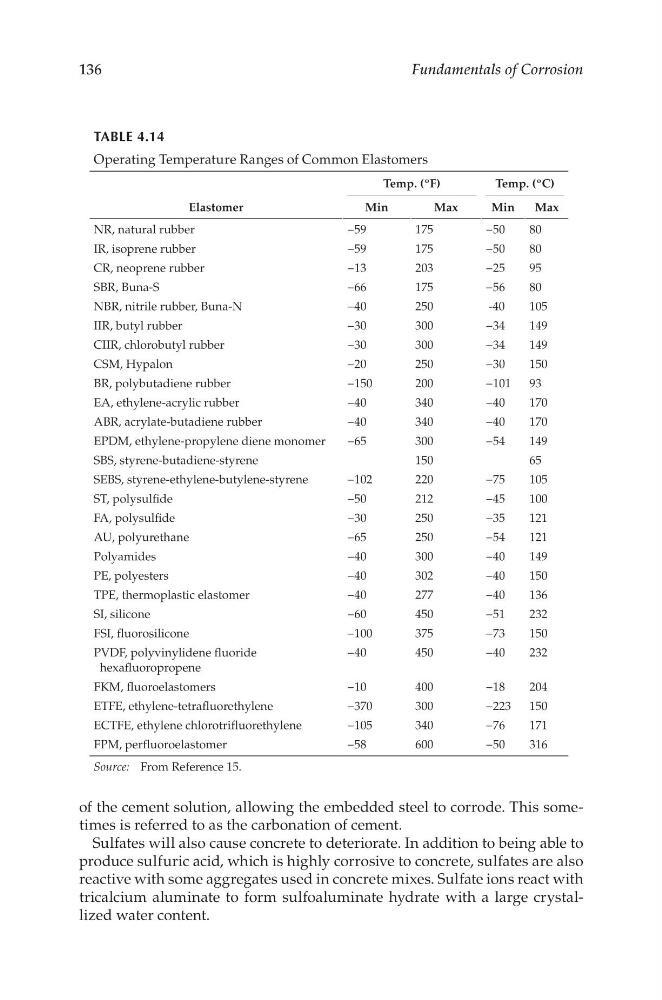
TabLE 4.14
Operating Temperature Ranges of Common Elastomers
Elastomer
Temp. (ºF)
Temp. (ºC)
Min
Max
Min
Max
NR, natural rubber
−59
175
−50
80
IR, isoprene rubber
−59
175
−50
80
CR, neoprene rubber
−13
203
−25
95
SBR, Buna-S
−66
175
−56
80
NBR, nitrile rubber, Buna-N
−40
250
-40
105
IIR, butyl rubber
−30
300
−34
149
CIIR, chlorobutyl rubber
−30
300
−34
149
CSM, Hypalon
−20
250
−30
150
BR, polybutadiene rubber
−150
200
−101
93
EA, ethylene-acrylic rubber
−40
340
−40
170
ABR, acrylate-butadiene rubber
−40
340
−40
170
EPDM, ethylene-propylene diene monomer
−65
300
−54
149
SBS, styrene-butadiene-styrene
150
65
SEBS, styrene-ethylene-butylene-styrene
−102
220
−75
105
ST, polysulfide
−50
212
−45
100
FA, polysulfide
−30
250
−35
121
AU, polyurethane
−65
250
−54
121
Polyamides
−40
300
−40
149
PE, polyesters
−40
302
−40
150
TPE, thermoplastic elastomer
−40
277
−40
136
SI, silicone
−60
450
−51
232
FSI, fluorosilicone
−100
375
−73
150
PVDF, polyvinylidene fluoride
hexafluoropropene
−40
450
−40
232
FKM, fluoroelastomers
−10
400
−18
204
ETFE, ethylene-tetrafluorethylene
−370
300
−223
150
ECTFE, ethylene chlorotrifluorethylene
−105
340
−76
171
FPM, perfluoroelastomer
−58
600
−50
316
Source: From Reference 15.
Fundamentals of Corrosion
of the cement solution, allowing the embedded steel to corrode. This sometimes is referred to as the carbonation of cement.
Sulfates will also cause concrete to deteriorate. In addition to being able to
produce sulfuric acid, which is highly corrosive to concrete, sulfates are also
reactive with some aggregates used in concrete mixes. Sulfate ions react with
tricalcium aluminate to form sulfoaluminate hydrate with a large crystallized water content.
TabLE 4.14
Operating Temperature Ranges of Common Elastomers
Elastomer
Temp. (ºF)
Temp. (ºC)
Min
Max
Min
Max
NR, natural rubber
−59
175
−50
80
IR, isoprene rubber
−59
175
−50
80
CR, neoprene rubber
−13
203
−25
95
SBR, Buna-S
−66
175
−56
80
NBR, nitrile rubber, Buna-N
−40
250
-40
105
IIR, butyl rubber
−30
300
−34
149
CIIR, chlorobutyl rubber
−30
300
−34
149
CSM, Hypalon
−20
250
−30
150
BR, polybutadiene rubber
−150
200
−101
93
EA, ethylene-acrylic rubber
−40
340
−40
170
ABR, acrylate-butadiene rubber
−40
340
−40
170
EPDM, ethylene-propylene diene monomer
−65
300
−54
149
SBS, styrene-butadiene-styrene
150
65
SEBS, styrene-ethylene-butylene-styrene
−102
220
−75
105
ST, polysulfide
−50
212
−45
100
FA, polysulfide
−30
250
−35
121
AU, polyurethane
−65
250
−54
121
Polyamides
−40
300
−40
149
PE, polyesters
−40
302
−40
150
TPE, thermoplastic elastomer
−40
277
−40
136
SI, silicone
−60
450
−51
232
FSI, fluorosilicone
−100
375
−73
150
PVDF, polyvinylidene fluoride
hexafluoropropene
−40
450
−40
232
FKM, fluoroelastomers
−10
400
−18
204
ETFE, ethylene-tetrafluorethylene
−370
300
−223
150
ECTFE, ethylene chlorotrifluorethylene
−105
340
−76
171
FPM, perfluoroelastomer
−58
600
−50
316
Source: From Reference 15.