

130
Fundamentals of Corrosion
Because of the need for strength in structural applications, thermoset polymers are usually used with fiber reinforcement, the most common of which is
fiberglass. Because there are now several different materials forming the composite, degradation of the composite can be complex because each material can
degrade separately or simultaneously. In addition, there are concerns about
the degradation of the interface between the polymer and the reinforcement.
Cure plays an important part in the corrosion resistance of a thermoset
polymer, as does the construction of the laminate itself and the type of glass
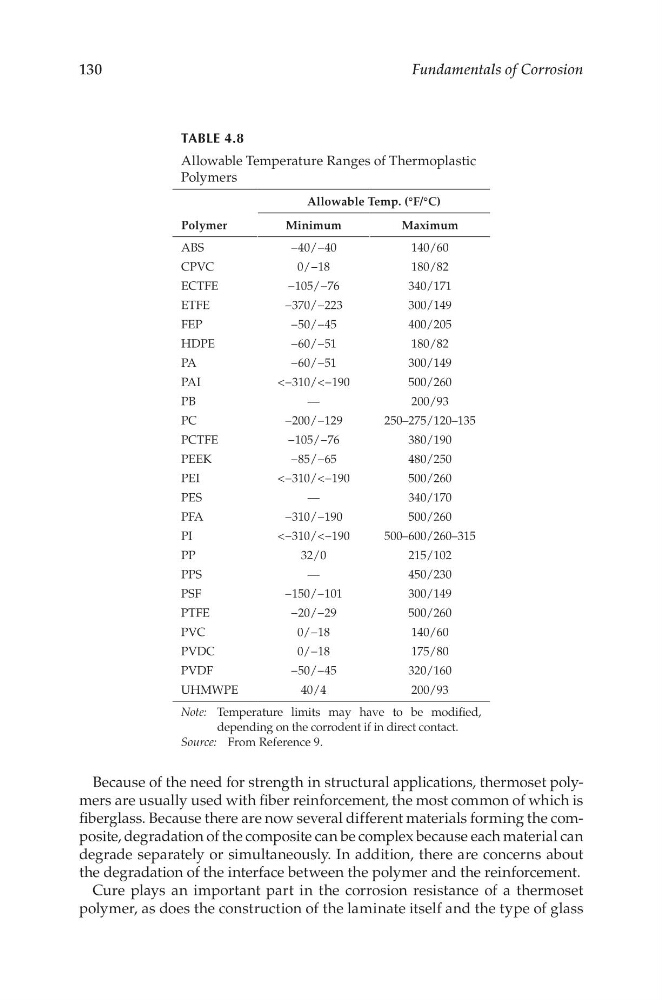
TabLE 4.8
Allowable Temperature Ranges of Thermoplastic
Polymers
Polymer
Allowable Temp. (°F/°C)
Minimum
Maximum
ABS
−40/−40
140/60
CPVC
0/−18
180/82
ECTFE
−105/−76
340/171
ETFE
−370/−223
300/149
FEP
−50/−45
400/205
HDPE
−60/−51
180/82
PA
−60/−51
300/149
PAI
<−310/<−190
500/260
PB
—
200/93
PC
−200/−129
250–275/120–135
PCTFE
−105/−76
380/190
PEEK
−85/−65
480/250
PEI
<−310/<−190
500/260
PES
—
340/170
PFA
−310/−190
500/260
PI
<−310/<−190
500–600/260–315
PP
32/0
215/102
PPS
—
450/230
PSF
−150/−101
300/149
PTFE
−20/−29
500/260
PVC
0/−18
140/60
PVDC
0/−18
175/80
PVDF
−50/−45
320/160
UHMWPE
40/4
200/93
Note: Temperature limits may have to be modified,
depending on the corrodent if in direct contact.
Source: From Reference 9.
Fundamentals of Corrosion
Because of the need for strength in structural applications, thermoset polymers are usually used with fiber reinforcement, the most common of which is
fiberglass. Because there are now several different materials forming the composite, degradation of the composite can be complex because each material can
degrade separately or simultaneously. In addition, there are concerns about
the degradation of the interface between the polymer and the reinforcement.
Cure plays an important part in the corrosion resistance of a thermoset
polymer, as does the construction of the laminate itself and the type of glass
TabLE 4.8
Allowable Temperature Ranges of Thermoplastic
Polymers
Polymer
Allowable Temp. (°F/°C)
Minimum
Maximum
ABS
−40/−40
140/60
CPVC
0/−18
180/82
ECTFE
−105/−76
340/171
ETFE
−370/−223
300/149
FEP
−50/−45
400/205
HDPE
−60/−51
180/82
PA
−60/−51
300/149
PAI
<−310/<−190
500/260
PB
—
200/93
PC
−200/−129
250–275/120–135
PCTFE
−105/−76
380/190
PEEK
−85/−65
480/250
PEI
<−310/<−190
500/260
PES
—
340/170
PFA
−310/−190
500/260
PI
<−310/<−190
500–600/260–315
PP
32/0
215/102
PPS
—
450/230
PSF
−150/−101
300/149
PTFE
−20/−29
500/260
PVC
0/−18
140/60
PVDC
0/−18
175/80
PVDF
−50/−45
320/160
UHMWPE
40/4
200/93
Note: Temperature limits may have to be modified,
depending on the corrodent if in direct contact.
Source: From Reference 9.