

118
Fundamentals of Corrosion
In the presence of chloride ions, pitting may be initiated. It is believed
that the chloride ions migrate to the oxide layer and lower its resistance to
outward migration of Al 3+ . During the propagation stage, aluminum is dissolved anodically to Al 3+ ions within the pit. A cathodic reaction takes place
either inside the pit, close to the mouth, or outside the pit and consists of the
reduction of oxygen or Η + ions. The passivating oxide layer has low electronic conductivity but the cathode reaction may locally destroy the protective oxide layer due to alkalization. This lowers the electrode potential and
may even make hydrogen liberation possible. Acid conditions are created
within the pit by hydrolysis of the Al 3+ ions, and a cap of Al(OH) 3 and/or
Al 2 O 3 forms over the mouth of the pit. The corrosion products finally block
the operation of the pit.
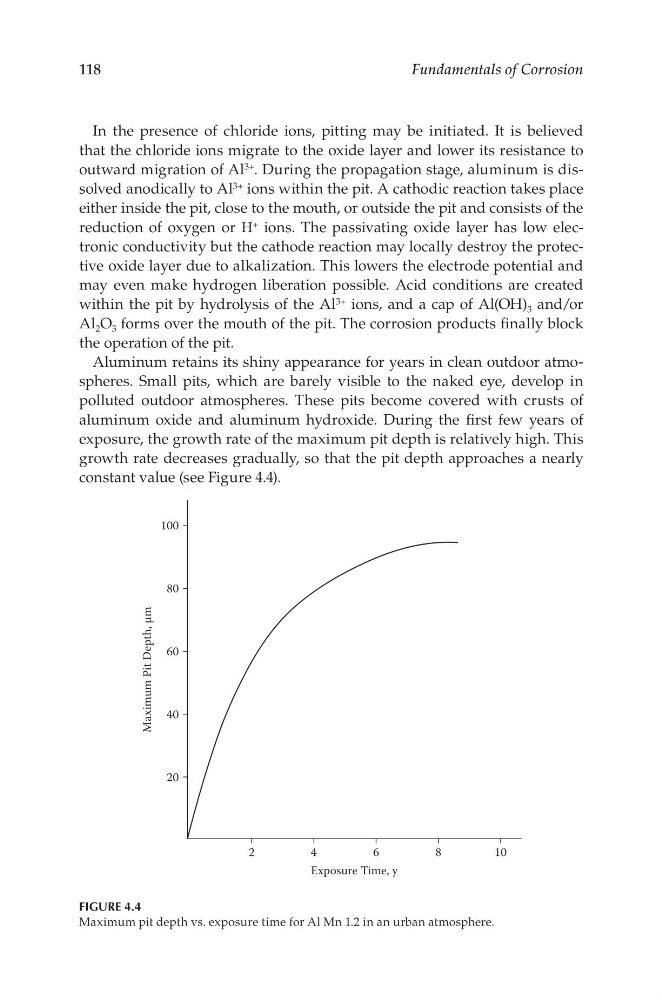
Aluminum retains its shiny appearance for years in clean outdoor atmospheres. Small pits, which are barely visible to the naked eye, develop in
polluted outdoor atmospheres. These pits become covered with crusts of
aluminum oxide and aluminum hydroxide. During the first few years of
exposure, the growth rate of the maximum pit depth is relatively high. This
growth rate decreases gradually, so that the pit depth approaches a nearly
constant value (see Figure 4.4).
10
8
6
Exposure Time, y
4
2
20
40
Maximum Pit Depth, µm
60
80
100
FigurE 4.4
Maximum pit depth vs. exposure time for Al Mn 1.2 in an urban atmosphere.
Fundamentals of Corrosion
In the presence of chloride ions, pitting may be initiated. It is believed
that the chloride ions migrate to the oxide layer and lower its resistance to
outward migration of Al 3+ . During the propagation stage, aluminum is dissolved anodically to Al 3+ ions within the pit. A cathodic reaction takes place
either inside the pit, close to the mouth, or outside the pit and consists of the
reduction of oxygen or Η + ions. The passivating oxide layer has low electronic conductivity but the cathode reaction may locally destroy the protective oxide layer due to alkalization. This lowers the electrode potential and
may even make hydrogen liberation possible. Acid conditions are created
within the pit by hydrolysis of the Al 3+ ions, and a cap of Al(OH) 3 and/or
Al 2 O 3 forms over the mouth of the pit. The corrosion products finally block
the operation of the pit.
Aluminum retains its shiny appearance for years in clean outdoor atmospheres. Small pits, which are barely visible to the naked eye, develop in
polluted outdoor atmospheres. These pits become covered with crusts of
aluminum oxide and aluminum hydroxide. During the first few years of
exposure, the growth rate of the maximum pit depth is relatively high. This
growth rate decreases gradually, so that the pit depth approaches a nearly
constant value (see Figure 4.4).
10
8
6
Exposure Time, y
4
2
20
40
Maximum Pit Depth, µm
60
80
100
FigurE 4.4
Maximum pit depth vs. exposure time for Al Mn 1.2 in an urban atmosphere.