

Atmospheric Corrosion
117
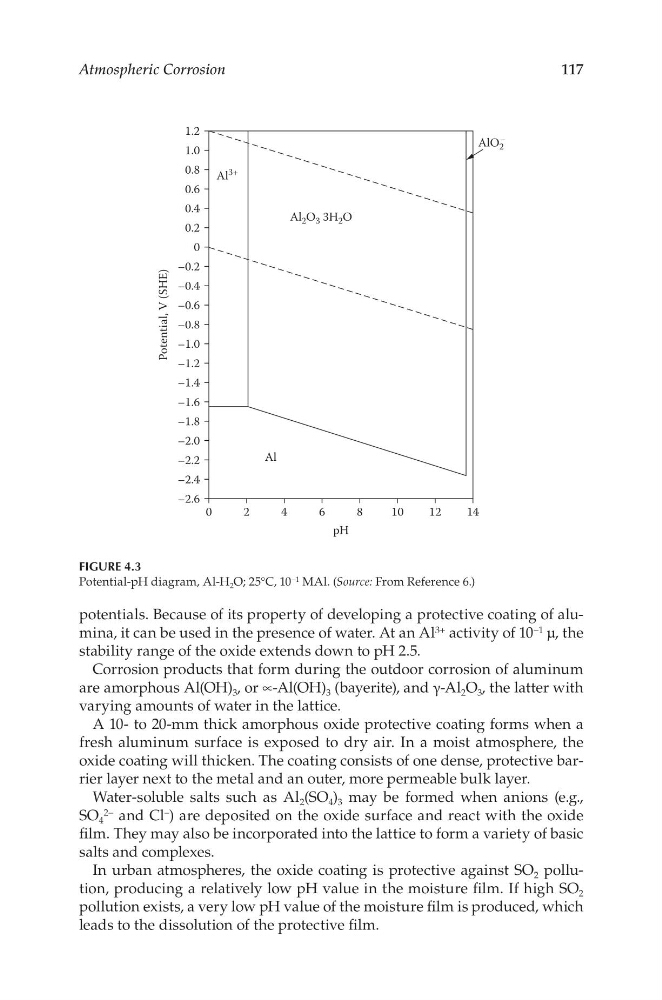
potentials. Because of its property of developing a protective coating of alumina, it can be used in the presence of water. At an Al 3+ activity of 10 −1 µ, the
stability range of the oxide extends down to pH 2.5.
Corrosion products that form during the outdoor corrosion of aluminum
are amorphous Al(OH) 3 , or ∝-Al(OH) 3 (bayerite), and γ-Al 2 O 3 , the latter with
varying amounts of water in the lattice.
A 10- to 20-mm thick amorphous oxide protective coating forms when a
fresh aluminum surface is exposed to dry air. In a moist atmosphere, the
oxide coating will thicken. The coating consists of one dense, protective barrier layer next to the metal and an outer, more permeable bulk layer.
Water-soluble salts such as Al 2 (SO 4 ) 3 may be formed when anions (e.g.,
SO 4
2− and Cl − ) are deposited on the oxide surface and react with the oxide
film. They may also be incorporated into the lattice to form a variety of basic
salts and complexes.
In urban atmospheres, the oxide coating is protective against SO 2 pollution, producing a relatively low pH value in the moisture film. If high SO 2
pollution exists, a very low pH value of the moisture film is produced, which
leads to the dissolution of the protective film.
14
12
10
8
6
4
2
0
–2.6
–2.4
–2.2
–2.0
–1.8
–1.6
–1.4
–1.2
–1.0
–0.8
–0.6
–0.4
–0.2
0
0.2
0.4
0.6
Al 3+
Al 2 O 3 3H 2 O
AlO 2
–
Al
Potential, V (SHE)
pH
0.8
1.0
1.2
FigurE 4.3
Potential-pH diagram, Al-H 2 O; 25°C, 10 −1 MAl. (Source: From Reference 6.)
117
potentials. Because of its property of developing a protective coating of alumina, it can be used in the presence of water. At an Al 3+ activity of 10 −1 µ, the
stability range of the oxide extends down to pH 2.5.
Corrosion products that form during the outdoor corrosion of aluminum
are amorphous Al(OH) 3 , or ∝-Al(OH) 3 (bayerite), and γ-Al 2 O 3 , the latter with
varying amounts of water in the lattice.
A 10- to 20-mm thick amorphous oxide protective coating forms when a
fresh aluminum surface is exposed to dry air. In a moist atmosphere, the
oxide coating will thicken. The coating consists of one dense, protective barrier layer next to the metal and an outer, more permeable bulk layer.
Water-soluble salts such as Al 2 (SO 4 ) 3 may be formed when anions (e.g.,
SO 4
2− and Cl − ) are deposited on the oxide surface and react with the oxide
film. They may also be incorporated into the lattice to form a variety of basic
salts and complexes.
In urban atmospheres, the oxide coating is protective against SO 2 pollution, producing a relatively low pH value in the moisture film. If high SO 2
pollution exists, a very low pH value of the moisture film is produced, which
leads to the dissolution of the protective film.
14
12
10
8
6
4
2
0
–2.6
–2.4
–2.2
–2.0
–1.8
–1.6
–1.4
–1.2
–1.0
–0.8
–0.6
–0.4
–0.2
0
0.2
0.4
0.6
Al 3+
Al 2 O 3 3H 2 O
AlO 2
–
Al
Potential, V (SHE)
pH
0.8
1.0
1.2
FigurE 4.3
Potential-pH diagram, Al-H 2 O; 25°C, 10 −1 MAl. (Source: From Reference 6.)