

98
Fundamentals of Corrosion
SO 2 has a lifetime in the atmosphere of 0.5 to 2 days. This limits the distance
that SO 2 can be transported to a few hundred kilometers. During this period,
the sulfuric acid may be partially neutralized, particularly with ammonia that
results from the biological decomposition of organic matter. When this occurs,
particles containing ammonium sulfate, (NH 4 ) 2 SO 4 , and different forms of
acid ammonium sulfate, such as NH 4 HSO 4 and (NH 4 ) 3 Η(SO 4 ) 2 , are formed.
Atmospheric corrosion results from the deposition of these various materials
on metal surfaces. Deposition of sulfur compounds can be accomplished by:
1. Dry deposition:
a. Adsorption of gas (SO 2 ) on metal surfaces
b. Impaction of sulfur particles
2. Wet deposition:
a. Removal of gas from the atmosphere by precipitation in the form
of rain or fog
The primary cause of atmospheric corrosion is dry deposition, which consists mainly of the adsorption of SO 2 . The amount deposited is proportional
to the concentration in the atmosphere. Different materials are subject to different deposition rates. Rusty steel surfaces will adsorb SO 2 quantitatively
at high relative humidities, whereas the deposition on copper, and particularly aluminum is much less. The rate of dry deposition of other sulfur compounds is less than that of SO 2 .
Sulfates are deposited primarily by wet deposition and experience a lifetime of 3 to 5 days. This permits these particles to be transported a distance
on the order of 1000 km. Sulfate concentrations are usually less than SO 2
concentrations close to the emission source.
The primary cause of atmospheric corrosion is the dry deposition of SO 2
on metallic surfaces. This type of corrosion is usually confined to areas having a large population, many structures, and severe pollution. Therefore, the
atmospheric corrosion caused by sulfur pollutants is usually related to an
area close to the source.
Under these conditions, dry deposition of SO 2 is considered the most
important sulfur deposition process for the corrosion of structural metals.
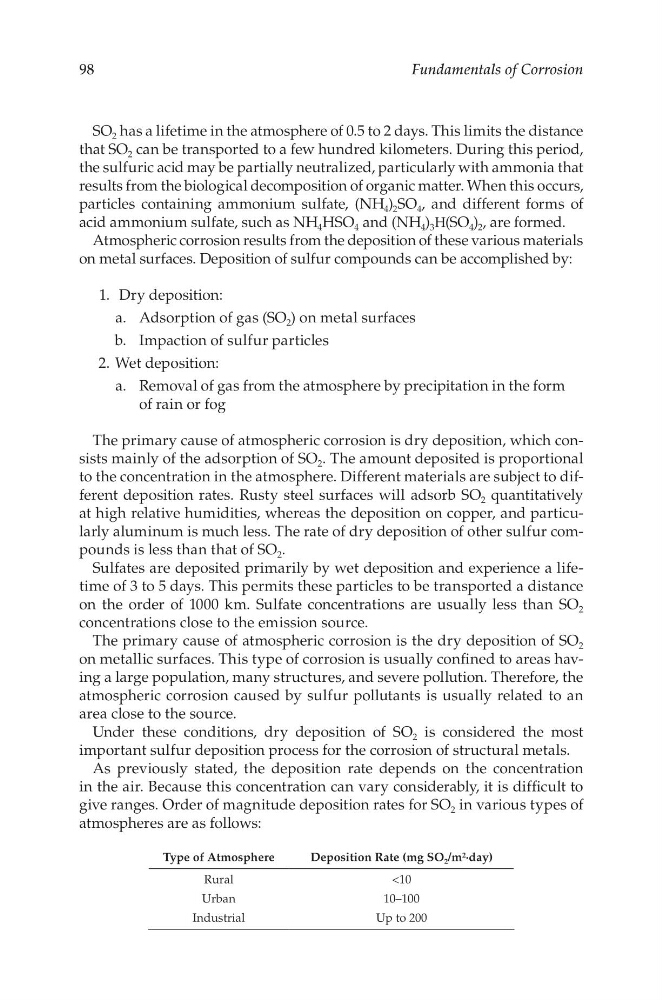
As previously stated, the deposition rate depends on the concentration
in the air. Because this concentration can vary considerably, it is difficult to
give ranges. Order of magnitude deposition rates for SO 2 in various types of
atmospheres are as follows:
Type of Atmosphere
Deposition Rate (mg SO 2 /m 2 ·day)
Rural
<10
Urban
10–100
Industrial
Up to 200
Fundamentals of Corrosion
SO 2 has a lifetime in the atmosphere of 0.5 to 2 days. This limits the distance
that SO 2 can be transported to a few hundred kilometers. During this period,
the sulfuric acid may be partially neutralized, particularly with ammonia that
results from the biological decomposition of organic matter. When this occurs,
particles containing ammonium sulfate, (NH 4 ) 2 SO 4 , and different forms of
acid ammonium sulfate, such as NH 4 HSO 4 and (NH 4 ) 3 Η(SO 4 ) 2 , are formed.
Atmospheric corrosion results from the deposition of these various materials
on metal surfaces. Deposition of sulfur compounds can be accomplished by:
1. Dry deposition:
a. Adsorption of gas (SO 2 ) on metal surfaces
b. Impaction of sulfur particles
2. Wet deposition:
a. Removal of gas from the atmosphere by precipitation in the form
of rain or fog
The primary cause of atmospheric corrosion is dry deposition, which consists mainly of the adsorption of SO 2 . The amount deposited is proportional
to the concentration in the atmosphere. Different materials are subject to different deposition rates. Rusty steel surfaces will adsorb SO 2 quantitatively
at high relative humidities, whereas the deposition on copper, and particularly aluminum is much less. The rate of dry deposition of other sulfur compounds is less than that of SO 2 .
Sulfates are deposited primarily by wet deposition and experience a lifetime of 3 to 5 days. This permits these particles to be transported a distance
on the order of 1000 km. Sulfate concentrations are usually less than SO 2
concentrations close to the emission source.
The primary cause of atmospheric corrosion is the dry deposition of SO 2
on metallic surfaces. This type of corrosion is usually confined to areas having a large population, many structures, and severe pollution. Therefore, the
atmospheric corrosion caused by sulfur pollutants is usually related to an
area close to the source.
Under these conditions, dry deposition of SO 2 is considered the most
important sulfur deposition process for the corrosion of structural metals.
As previously stated, the deposition rate depends on the concentration
in the air. Because this concentration can vary considerably, it is difficult to
give ranges. Order of magnitude deposition rates for SO 2 in various types of
atmospheres are as follows:
Type of Atmosphere
Deposition Rate (mg SO 2 /m 2 ·day)
Rural
<10
Urban
10–100
Industrial
Up to 200